Showing posts with label Belle Epoque. Show all posts

Tuesday, May 31, 2016

Belle Époque Artists: Jean Béraud

Outside the Vaudeville Theatre, Paris


Jean Béraud (January 12, 1849 – October 4, 1935) was a French painter, noted for his paintings of Parisian life during the Belle Époque. He was born in Saint Petersburg. His father (also called Jean) was a sculptor and was likely working on the site of St. Isaac's Cathedral at the time of his son's birth. Béraud's mother was one Geneviève Eugénie Jacquin; following the death of Béraud's father, the family moved to Paris. Béraud was in the process of being educated as a lawyer until the occupation of Paris during the Franco-Prussian war in 1870.
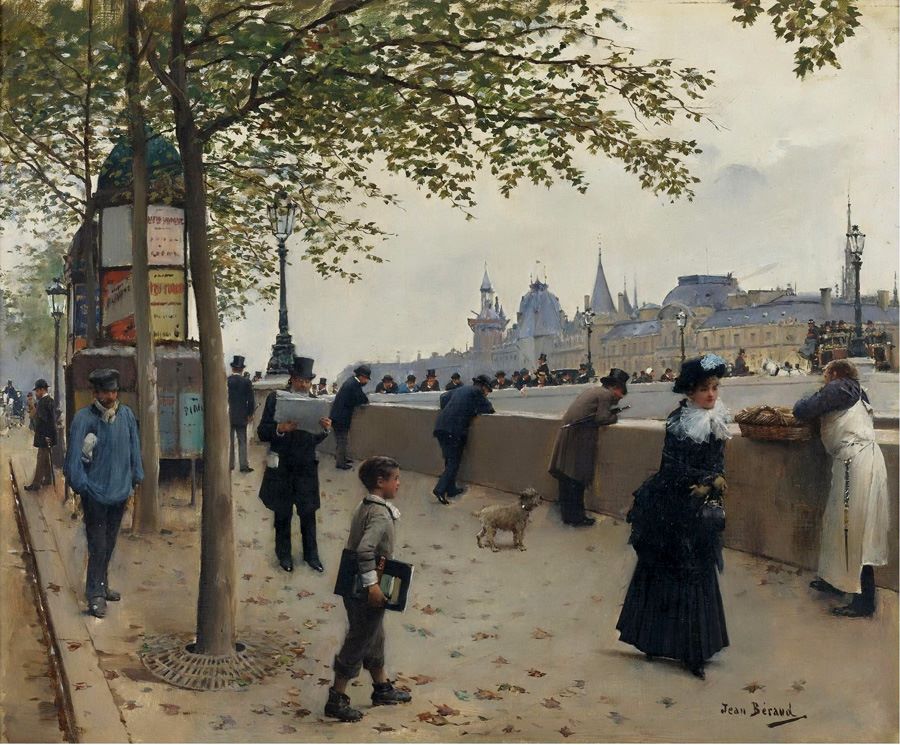
Le Pont Neuf

Béraud became a student of Léon Bonnat, and exhibited his paintings at the Salon for the first time in 1872. However, he did not gain recognition until 1876, with his On the Way Back from the Funeral. He exhibited with the Society of French Watercolorists at the 1889 World's Fair in Paris. He painted many scenes of Parisian daily life during the Belle Époque in a style that stands somewhere between the academic art of the Salon and that of the Impressionists. He received the Légion d'honneur in 1894.

Children With a Toy Seller on the Quai du Louvre

Béraud's paintings often included truth-based humour and mockery of late 19th-century Parisian life, along with frequent appearances of biblical characters in then contemporary situations. Paintings such as Mary Magdalene in the House of the Pharisees aroused controversy when exhibited, because of these themes.

Cottage cyclists in the Bois de Boulogne (1900)

 Towards the end of the 19th century, Béraud dedicated less time to his own painting but worked on numerous exhibition committees, including the Salon de la Société Nationale.

I posted this for my Belle Époque Event 2016, You will find more artists along the year.


Friday, April 15, 2016

Belle Époque Artists: Victor Gabriel Gilbert

Victor Gabriel Gilbert (1847-1935) was a French painter of genre scenes. Gilbert was born in Paris on 13th February 1847. His natural ability for drawing was acknowledged at an early age but due to financial circumstances he was required to work as an artisan. He received his formal training from L. Em. Adan, Levasseur and Ch. Busson.

In 1873 he had his debut at the Paris Salon and continued to be a faithful exhibitor at the Salon des Artist Francais where he obtained a silver medal in 1889, received the Bonnet Prize in 1926 and the Knight of the Legion of Honour in 1897. He was highly respected for his fine detailed work and was considered an inspiration to many artists. His views of the colourful Parisian life, the boulevards, cafés and flower stalls became well known. At the same time he turned his effect on the portrayal of adorable children, accomplishing a sensibility and great harmony towards his subject.


The Square in front of Les Halles, 1880

Any Zola's fans must have remembered that this paintings was used by Oxford World's Classics as The Belly of Paris' cover. Such a nice idea too to pick a painting from one of Belle Epoque's artists. I imagined... maybe Gilbert was one of Zola's Impressionist friends...

The Fish Hall at the Central Market, 1881


Flower Seller in front of the Madeleine Church

It was during the mid 1870s that Gilbert became a close friend to Pierre Martin, one of the principal supporters of the impressionist movement and Victor Gilbert’s paintings secured a place amongst his collection of Impressionists like Monet, van Gogh, Cezanne and Gauguin. Victor Gilbert’s paintings were not only well sought after in France, he also exhibited in 1883 in Munich, 1894 in Vienna and he was a great success in London in 1908. Today his work can be viewed in the Museums of Bayeux, Besançon, Bordeaux, Dieppe, le Havre, Lille, Liége, Nice and Strassbourg.


The Children's Dance Recital

Place dAnvers Et Le Sacre Coeur

I posted this for my Belle Époque Event 2016, You will find more artists along the year; the next one will be up (hopefully) very soon!


Thursday, February 18, 2016

Belle Époque Artists: Gustave Caillebotte

Paris Street, Rainy Day, 1877


Gustave Caillebotte (19 August 1848 – 21 February 1894) was a French painter, member and patron of the group of artists known as Impressionists, though he painted in a much more realistic manner than many other artists in the group. Caillebotte was noted for his early interest in photography as an art form. Caillebotte's style belongs to the School of Realism but was strongly influenced by his Impressionist associates.

Caillebotte is best known for his paintings of urban Paris, such as The Europe Bridge (Le Pont de l'Europe) (1876), and Paris Street; Rainy Day (Rue de Paris; temps de pluie, also known as La Place de l'Europe, temps de pluie) (1877). The latter is almost unique among his works for its particularly flat colors and photo-realistic effect which gives the painting its distinctive and modern look, almost akin to American Realists. Showing little allegiance to any one style, many of Caillebotte's other urban paintings produced in the same period, such as The Place Saint-Augustin (1877), are considerably more impressionistic.


Le Pont de l'Europe, 1876

My Note:
Gustave Caillebotte's paintings are not new to me... well, several of them, at least. Apparently, Oxford World's Classics used at least three of them as covers for Emile Zola's books. The "Paris Street, Rainy Day" was used for The Kill's cover, while "Le Pont de l'Europe" was actually picked by OWC as the cover of La Bête Humaine. And if you own the latest edition of The Money from OWC, you will not  be surprised to see that its cover was borrowed from Caillebotte's "Man on a Balcony". To me it's really nice of OWC to pick French Impressionist's paintings as Zola's book cover. Zola was one of the supporters of Impressionism on his era anyway.


Man on a Balcony, Boulevard Haussmann, 1880

A Balcony, Boulevard Haussmann, 1880

I posted this for my Belle Époque Event 2016, You will find more artists along the year; the next one will be up in March!


Monday, January 4, 2016

Belle Époque Artists: Édouard-Denis Baldus


Hotel de Ville et Pont d'Arcole, Paris
Édouard-Denis Baldus (June 5, 1813, Grünebach, Prussia – 1889, Paris) was a French landscape, architectural and railway photographer. Baldus was originally trained as a painter and had also worked as a draughtsman and lithographer before switching to photography in 1849. In 1851, he was commissioned for the Missions Héliographiques by the Historic Monuments Commission of France to photograph historic buildings, bridges and monuments, many of which were being razed to make way for the grand boulevards of Paris, being carried out under the direction of Napoleon III's prefect Baron Georges-Eugène Haussmann.


Reconstruction of Hotel de Ville de Paris, 1880

The high quality of his work won him government support for a project entitled Les Villes de France Photographiées, an extended series of architectural views in Paris and the provinces designed to feed a resurgent interest in the nation's Roman and medieval past.

In 1855, Baron James de Rothschild, President of Chemin de Fer du Nord, commissioned Baldus to do a series of photographs to be used as part of an album that was to be a gift to Queen Victoria and Prince Albert as a souvenir of their visit to France that year. The lavishly bound album is still among the treasures of the Royal Library at Windsor Castle.

In 1856, Baldus set out on a brief assignment to photograph the destruction caused by torrential rains and overflowing rivers in Lyon, Avignon, and Tarascon. He created a moving record of the flood without explicitly depicting the human suffering left in its wake.

He was extremely well known throughout France for his efforts in photography. One of his greatest assignments was to document the construction of the Louvre museum.

La Grande Galerie, Paris, 1870

Baldus used wet and dry paper negatives as large as 10x14 inches in size. From these negatives, he made contact prints. In order to create a larger image, he put contact prints side by side to create a panoramic effect.

Baldus was renowned for the sheer size of his pictures, which ranged up to eight feet long for one panorama from around 1855, made from several negatives.

View of the Seine, Paris

Despite the documentary nature of many of his assignments, Baldus was no purist when it came to technique. He often retouched his negatives to blank out buildings and trees, or to put clouds in white skies; in one print from 1851, he pieced together fragments of 10 different negatives to create a composite print of the medieval cloister of St. Trophime, in Arles.


~~~~~~~~~~~

I will post more French artists in this blog for this event:


Thursday, December 10, 2015

Belle Époque Event 2016


I have been wanting to do this since early this year; maybe since my Zoladdiction event—which, by the way, I am not going to host for next year. I have been doing this fun reading of Emile Zola for three years, but right now I don’t think I have time & energy to host it. It’s not ended yet, maybe next year it will be back, but for right now I just like to have a quiet event, in which I can still read Zola!... ;)

Belle Époque is forty years of beautiful (or golden) era in France, started from the end of Franco-Prussian War (1871) to the outbreak of World War I (1914). It’s an era of optimism, prosperity, and flourishing of art, architecture, and entertainment—especially in Paris. It’s joie de vivre during French Third Republic. Post-impressionist artists like Monet, Gaugin, Matisse, Rodin, and Picasso belonged to Belle Époque era; so did naturalism authors like Zola, Maupassant, and Proust. It’s also the era of salon music and cabaret (Moulin Rouge!), and the building of Paris Metro and Eiffel Tower. Oh, and don’t forget the infamous Dreyfus Affair! In short, things that made me love Paris, began at the Belle Époque period. How can I not love it?

And now the event…. It’s really simple!
  • Read and post as many things from Belle Époque era, and as often as you can, during 2016.
  • You can read books from Belle Époque authors, or books about… whatever happened during or about the era. It can be fiction or non-fiction, just whatever you can find.
  • Or maybe you just want to decorate your blog by posting Belle Époque paintings? That’s fine too!
  • Just don’t forget to submit it to the linky in this post (will be up only on January 1st).
  • But first…. Sign up with the linky below!

In my part, I planned to do this:

Reading:
Emile Zola – Pot Bouille (1882)
Emile Zola – The Ladies’ Paradise (1883)
Guy de Maupassant – Bel-Ami (1885)
Emile Zola – The Dreyfus Affair: “J’Accuse” and Other Writings (1901)
Marcel Proust – Swann’s Way (1913)

Posting:
Works and some information of Belle Époque artists we rarely heard of. I plan to do this every month (one artist per month).


What are you waiting for? Let’s explore and have fun!....