Showing posts with label Charles Dickens. Show all posts

Sunday, March 13, 2022

Martin Chuzzlewit by Charles Dickens

πŸ’° If I have to categorize Dickens' novels into favorites and non favorites, then Martin Chuzzlewit would definitely go to the non favorite (along with Hard Times and Dombey and Son). Not only that Its humour is dry - exaggerated sarcasm rather than comical - its plot is also weak and felt weird. There're abundant characters but lack of development, and the story is dragging on in the first two third; only started building pace in the last third. I honestly thought of DNF-ing it, but decided in the end to plough on - which is quite paid off, for at least I can check it off from my Dickens-unread list. Only one Dickens novel left now to read!

πŸ’° Tired of his greedy and selfish family, wealthy old Martin Chuzzlewit lived a secluded life with only a companion - a pretty young girl called Mary Graham - to whom he said quite frankly that he will pay her wages generously, but she will not be left anything in his will. By this arrangement the old man hoped that she will serve him best without wishing him dead (in the hope of inheriting something).

πŸ’° His grandson, young Martin Chuzzlewit fell in love with Mary (the feeling is reciprocated), but when he uttered this to his grandfather, the old man was enraged, and grandfather and grandson separated ways in anger.

πŸ’° Then young Martin was apprenticed to a gentleman by the name of Seth Pecksniff. He calls himself a surveyor and architect, but all he ever produces are the works of his pupils which he claimed as his own. Yes, Pecksniff is what you call a sanctimonious person - a hypocritical swindler in a gentleman disguise. He accepted Martin because of his rich grandpa, but then banished him when the fact of their separation was known to him.

πŸ’° Humiliated and poor, young Martin left for America with the jolliest young man on earth as his servant-slash-companion: Mark Tapley. Here is a chance for Dickens to reflect upon his own visit to America. And boy, didn't he smash those Americans with ugly picture of mean, selfish, greedy, hypocrite and opportunist people! Martin Chuzzlewit might be considered as Dickens' personal favorite, but I doubt if it would be an enjoyable read for American people. Is that one of the reasons why this book becomes one of Dickens' least favorite? Hmm...

πŸ’° Anyway, the America period in young Martin Chuzzlewit's adventure changed him considerably when he touched English land months later. And meanwhile, we were introduced to another villain-even more evil than Mr. Pecksniff: the coward heartless scoundrel: Jonas Chuzzlewit, nephew of old Martin Chuzzlewit. The cruellest villain in Dickens' novel so far.

πŸ’° Martin Chuzzlewit is a story about greediness, excessice pride, and selfishness. It is also the first appearance of a detective in Dickens' novel. It could have been a promising story, but like I said before, the first two third is rather flat, and only the last third is really enjoyable. It has some memorable secondary characters: Tom Pinch - the naive and tenderhearted pupil of Pecksniff who failed to see his hypocrisy; Ruth Pinch - Tom's little energetic sister; and John Westlock - another alumni of Pecksniff academy, and a kind-hearted young man. Unfortunately Dickens included too many characters in this story that he hadn't had enough space to develop them further.

In the end, while the story is conclusive enough to be satisfying, it's far from making it memorable. I have even forgotten some of the plots while writing it!

Final rating: 3 of 5

Sunday, March 28, 2021

Nicholas Nickleby by Charles Dickens | #NicholasNickleby2021 Wrap Up


Two weeks ago is supposed to be the last weekly part of our Nicholas Nickleby Readalong 2021. However, for some reasons (strained right arm was one of these), I have failed to write any post at all until this weekend. Thus, this post will serve as my final review of the book, as well as a wrap up of our #NicholasNickleby2021 Readalong.

Nicholas Nickleby is by far the most comical novel by Dickens I have ever read. The Pickwick Papers is another comic piece that guarantees to make you laugh, but I categorized it more as a series of picturesque journal of a club which were compiled to make a novel - it lacks a significant plot to make it a whole one. Nicholas Nickleby, on the other hand, is a wholesome novel with satisfying plot, memorable characters (even the minor characters are interesting and colorful), and, even though presenting a grim subject such as the cruelty of faulty schools in Yorkshire, it is highly entertaining with all the extremely hilarious scenes!

Summary of the previous chapters:
Chapter I - XI
Chapter XII - XXI
Chapter XXII - XXXI
Chapter XXXII - XLI
Chapter XLII - LI

The last sixteen chapters tells Nicholas' strategy to save Madeline Bray from her doomed marriage with Arthur Gride - a scheme by Ralph Nickleby to gain money, which Madeline's father owed him, as well as to snatch Nicholas' lover, and thus avenging him. It is nice to read how the rescue operation involves all the good people - Nicholas' friends. It seems to represent the battle of the bad v the good, of which, the good always wins. As usual, Dickens rounded up the ending of each characters "beautifully" for the good ones, and most especially for the wicked ones - though I think Sir Mulberry Hawk needs more sufferings before his death: some excruciating painful illness perhaps?... 😎 And then... there's the epic breaking up of the Dotheboys Hall - thanks to John Browdie! Apart from the wretched condition the boys must have been in after the breaking up, that was perhaps one of the most satisfying fictional "closures" ever!


Love is in the air, indeed, as three of the female characters finally meet their future husbands. Yes, I love how Dickens found a match for Miss La Creevy - not that she won't be happy without, because when you have love and gratitude, you'll have peace and happiness. I just hope that she'll keep her miniature painting business just to keep her busy while Tim Linkinwater is working at the counting house. That will give her the utmost happiness and satisfaction, which she fully deserves.

I've been discussing several topics covered by Dickens in the weekly update posts. The main topic is corrupted educational system in Yorkshire for unwanted children, which Dickens had write it so convincingly, that public investigations were held upon the real schools, and many of them were closed for good. Bravo Dickens! I'm more interested, however, in one minor topic which Dickens, unintentionally perhaps, has hinted in this book, that is: social treatment towards women in 19th century (and how the women perceived it).

Interestingly, five women are subjected to special interests from men throughout the book, though with different intensity: Kate Nickleby (from Sir Mulberry Hawk), Henrietta Lilyvick - neé Petowker (from old Mr. Snevellici), Mrs. Nickleby (from the gentleman with the small clothes 🀭), Miss La Creevy (from Tim Linkinwater), and in a way - Madeline Bray (talked of by a registry office clerk). When Kate Nickleby became the topic of free gossips by Sir MH in a drinking house, Nicholas Nickleby thought it abominable (and attacked the assailant). The same happened when Frank Cheeryble heard the clerk was talking (admiringly but perhaps jokingly?) of Madeline Bray in public. These gentlemen were indignant that the ladies are talked of publicly without respect. The clerk protested that he only praised Madeline's beauty, which was strongly supported by the bar maid. Two different classes view the case differently.

Then there is the indignant Mr. Lillyvick, who was angry with Mr. Snevellicci's openly flirt with his (Mr. Lillyvick) wife, while Mrs. Lillyvick accepted it as normal, and was even angry with her husband for being insensible, for it's only a joke (the same woman who later eloped with a man - poor Mr. Lillyvick!) Mr. Lillyvick, though comes from working class, is quite gentlmemanly-minded. The same subtlety is showed by the clerk Tim Linkinwater when wooing Miss La Creevy; he never forced himself on her, only using his affectionate tone (poetic and funny!) WHEN he's assured that the lady reciprocated his feeling. The very different manner is showed by the gentleman with the small clothes, who, ignoring Mrs. Nickleby's polite implore to leave her alone, kept forcing himself on her, though romantically hilarious. Mad as he was, I don't believe he'd be any better when he's sane. These instances only proof that honor doesn't always come with wealth nor class - it's something you can never earn by yourself.

Over all, Nicholas Nickleby is a very entertaining novel with satisfying plot, hilarious scenes, and most memorable characters. It instantly becomes one of my favorites.

I thank all of you who has participated in this Readalong, for your accompany, posts, and comments. It has been a memorable and also inspiring reading event. For you who didn't or haven't finished, don't be disappointed - it's just not your time yet, but I'm sure you'd pick it up again some other time, as it's really a fun reading. I wish I could wish we meet again in next readalong, but for now, I'm not sure at all there will be another. Let's just see!

Final rating: 4,5 / 5

Tuesday, February 25, 2020

Hard Times by Charles Dickens


Hard Times is officially my least favorite of Dickens (so far). I feel like he's venting his anger on something when writing the story. It's not just a satire to criticize something, it felt more like a punishment or avenge on something/someone.

Shortly, it's about a gentleman (Mr. Gradgrind) who is fanatical to facts and numbers, that he brings up and educates his children (Louisa "Loo" and Tom Gradgrind) by cramming their minds with only facts and statistics. They never get teaching about morality, love, or charity. Mr. Gradgrind even opens a school teaching and emphasizing on these utilitarian curriculums. As the story unfolds, we get to witness how wrong this kind of education is. Louisa becomes almost like robot, who isn't familiar with emotion, tenderness, and affection. She had a loveless marriage with Mr. Bounderby, only to save her beloved brother Tom - an egotistical boy who doesn't return his sister's love, and ends up as a criminal.

The second theme brought up by Dickens is social and economic disparities of upper and working classes. The story is set in a small industrial town: Coketown. Mr. Bounderby (Louisa's husband) is the owner of a factory - a hypocrite man who boasted himself as a self-made man, while it turns out it was his mother who has sacrificed everything for her son's success - and he always unfairly accuses his workers of being greedy. One of the poorest of the workers is Stephen Blackpool. He was falsely accused of robbing Mr. Bounderby's bank, while the real culprit is from the upper class.

There's nothing wrong with these ideas; I totally agree. The nurturing of brain and soul has to be balanced in order to produce great characters. My objection is in Dickens' rather generalization of contrasting the upper and the working classes. He made it look like the gentlemen were almost always immoral, while the kind people are mostly the working class. But I chose to believe that morality is more individualistic, though it is still influenced further by breeding and education. Proof? Exhibit A: Louisa and Tom Gradgrind. Were they not brought up and educated equally to the Gradgrinds' standard? Yet, from the start we could see that Louisa was more than that. She was more troubled and confused with her upbringing than Tom. Though vaguely, she realized that there was something missing in her, something hollow in her soul; while Tom... well, as Dickens nicknamed him, is just a whelp. Moreover, the idea of an education based solely on facts is rather ridiculous.

James Harthouse & the Whelp!


Another thing that annoyed me **spoiler alert!** is how Dickens let Tom get away with his crime, while Stephen Blackpool - the only character I could relate with - must die, even before he could witness his reputation be rehabilitated. Dickens didn't let Stephen experiencing any happiness at all, however tiny, but he let the whelp go easily from punishment - if not imprisonment (okay, because his crime is partly caused by his upbringing), then at least let him suffer from humiliation! He who ruined Stephen's reputation (if not his entire life) gets second chance without harm - and helped by Sissy Jupe and Mr. Sleary too - while Stephen gets double 'punishment' (ruined reputation AND fallen in the Hell Shaft), and at the end.... dies without at least properly showing his love to Rachael or even a humble marriage. Come on, what happened here, Mr. Dickens? It's not like you!

Is it maybe that this book is too short (in fact it's Dickens' shortest novel) to let the characters developed a bit without them being so typical? The immoral dark handsome James Harthouse, the cunning widow with her sharp nose Mrs. Sparsit, the liar and boastful Mr. Bounderby - they're all so... hmm... typical? And then there is the "fairy" Sissy Jupe who is selfless, won everyone's heart, always to the rescue (yea.. even rescuing the criminal whelp!). They are all so unnatural. I know that Dickens always include some inhuman fairies throughout his books, but usually, he’d balance them with other humane characters. Not in this book, though, unfortunately. Maybe Louisa Bounderby (nee Gradgrind) is the closest to reality.

Well, I have been ranting too long. In short, it's a bit an unpleasant reading for me, though Dickens never fails to make me laugh at times with his comical writing. I was also disturbed by the way he wrote Stephen's and Mr. Sleary's speeches - I must think hard all the time to decipher what they're saying. So my final rating is...

3/5

Tuesday, December 18, 2018

Dombey and Son by Charles Dickens


Mr. Dombey is a proud gentleman. And being proud in Victorian-England terms also meant calculating, stiff, unyielding; without passion, love, or affection. For Mr. Dombey, money and honour are his gods, and he lives solely to achieve them. Mr. Dombey has founded a counting house, and if this company should have had a vision-mission, it would have been: "Dombey and Son"—a company ruled by father and son. To that end, he has married a lady, not because he loved her, but to have a son, why, you'd need a wife! Mrs. Dombey was soon pregnant, and when the time came, she gave birth to.... a girl!

What? Mr. Dombey was dismayed; a girl is not what he has ordered! 'Just ignore her, and now make another baby; this time it's better be a boy!' is what Mr. Dombey has probably said to his wife. And as Mrs. Chicks (Mr. Dombey's sister) used to say, Mrs. Dombey 'made an effort', and with her last breath, she finally gave Mr. Dombey the son he has ordered.

Being a good businessman, Mr. Dombey took no time to plan, shape, and mould baby Dombey into the perfect-partner he has been envisioning; forgetting all along that his son is not a robot, but just a child who needs love and care. And as you can probably guess, his plan was eventually failed.

That was just the beginning; nevertheless from that short little summary you can see that pride would be the main theme of this book. And to emphasize that, Mr. Dombey is not the only example. There is another proud character, a lady, who was Mr. Dombey’s equal: Edith Dombey nee Granger. Can you imagine what would happen when two proud persons are tied in one institution: marriage? Disaster! And as usual, Dickens contrasted the proud couple with several humble characters: Florence Dombey—the unwanted daughter, and another main character in this story, as well some other secondary characters. Their faiths are intertwined in the numerous consequences of the major crime in this story: pride.

Unlike his usual style, in this book, Dickens mercilessly judged and punished the proud unloving father for neglecting and rejecting his daughter's love. He even 'slaughtered' the villain antagonist quite brutally (at least for Dickens' style). Sometimes it even felt almost Zola-ish. It’s not only the brutality, but the way Dickens described Mr. Dombey's psychological struggles with repetitive rhythmic sentences, is also very similar to Zola's. However, Dickens' unique comical characters, his witty satirical prose, and abundant of love—which were his trademark—help making the story more cheerful and warm; the quality which always makes his novels a perfect choice for holiday season’s reading.

4,5 / 5


Thursday, December 21, 2017

Bleak House by Charles Dickens


Jarndyce and Jarndyce was a legal case with a long history in the Chancery court. It's about a conflicting wills which affected many people of several generations and ruined many of its suitors’ lives because of the corrupted law system. Of the many victims are John Jarndyce, the owner of Bleak House, the two orphaned cousins Richard Carstone and Ada Clare, and Lady Honoria Dedlock. Together with another orphan girl which became John Jarndyce's ward: Esther Summerson, they become the leading characters of this book.

Dickens wove the story using voices of two narrators with different character: Esther Summerson's—calm and reserved, and the omniscient—rather cold and severe. This makes Bleak House less dull, but still I missed Dickens' warm and affectionate voice he used in several books I have read so far.

Unlike his other books, Bleak House was built by several plots or subplots which are often unrelated to each other, but for the (abundant) characters. The Jellybys and the Turveydrops, for example, are not really related to the others, except Caddy Jellyby who are so fond of Esther Summerson. Is it only Dickens's way to highlight Esther's amiable and unselfish character? But what about the Dedlocks? Lady Dedlock is another prominent character here, but although she was also suitor in the Jarndyce vs Jarndyce, her part is not related to the law suit; which made me thinking what purpose does she really bring to us, reader?

Speaking of Lady Dedlock, she has become my favorite character of this book. From the moment she went to the burial ground, disguised, guided by poor Jo, I have said to myself: here is a brave, strong, smart woman with a steely determination underneath her elegant bearing. Compared to Esther Summerson or John Jarndyce, Lady Dedlock seems more humane, and thus more prominent. For a distinguished lady who had a dark past, how she could bear it bravely alone… that’s the real heroine to me. Esther and, especially, John Jarndyce are almost like fairytale’s character. Can one be THAT unselfish and always perfectly kind like Jarndyce? I would have loved him to be selfish, at least when his love was concerned, but for his lover’s happiness, he’d reluctantly give way to the man she really loves. That would be much acceptable. But, it’s Dickens anyway, and despite all that, Bleak House was loveable and memorable.

Oh, I forgot to mention Harold Skimpole, who, to me, was the WORST antagonist of all time! How can that kind of person ever exists in the world, I can’t imagine. Well, enough for the rants... I would have given Bleak House five stars just for Lady Dedlock’s sub-plot. The search by Inspector Bucket and Esther is so thrilling. And I could see whence Hercule Poirot’s investigating style was inspired—his casual talking to extract facts innocently, his systematic pattern of search (and his cool way to do it), and the way he confront the accused by shaking his/her emotion in front of others. Now, that part deserves five stars, but Esther’s narrative and the Jarndyce and Jarndyce are rather dull and unreal. 4,5 of 5 is my best compromise.


Thursday, December 12, 2013

David Copperfield

As soon as I read the last line, and closed the book for good, I could only think…how emotional David Copperfield is; it’s much more intense than any other books I have read so far by Dickens. Then I realized, David Copperfield is Dickens’ autobiographical novel, and so he must have written it deep from his heart. Things that might have been suppressed during his life, he poured down into this book. And so, I felt like Dickens himself was speaking to me; telling his unfortunate childhood, and how he became the man he was when he wrote this book. It became very personal and compassionate reading for me; and David Copperfield now becomes one of my favorites, and the most memorable from Dickens.

The book tells about the life of David Copperfield, from his unfortunate childhood—being an orphan; tormented at home by his wicked stepfather Mr. Murdstone; witnessing injustice and cruel treatment at school, his difficult runaway—to being in his aunt Betsey Trotwood’s custody, his apprenticeship time, until he came of age, marrying the girl he adored, and experienced the sweetness and bitterness of life. And during those times, David Copperfield—later on was also called Trotwood Copperfield by his aunt—met many memorable characters—some loved him, some despised him, some did him good, but some did him worse. Through them all, David (Trotwood) Copperfield strove to build his own character and to have a better life, just as Charles Dickens emerged as one of the greatest novelists of all time.

Strangely, unlike any other main protagonists in Dickens’ novel, I didn’t find Copperfield as distinguished as I expected. Yes, he is kind, friendly, helpful, persevering in hard times and has ‘undiciplined heart’—as Dickens put it—but other than that, he seems to be too plain; like there are no specific or unique personalities that distinguishes him from others. I even like Tommy Traddles more than Copperfield; he is more ‘humane’ than Copperfield here. And of course, I like Agnes Wickfield and Betsey Trotwood—who wouldn’t love to have an aunt like that?... :)

Mr. Micawber would have one of my favorites if not for his distressing law-styled letters—which gave me enough headaches to read. Oh, Mr. Pegotty is also my favorite, this is a genuine humble man with abundance of love in his heart; bless him for his sacrifices and forgiveness for Little Em’ly! Then there is the notorious Uriah Heep with his ‘umbleness’. I felt from the beginning that Uriah’s ‘umbleness’ was fake; and I always believe that people with that exaggerated humility must have been spiteful inside.

The best part of this novel is when young Copperfield must live alone by himself, beginning actually after her mother remarried. That was the starting point of his miseries, as young as he was then—10 years?—he must take care of his own and fed himself. As Dickens wrote it from his own experience, it becomes so intense. I could sympathize with Copperfield very much; and I often felt that I was reading Dickens’ own diary. I could also feel how his wound must have been re-opened while he was retelling those dark histories of his. I could only hope that Dickens’ emotional wounds would be relieved, at least a bit, after telling it to us then. And don’t forget about the sea storm Dickens wrote so lively, almost felt like reading a semi-thriller.

Knowing that this book is Dickens’ half fictionalized memoir, I can only wonder which one of the characters here that represent the true figures in Dickens’ life. Does, for instance, Dora represent Maria Beadnell, his first lover? At least I read about it in Wikipedia. But her death in so young of age, doesn’t it represent Mary—Dickens’ sister in law—to whom he became very attached—who died of an illness on her 17 years of age, and of whom—they say—Dickens has never recovered from his grief? And what about Agnes Wickfield? Could she be the representation of Ellen Ternan, whom was believed to be Dickens’ last lover? Or did he write DC before he met Tarnen? I really need to consult my Dickens’ biography again!

In short—as Mr. Micawber usually concluded his speeches :D—David Copperfield is one of the most memorable from Dickens, and I am grateful I have chance to read it. It was so enjoyable, and I think it is one book that I would love to reread from time to time, at least the one from Dickens.

Five stars for David Copperfield.

~~~~~~~

*I read Wordsworth Classics edition*

*This book is counted as:*


Tuesday, February 26, 2013

The Mystery of Edwin Drood


Of all Dickens’ novel I haven’t yet read, The Mystery of Edwin Drood is perhaps one I’ve been looking forward the most. Edwin Drood is the first and the last of Dickens; the first mystery novel he’s ever written, and also the last novel we’d ever read from him. But the most interesting aspect of Edwin Drood is because Dickens was in the middle of writing it when he died. Moreover, on his last days on earth, Dickens’ mood was very dark and gloomy. The Staplehurst train accident that gave him a near-death experience seemed haunted him until he died. Dickens’ health was also getting worse at that time. Those were the circumstances that much affected Dickens when he started writing Edwin Drood.

From the beginning the dark and hopeless atmosphere has appeared between the lines. Remarks of death, the cold tombs, and the dark crypt can be found quite often. The dark soul of Jasper—beaten by the power of opium, and his mad love to Rosa—was vividly portrait by Dickens. Shortly, Dickens’ usual melancholy and sense of humor we have been familiar with, faded in this particular work.

Edwin Drood was a cheerful and easy going young man. Being an orphan, his uncle Jasper—an opium addict—has been his most close relative and friend. Edwin was betrothed to Rosa Bud—daughter of his late father’s friend—and now it’s time for realizing their marriage. Edwin came to Cloisterham—a cathedral town—but there he was welcomed with a dark atmosphere. There were his uncle who secretly madly in love with his fiancΓ©e and acted strangely towards him; there were also orphan temperamental twin of Neville and Helena Landless. One day Neville chaffed him of being indifferent to his fiancΓ©e in an offensive manner that ignited a quarrel.

Approaching the day of their marriage, Edwin and Rosa met secretly and decided that they were better befriending than being husband and wife. Edwin has been carrying a diamond ring he got from Rosa’s guardian on the day of the meeting, however as the marriage was cancelled, he was about to wait for Mr. Grewgious’ visit to return it. Meanwhile, before he could inform Jasper about the marriage cancellation, he took a stroll with Neville on the night of Christmas Eve. Then he was mysteriously gone. Either he voluntarily disappeared or being murdered, his body was never found. And now, in the middle of the mystery, Dickens died without ever finishing the book, and thus left the mystery unsolved forever.

From the beginning it seems that Dickens brought us to take Jasper as the suspect of the crime. We never knew whether Dickens had intended to “kill” Edwin Drood, or made him disappeared. Some critics suggest that as the book title is The Mystery of Edwin Drood, Drood might have not been dead, or otherwise there won’t be any mystery left about him. Makes sense, but anyway, it was quite obvious that Edwin Drood was set to be murdered. By who? And with what motive?

Everything concerning Jasper was dark, mysterious and suspicious, and he has a strong motive to kill Edwin. As I am discussing in this interactive post, his big interest in the cathedral crypt and Durdles’ set of keys and their night adventure was very suspicious. He even fainted when Mr. Grewgious told him about the marriage cancellation—shocked from realizing that he had killed his beloved nephew in vain?

So I was questioning myself, if Dickens wanted this to be a mystery, surely he would conceal the truth and spread false signs here and there to mislead us. Was that the case here? Was Jasper’s mysterious conducts meant as a distraction to conceal the real crime? Once again, the only one who can answer these never-ending questions could not satisfy us, and left us forever in wonder.

And what about the motive? I can figure out two motives at least, of love and of greediness. If love was it, the suspect would be either Jasper or Neville—yes, in mystery we should always think of the most impossible, right? But if it was greediness, how about the diamond ring Edwin had got from Mr. Grewgious? If it was the case, than we could suspect Bazzard, for except Mr. Gewgious and Edwin, he was the only one knew the existing of the ring. Considering that the story—when Dickens left it—was still in the middle stage, anything can happen, and that someone who has been previously behind the curtain could turn out to be someone with important role.

Well, we can go on and on with our analysis, but all would be in vain because we would never know the truth. I guess, even Dickens have not known where this story would end when he died, as he never created a fixed plot before writing this particular story. I read elsewhere that Dickens just wrote the story and thought about the details in progress.

Finally, I can only say that although this won’t be my most favorite of Dickens’; I still felt his personal emotions involved in the story, as if I could feel his despair, his struggles, his agony, and his fear of death—or should I say the intuition that death was approaching?—in most of the lines in this unfinished book. The Mystery of Edwin Drood, I think, is one of the most precious legacies Charles Dickens has left us. Four and a half stars I grant for this book.

~~~~~

*I read the 2005 Dover Thrift Editions paperback*

*This book is counted for*


Friday, February 22, 2013

Little Dorrit


Until now, Little Dorrit might have been the most struggling Dickens I have ever read. If you think it’s the thickness, no, it’s not a problem at all. It’s not the story either—although I did have several complaints I would have made to Dickens on it if he’s still alive. The most annoying aspect in this book for me is Dickens’ lengthy depiction around Circumlocution Office and the economics system, which reminds us of the infamous Ponzi scheme. I know, it’s mainly on those two subjects that Dickens wanted to criticize through Little Dorrit, but again, his tedious description and emphasize on those subjects really bored me to death.

Little Dorrit followed the story of the Dorrits in their two extreme conditions. In the first stint, they lived poorly in Marshalsea debt prison—Dickens wrote it from his own childhood experience. Amy Dorrit born and grew in this prison, and after her mother died, she must endure not only poverty, but most of all—especially for Mr. Dorrit the father—family’s humility. In this prison also, Amy befriended a young man, Arthur Clennam, whose kindness and attentive manner has stolen her heart. In the second stint, the Dorrits unexpectedly inherited a large sum of money, which altered their faith. Leaving the prison behind, they hastily entered the high society of London.

Beyond that, Dickens also took us to the chronicles of the Clennams, the Merdles, the Meagleses, the Gowans, Rigaud and Cavalletto, and of course the mysterious Miss Wade. Their stories intertwined with each others, and through them Dickens presented us with the dark themes of social injustice, hypocrisy, greedy, hatred and revenge; and showed us how love and kindness were the only way to happiness.

My first impression after finishing this book was how Mrs. Clennam reminded me of Miss Havisham, both with their eternal passion of vengeance against love infidelity, and both rotted in their darkness houses and hearts. And then I was thinking how vividly Dickens wrote about their hatreds, did he experience the same feeling himself? In the same likeness, Little Dorrit also reminds me of Little Nell in The Old Curiosity Shop. Both were tender, shy, grew in poverty—which forced them to bear a bigger responsibility than what girls at their age must bear. Both were full of love, and must take care of the elders, and both were called ‘Little’. I think this was much influenced by Dickens’ fondness of young, delicate and innocent girls.

From the plot I felt that, here and there, Dickens seemed to force things to suit each other. At first the story was quite boring, again, with long description of the Circumlocution Office—the satiric way Dickens criticized the unbearable bureaucracy; that even they seemed to always be busy, they in fact did not do anything but circling one task all over the office without ever gone out from it. Fortunately nearly the end, we were entertained with the mysteries surrounded the Clennams, which boost the plot a bit faster, although I felt it too faster this time. There were still few things I still didn’t get after finishing it.

First of all, what did really happen with the money Little Dorrit should inherit? Was the money still existed when Mrs. Clennam revealed the secret? Was it kept in Mrs. Clennam’s possession all the time? Or whether Mrs. Clennam had spent the money? But on what? Considering on how wretched her old house was, the fact that she could not afford to buy back the codicil from Rigaud/Blandois, and her high pride, it’s very unlikely that she did as low as using the money herself. And speaking about the house, don’t you think its ruining or blazing was a bit exaggerating? And, who was the “the poor thing that kept here secretly”, whose ghost haunted the house and whose “sounds” Affery used to hear?

And what about the oddness of how Mr. Gilbert Clennam—uncle of Mrs. Clennam’s husband—had made his will. After the woman with whom Arthur’s father had had adultery died, the money must be granted to her patron’s youngest daughter or the youngest daughter of the patron’s brother if the patron didn’t have any. Wasn’t the plot a bit forced, do you think? Why her patron? And most of all, why the youngest daughter? Well, it is supposed to be a tale anyway, but still….

I keep also wondering why Little Dorrit insisted upon burning the codicil. I think Arthur had the right to know who his mother was. Mrs. Clennam has died anyway, so Little Dorrit won’t hurt anyone—but Arthur—if she just let Arthur read the document. And I don’t think Arthur would have been much hurt by the secret, he might have been angry to Mrs. Clennam for deceiving him, but still...I would never agree on one’s hiding a truth from someone he/she loves. Or perhaps Little Dorrit was afraid that the legacy will make her rich and unhappy? But the one she burned was only the codicil, not the original legacy, isn’t it? Oh well….whatever, I’m confused.

Apart from those confusions, Little Dorrit brings us the true portrait of social and economics of London in 19th century. From this book we came to know how the combination of careless investment and the corrupt government would do injustice to innocent people. Mr. Dorrit was imprisoned in Marshalsea after failing to pay his debt. He should have not stayed there for such a long time if the Circumlocution had done their works. Moreover, families of the prisoner suffered much from humility and banished from the society. Even after being released from it, the imprisonment itself left a dark trace in one’s life, as had happened to Mr. Dorrit.

In term of moral value, Little Dorrit taught us also that the real happiness does not come from wealth and status, but from love. Little Dorrit never looked at her poverty as a handicap; she always rich in love, and because of that, people loved her.

Three and a half stars for Little Dorrit, it’s not one of my favorites, but still….how can you don’t love Dickens’ witty and sweet story telling?


~~~~~~~


*I read the 1996 Wordsworth Classics paperback edition*

*This book is counted for*


Friday, December 7, 2012

Great Expectations


I don’t think one would be worthy to be called a Dickensian before reading Charles Dickens’ masterpiece: Great Expectations. I have just done it, so I’m now proudly calling myself a Dickensian! :) I don’t know why it took me rather long before I come to Great Expectations; maybe because I had long time ago watched its modern-setting movie adaptations—1998 version with Ethan Hawke and Gwyneth Paltrow— which was rather weird to me and I didn’t like at all (bookish lesson #1: do not watch a movie before you read the book!). Anyway, I have read it at last, and I admit now that enjoyed Great Expectations very much from the first to the last page.

Great Expectations was written as an autobiography of a fictional character: Pip. It was started when Pip was very young (around seven years old)—an orphan boy who was brought ‘by hand’ by his sister, wife of a kind-hearted blacksmith named Joe. In the real life, Pip might have grown up as a simple and humble blacksmith in a small village, marrying a simple and smart girl like Biddy, have kids, and would have finally buried in the church’ cemetery, just like his father. However, faith brought him to another scenario of life. I don’t know which one between the runaway convict and the eccentric Miss Havisham who had the most effect in shaping Pip’s life into its new mold. I believe both of them had an equal share, just like our lives molded by so many circumstances.

Pip and the convict

If little Pip had never been to Satis House, he would never had realized that he was a coarse and common boy, he would have never wanted more than life had been providing him up to that moment. And with that realization, come the need to have more. I’ve been reflecting, if Pip had never been granted with the great expectations, would he be happier then—as a poor boy who longed to have more but didn’t have the power to reach it? I think Pip would always be tormented by his own dream, he would always feel unworthy to love Estella, yet he loved her still.

The great expectations molded Pip’s life even beyond his own dream, from a coarse poor boy, he became a gentleman. He could now live the life he has always wanted. Yet, happier was he? At first everything was so fantastic, but after that Pip went through a lot of hard times that in the end he missed his old time again, and wished he’d never have met either Miss Havisham or Magwitch the convict.

Pip met Miss Havisham & Estella

Back to my reflection again, which one would be better for Pip? I believe the later one. The hardship opened Pip’s realization of what were true and what were abstract in life. Through the prosperity, and through Estella’s cruel and cold respond towards his love, Pip learned so many things in his journey to be a grown up man, that he finally knew by himself what he really wanted and what was the most important and valuable in life for him. The great expectations have built Pip’s personality much greater than if he lived as a blacksmith all his life.

To me, Pip is representing our own lives. He was not perfect, he made a big mistake as a matter of fact by being snob at Joe and Biddy, but he endured all his hard times very well, and he could learn from his mistake. I am happy because Pip was forgiving and grateful to his benefactor, despite all the negative consequences they had brought him. I think Pip know that people could bring you their influences, but at the end, it’s you who must make the final decision. Pip had made his own decision, wrong it was, but he learned, he regretted, he asked for forgiveness, he learned for the good.

[might contain spoiler] The copy I read (Penguin English Library) contains George Bernard Shaw’s analysis of Great Expectations and other Dickens’ works, and from it I know what kind of ending Dickens had originally put for this book, but was asked to discard it by Bulwer-Lytton. What we read now was the second ending Dickens wrote, but I somehow felt that it was still not a perfect ending after all. I would have preferred Dickens to end Pip and Estella’s love story for good, than being hung with: “I saw the shadow of no parting from her”. I felt that Dickens was forced to put a happier ending, but somehow did not want to explicitly make it a ‘they-lived-happily ever-after” tale-kind of ending. [spoiler ends]

Anyhow, I grant five stars for Great Expectations, it was a great moral lesson in a great story telling with aspects you can hope from a Victorian novel: romances, mystery, action, the gothic atmosphere of Miss Havisham's Satis House, and criticism to hypocrite society who over-praised wealth and gentlemanship.


I read this for:


Monday, July 16, 2012

The Old Curiosity Shop


[Conclusion in English is at the bottom of this post]

Di sinilah semuanya berawal, di sebuah old curiosity shop di kota London—sebuah toko yang menjual barang-barang antik (di mana anda akan menemukan sesuatu yang mengundang keingintahuan=curiosity), karena di sinilah tokoh utama kita, seorang gadis yatim-piatu berusia empat belas tahun bernama Nell tinggal bersama kakeknya. Hanya berdua saja di dunia ini menjadikan Nell dan kakeknya memiliki ikatan cinta kasih yang amat kuat, sehingga meski hidup pas-pasan, mereka berdua merasa bahagia.

Sayangnya sang kakek, dalam harapannya untuk mengentaskan Nell dari kemiskinan, mencoba mencari uang lewat jalan pintas—perjudian. Ketika akhirnya harta mereka yang sedikit dan rumah mereka berpindah ke tangan lintah darat jahat bernama Quilp, mereka pun terpaksa pergi dari rumah, mencoba mencari kebahagiaan di alam bebas, rela hidup sederhana daripada berada di bawah kekuasaan Quilp. Dalam pengembaraan mereka, ada begitu banyak hal terjadi. Ada saat-saat mereka bertemu dengan orang-orang yang baik hati, yang memberi tumpangan dan uluran kasih, namun ada juga orang-orang jahat yang ingin memanfaatkan kerapuhan kakek Nell dalam perjudian.

Sepanjang pengembaraan mereka, Nell—di usianya yang teramat muda—harus menanggung beban yang terlalu berat baginya. Ia harus bertahan hidup sembari khawatir Quilp akan menemukan mereka, sekaligus memelihara kakeknya yang—setelah ‘kejatuhan’ mereka—mengalami kemunduran mental. Yang lebih hebat lagi, Nell menjadi semacam hati nurani bagi si kakek; pada saat si kakek nyaris jatuh dalam jerat jahat perjudian, Nell lah yang harus mengambil keputusan berat dan berani untuk melarikan diri.

Setelah semua pengalaman mereka—yang indah maupun yang kelam—akhirnya mereka tiba di sebuah desa nan tenang dan memulai hidup yang baru. Akankah mereka menemukan kembali kebahagiaan seperti yang sering mereka rasakan ketika masih di rumah lama mereka, old curiosity shop?

Sementara itu, ada juga seorang anak laki-laki yang biasa bekerja di curiosity shop kakek Nell, bernama Kit. Ia anak yang miskin, baik hati, jujur dan sangat mengagumi Nell. Ketika Nell dan kakeknya pergi mengembara, ia pun mengalami banyak petualangan, dari yang menakutkan hingga membahagiakan. Kisahnya boleh dibilang mengiringi kisah Nell. Dengan dua tokoh utama ini, banyak pula hadir para ‘penggembira’, baik dari kubu yang jahat maupun yang baik, menjadikan kisah ini semacam dongeng yang dituturkan dengan indah oleh Charles Dickens, kisah yang akan selalu melekat di benak siapa pun yang membacanya.

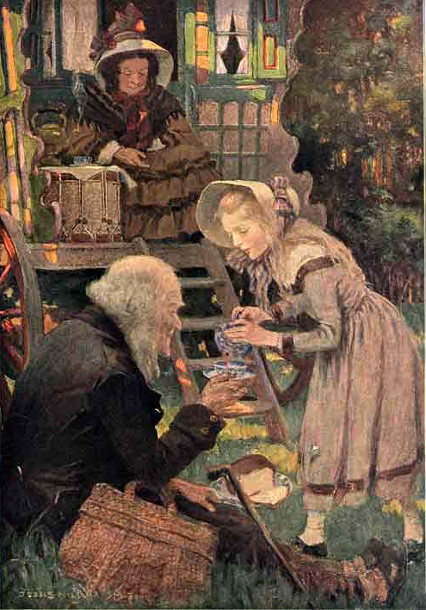
Nell & grandfather in Mrs. Jarley's caravan

Conclusion:

This is my fifth Dickens, and I can say that The Old Curiosity Shop has just become my new favorite. Usually I don’t quite like tales, where there were only black and white, the good ones must be perfect: handsome, kind-hearted, yet weak and poor; while the bad ones were always imperfect: ugly, wicked, heartless and powerful. Can you see Little Nell and Quilp in those two opposite frames? Like I said, if I don’t like tales, then I should have disliked The Old Curiosity Shop. However, it turned out that I really enjoyed reading this book. One of the reasons perhaps, because this book spoiled me with many adventures scenes during Nell and grandfather’s pilgrimage, which made the plot went quite fast. Other reason is the appearance of comical characters like the funny-eccentric Dick Swiveller or the street entertainers Nell met within her pilgrimage. Mrs. Javier’s waxwork company and Whisker the funny pony of Mr. Garland were also highly entertaining!

Besides the entertaining aspects, I also found satisfaction in Dickens’ concerns of injustice—especially to children—which became this book’s main theme. For your information, I always love to read novels that bring concerns for injustice as the main theme! Here we got two cases, one was Little Nell and the other was Kit. Both were innocent and kind-hearted children who must suffered from adult’s faults, crime and greediness. Dickens interestingly crafted these two cases in two separate frames of story with Quilp being one of the main red-thread that related them both to be concluded in the last chapters.

Speaking of the last chapters, they were very emotional, and this aspect is the one I like the most from this book. **spoiler** I can feel that Dickens had poured out his own emotion into these last chapters—the scene of Nell’s death, that he wrote them while remembering and memorizing the death of Mary Hogarth—her sister-in-law—in her seventeenth age, almost as youth as Nell was. You might have read on his biographies, that Dickens have an affection towards Mary, and was quite shocked when Mary died from heart failure in his arm. “Mary’s death affected him grievously and the shock never seemed completely to dissipate.” [from Dickens’ Bicentenary 1802-2012 by Lucinda Dickens Hawksley]. I can’t but share Dickens’ grief when he wrote about Nell’s burial, and how his grandfather and others felt about it, feel how Dickens must have felt on Mary’s sudden death, and the consolation he must have seek at that time, just as what he wrote here...

“Oh! It is hard to take to heart the lesson that such deaths will teach, but let no man reject it, for it is one that all must learn, and is a mighty universal Truth.”

And from the same book too—Dickens’ Bicentenary—I learned that writing about Nell’s death had re-opened Dickens’ old wound of Mary Hogarth: “I am ….nearly dead with work—and grief for the loss of my child.**spoiler ends**

And last but not least, I also like how Dickens concluded every piece of fragments nicely. I am a reader who judges a book from its ending, not about happy or sad ending, but more on whether it was cleanly closed or not. I don’t like it when there were still one or few things unfinished or unclear, it will make me keep asking questions like why that should happened, or what caused this or that, etc. In this book, one concern raised in my mind near the ending. I noticed that Kit—after his release from jail—had met and thanked everyone except the biggest heroes: Dick Swiveller and the Marchioness, whom Kit never mentioned nor made initiative to come to thank personally. You might think I’m being absurd to think of such small things like that, but as I said, I am a perfectionist when it comes to story ending, everything must be cleared up before I closed the book (most likely) forever. However, thanks to Dickens, I was rewarded by the final page where Kit and Barbara named one of their children as Dick “whom Mr. Swiveller did especially favour” (p. 544). And so…this story becomes one of my favorites of Dickens so far, and I rewarded him with five stars!

Title: The Old Curiosity Shop
Author: Charles Dickens
Publisher: Wordsworth Classics
Published: 1995
Pages: 544 + notes

Monday, June 18, 2012

Sketches by Boz by Charles Dickens


[Conclusion in English is in the bottom of this post]

Andai pada musim gugur 1832 itu seorang penulis muda—dengan gemetar ketakutan—tidak jadi memasukkan naskah tulisannya ke kotak surat gelap di sebuah kantor, dan andai sang Editor yang kemudian membacanya tidak kemudian menerbitkannya di The Monthly Magazine dengan judul ‘A Dinner At Poplar Walk’, maka dunia mungkin takkan pernah menikmati karya-karya menawan seorang Charles Dickens. Ya, penulis muda yang kuceritakan tadi adalah Charles Dickens. Dan dari naskah awal yang diterbitkan itu, mengalirlah pesanan tulisan berupa sketsa jurnalistik yang mengisi The Monthly Magazine secara berkala. Saat itu sang penulis menggunakan nama pena “Boz”. Di kemudian hari, sketsa-sketsa Boz akhirnya diterbitkan sebagai buku yang aku review ini: Sketches by Boz.

Sketches byBoz adalah cerita-cerita pendek yang merupakan ilustrasi dari hasil observasi Charles Dickens terhadap denyut kehidupan kota London saat itu (jaman Victoria), mulai tahun 1833 hingga 1836. Dickens menulis tentang banyak hal, dari suasana jalanan kota London dari pagi hingga malam hari, tempat-tempat hiburan yang diminati penduduk London, toko-toko, kebiasaan-kebiasaan orang-orangnya, sampai ke masalah-masalah yang sepele maupun serius yang sering mereka hadapi. Semuanya ia tuliskan dengan gayanya yang khas, kadang lucu yang sinis, kadang juga lucu yang membuatku sungguh-sungguh terbahak.

Membaca Skecthes by Boz kita jadi seolah hidup juga di London abad 19. Kita jadi mengenal tipe dan cara pandang orang-orang saat itu, gaya berbicara mereka, singkatnya budaya mereka. Inilah yang paling menarik dari buku ini, karena tidak gampang dengan sabar melahap 60 cerita pendek dengan gaya bertutur Dickens yang penuh kalimat-kalimat panjang. Dan salah satu kelemahanku adalah selalu tidak sabar membaca cerita pendek, sehingga kenikmatan membaca buku ini menjadi sedikit berkurang. Yang jelas, Sketches by Boz menawarkan perkenalan pertama pada karya Charles Dickens, karena dari variasi cerpen-cerpen di buku ini, kita akan menemukan humor sinis yang menyindir keabsurdan sosial jaman itu, dan melankoli dalam ketidakadilan yang kelak menjadi tema utama karya-karya besar Dickens berikutnya.

Tiga setengah bintang untuk Boz!

Conclusion:

Being his earliest work, Sketches by Boz has already shown Dickens’ witticisms and satires that we would find later in most of his works. Consisting of 60 short stories, Boz is a combination of literary journalisms and fictional stories, as the result of Dickens’ thorough observation of his surroundings. Sketches by Boz was first published as installments in The Monthly Magazine from 1833 to 1836. Later on, the sketches were sorted and categorized under four big parts: Our Parish, Scenes, Characters, and Tales, to be made into a book. Outside the four parts, there are three more collections of sketches, and the book is finally closed with Familiar Epistle From A Parent To A Child, which is—no doubt—something Dickens wrote for one of his children. So far, the epistle is one of my favorites from all sketches.

The tale of The Black Veil—which is the most touching of all stories—is also one of my favorites. It depicted the faith of a widow after her son hanged for a crime he committed. The touching part is when the young surgeon who attained the case, being a generous and kind hearted fellow, was willingly to take care of the widow now and then, despite of his unfruitful business. The widow on the other hand, always prayed heartily for her young supporter, that at the end her prayers was heard by the Heaven and resulting a good business for the young surgeon in return. A tale of love always touches my heart!

The most intriguing tale is perhaps The Drunkard’s Death. It’s about a drunkard who neglected everything in his life for drinking. Dickens wanted to speak about the risk of alcohol which can lead men and women into poverty and death. This tale is very similar to Emile Zola’s L’Assommoir, although Dickens wrote it more on the melancholy aspect, rather than its brutality as depicted by Zola. It’s interesting to see two different ways of writing, from two great authors, for the same topic at the same era. But of course, in this case, my winner is Zola.

I think the main strong point of this book is Dickens’ thorough observation, especially on human’s character. I am only imagining, if I was being in a dinner party where Dickens was also invited; would I become his observation object too? And if I happened to subscribe The Monthly Magazine, would I find myself illustrated on one of his sketches few days after the party? What would he write of me? That’d be interested! But of course I wouldn’t know whether Dickens was going to write good things or bad things about me. Anyhow, I think, people cannot get angry with him for writing about them. In worst cases, I think they would only put sour smiles on their lips. Or it is most likely that they would laugh heartily on their own sketches. Like Dickens said in ‘The Pantomime of Life: “A pantomime is to us a mirror of life; nay more, we maintain that it is so to audiences generally, although they are not aware of it, and that this very circumstance is the secret cause of their amusement and delight.” For people who lived at that certain time, Sketches by Boz is also a mirror of their own everyday life, either they were aware of it or—most likely—not. Boz was like a pantomime, where people can see and laugh at themselves. And that’s why they love Boz. Boz was something new and different than any other Victorian readings when it is first published. And the success of Boz then brought further success for Charles Dickens, until today!

Three and a half stars for Boz, as although it’s a unique work, Sketches by Boz is sometimes boring. Anthologies have not been my favorite, so maybe this is why I cannot put a high appreciation on Boz. It is good but unfortunately flat…

Title: Sketches by Boz
Author: Charles Dickens
Publisher: Oxford University Press
Published: 1987
Pages: 688

*This is my 2nd review for The Classic Bribe 2012*

Tuesday, February 7, 2012

A Tale of Two Cities: Kisah 2 Kota


Diperlukan sebuah pengorbanan besar demi mencapai sesuatu yang lebih baik. Tampaknya pesan inilah yang hendak diusung oleh Charles Dickens dalam salah satu masterpiece-nya, yang menjadi salah satu novel paling terkenal dalam sejarah penerbitan literatur di dunia ini: A Tale of Two Cities. Dan pengorbanan itu berlaku dalam cinta maupun dalam tatanan kehidupan, seperti halnya buku ini berkisah tentang cinta dan kesengsaraan hidup. Revolusi Prancis merupakan tonggak perubahan dalam negara itu; pergolakan rakyat kelas bawah terhadap kekejaman dan keserakahan kaum aristrokat yang selama itu berkuasa. Meski demikian—sesuai judulnya—A Tale of Two Cities ini tidak hanya ber-setting di Prancis saja, namun juga di London.


Kisah dibuka dengan perjalanan seorang bankir Inggris bernama Tuan Jarvis Lorry dari Inggris ke Prancis demi membawa pulang seorang pria yang telah 18 tahun dipenjara dengan tidak adil, meski tak bersalah. Pria itu adalah Dokter Manette. Bersama dengan Tuan Lorry, ikut juga Lucie Manette—anak gadis Dokter Manette—yang mengira ayahnya selama ini telah meninggal. Saat itu Dokter Manette tinggal di rumah pemilik kedai anggur bernama Defarge, yang dulu adalah pelayan sang dokter. Ada sesuatu yang aneh di kedai anggur ini, yaitu Madame Defarge yang selalu duduk diam sambil merajut. Ya, ia tak henti-hentinya merajut. Acuh pada keadaan sekelilingnya dan tetap konsentrasi pada rajutannya. Apa yang dirajutnya itu? Ternyata jawabannya kelak erat berkaitan dengan inti kisah ini…


ilustrasi kedai anggur Defarge, dengan Mme Defarge yang asyik merajut

Singkat kata, Tuan Lorry berhasil menyelamatkan Dokter Manette sehingga sang Dokter hidup berbahagia dengan putrinya, Lucie di Inggris. Namun ketenangan mereka tak berlangsung lama. Suatu hari mereka harus menjadi saksi di pengadilan seorang pemuda bernama Charles Darnay, yang dituduh sebagai pengkhianat negara. Saat itu Darnay dan Lucie langsung jatuh cinta. Kelak ketika Darnay hendak menikahi Lucie, barulah Dokter Manette mengetahui bahwa Charles Darnay sebenarnya adalah kemenakan Marquis EvrΓ©monde yang kejam—lambang eksploitasi kaum aristokrat terhadap rakyat miskin di Prancis pada jaman itu. Charles Dickens menggambarkan kekejaman itu lewat acuhnya sang Marquis ketika kereta kudanya yang melaju cepat menabrak seorang bayi di jalanan. Tak heran bila kemudian rakyat pun berontak dengan membunuh dan membakar kastil sang Marquis. Di titik ini benih-benih pemberontakan rakyat miskin yang telah lama tertindas mulai tumbuh. Lalu bagaimana dengan kemenakannya? Karena muak dengan kesemena-menaan kaum aristrokasi, Darnay melarikan diri dari Prancis sambil melepaskan kebangsawanannya, lalu tinggal sebagai rakyat biasa di London.

Bersamaan dengan lamaran Darnay untuk mempersunting Lucie, ada seorang pengacara malas, pemabuk dan selalu berpenampilan acak-acakan yang juga menyatakan cintanya kepada Lucie. Si pengacara—Sydney Carton namanya—secara tak langsung telah menyelamatkan Darnay dari tiang gantungan saat di pengadilan dulu, berkat wajah mereka berdua yang mirip. Sejak pengadilan itu, Carton menjadi sahabat keluarga Manette selain Tuan Lorry. Sydney Carton adalah contoh manusia yang tak berguna dan takkan pernah menjadi orang penting, apalagi pahlawan. Namun demikian, saat menyatakan cintanya pada Lucie, Carton berjanji bahwa ia bersedia untuk mengorbankan apa saja demi Lucie dan semua orang yang dicintainya.

Sementara itu benih-benih kebencian yang selama ini telah ditaburkan oleh kejahatan kaum aristrokat perlahan-lahan bersemi dalam bentuk pergerakan rakyat miskin. Dengan kata sandi “Jacques”, topi khas warna merah dan emblem tiga-warna, kelompok ini mempersenjatai para petani dan pekerja, dan pada hari paling bersejarah bagi Prancis—14 Juli 1789—mereka pun merebut penjara Bastille dan dengan demikian mengakhiri kekuasaan monarki. Kaum bangsawan dan keluarganya ditangkap dan dibantai. Di sinilah diperkenalkan alat penyiksa terbaru yang kemudian menjadi sangat terkenal—terkenal karena kekejamannya tentu saja: La Guillotine. Charles Darnay adalah salah satu calon korban sang “wanita tajam” ini (sebutan yang ironis terhadap guillotine yang dalam bahasa Prancis merupakan kata benda yang menyandang “genre” feminine). Karena Darnay adalah keturunan bangsawan, maka ia beresiko untuk dihukum mati pula.

ilustrasi perebutan Penjara Bastille


ilustrasi dandanan para revolusioner

Maka sekali lagi, kawan-kawan kita dihadapkan pada masalah yang pelik. Rencana penyelamatan harus kembali disusun, meski nampaknya sia-sia berkat sebuah rahasia besar yang hingga saat itu baru terungkap. Berhasilkah mereka? Dan kalau begitu, siapakah pahlawan sesungguhnya dalam kisah ini?


Membaca A Tale of Two Cities ini kita seolah menyantap hidangan dengan aneka macam rasa di satu piring. Yang pertama, ada tema sejarah Revolusi Prancis yang membuat kita mengetahui akar dari salah satu revolusi paling terkenal dan yang mempengaruhi seluruh dunia itu. Kedua, tema kesengsaraan dan pengorbanan yang harus terjadi untuk mencapai sebuah kebangkitan. Revolusi adalah contoh kongkritnya. Begitu banyak nyawa jatuh dalam balas dendam yang amat kejam. Namun, tanpa revolusi itu takkan pernah terjadi perubahan, rakyat miskin pun akan terus menjadi korban. Di sisi yang lebih abstrak, pengorbanan yang seutuhnya dibutuhkan, agar kehidupan yang jauh lebih baik dari orang-orang yang kita cintai dapat tumbuh dan bersemi. Bak benih yang mati lalu jatuh ke tanah. Bukannya binasa, ia justru akan menumbuhkan kehidupan yang baru.

Sepertinya Charles Dickens pun hendak berbicara tentang bagaimana manusia harus bersikap tentang kejahatan dan penindasan. Di satu sisi kelompok pemberontak yang dengan kejam menyiksa dan membantai kaum bangsawan dengan tak pandang bulu. Bukan saja mereka yang memang suka menyiksa seperti Marquis, tapi juga seluruh keluarganya—termasuk wanita dan anak-anak yang tak berdosa. Kalau begitu, lalu apa bedanya mereka dengan para aristrokrat yang mereka hujat itu? Toh akhirnya mereka sama-sama membunuh dengan keji?

Nah, di sisi lainnya ada Dokter Manette yang mengalami ketidakadilan dan kesengsaraan selama 18 tahun. Bahkan saking parahnya penderitaan itu, ia harus mengkompensasikannya dengan bekerja tekun membuat sepatu, demi agar otaknya beralih ke pekerjaan rutin alih-alih memikirkan deritanya. Akibatnya, bahkan setelah ia bebas, tiap kali ia merasa depresi, Dokter Manette harus kembali bekerja membuat sepatu. Namun anda akan melihat di akhir kisah ini, betapa besar pengampunan Dokter Manette pada orang yang—kalau meminjam cara pandang kaum revolusioner—harusnya adalah orang yang paling ia benci.

Charles Dickens sepertinya mau mengatakan bahwa ketika kejahatan kita balas dengan kejahatan, maka kejahatanlah yang kelak akan membalas kita juga. Sebaliknya, ketika kejahatan kita balas dengan kebaikan, maka berarti kita telah menang terhadap kejahatan, dan kebaikanlah yang akan kita genggam, bukan hanya bagi kita sendiri, tapi juga anak cucu dan semua yang kita cintai. Pada akhirnya, cinta jualah yang selalu menang, bukan?

-----

Seperti biasa, Charles Dickens selalu menyisipkan ironi yang terbungkus humor di sana-sini di karya-karyanya, seperti juga di buku ini. Kisah yang menawan ditambah dengan gaya penulisan Charles Dickens yang cantik, membuatku tak ragu menganugerahkan lima bintang untuk A Tale of Two Cities ini, meski tetap ada hal-hal yang terasa aneh bagiku. Bukan hal-hal yang mendasar, hanya detil-detil yang nampaknya sepele tapi tetap membuatku tetap berpikir: “bagaimana bisa…?”. Tambahan lagi aku kurang sreg dengan cover terjemahan Elex Media ini. Bunga-bunga warna merah jambu yang mengelilingi guilootine dan font judul yang berwarna merah jambu itu terasa terlalu romantis, seolah-olah ini kisah romance biasa. Meski aku paham, mungkin ilustratornya ingin menunjukkan ironi dari kekejaman dan cinta yang menjadi tema utama kisah ini, tapi tetap saja… Aku lebih suka cover-cover aslinya yang lebih terasa klasiknya, dan Revolusi Prancis-nya tergambar jelas di sana, seperti ini...


Terlepas dari detil-detil yang mengganggu itu, A Tale of Two Cities tetap salah satu karya klasik dunia yang mempesonaku. Bravo Charles Dickens!


*Review ini dibuat tepat di hari bersejarah: Hari Ulang Tahun ke 200 Charles Dickens (7 Februari 1812 – 7 Februari 2012), sebagai “hadiah” dariku bagi Charles Dickens.*

Judul: Kisah Dua Kota
Judul asli: A Tale of Two Cities
Penulis: Charles Dickens
Penerjemah: Peusy Sharmaya
Penerbit: Elex Media Komputindo
Terbit: 2010
Tebal: 564 hlm