"When you reread a classic you do not see more in the book than you did before; you see more in you than there was before." — Clifton Fadiman
Friday, April 12, 2024
The Miller's Daughter and Captain Burle by Émile Zola #Zoladdiction2024
THE MILLER'S DAUGHTER
🔷️ This one is set in a small French village of Rocreuse during the Franco-Prussian War in 1870. Pere Merlier, the miller, is the mayor. He owns a picturesque Mill which he loves almost as much as his love for his daughter, Françoise. When the German troops entered their village, the French army picked the Mill as their fortress. It breaks Pere Merlier's heart while his beloved mill received shots after shots. Françoise' fiance, Dominique, is not a French; he came from Belgium. But he shoots the German to protect Françoise, and that's why the German captured him to be executed. I won't tell you the end, but it's quite suspenseful.
🔷️ But what made me fell in love with this story is Zola picturesque description of the Mill and its surrounding. I imagine he really found that beautiful corner, and captured it just as a painter would paint it, Zola painted it using his pen as brush. And he presented that artful and poignant suspenseful story in just 40-ish pages. Just amazing! Writers... that's how you do a short story!
Rating: ⭐⭐⭐⭐⭐
CAPTAIN BURLE
🔷️ Compared to the above first story, this one is, unfortunately, rather flat though quite interesting, and of a different vibe. Captain Burle had had a brilliant military career before he resigned to do administration job as a Quartermaster. But one thing never changes, his nickname is "Petticoat Burle" and women is his weakness.
🔷️ Major Laguitte has served under Captain Burle and maintained a friendly terms with the family. He witnessed how the Captain was more and more captivated by the widowed owner of a "cafe". Then one day he found discrepancies in the Captain's bookkeeping. And that would be the downfall of the honor of the family's name as well as the army's. Something must be done, but what?
🔷️ This story talks about respect, honor, dignity, and friendship; expectation as well as disappointment. Madame Burle, who had high expectation of her son to marv on military career, was hugely disappointed, and so she put her efforts into making her grandson Charles - a tender child - to be what his father failed. Poor Charles! I really admired Laguitte's loyalty to the Burles. And Zola really excelled in manipulating emotions in each character. Not a bad story, but not as poignant as I have expected.
Rating: ⭐⭐⭐1/2
Wednesday, November 22, 2023
Behind a Mask: or, A Woman's Power by Louisa May Alcott: An Audiobook Review #NovNov23
🎭 Behind a Mask or A Woman's Power is one of Blood and Thunder Tales, a thriller series, which Alcott had written years before Little Women. The first of these was a novelette titled Pauline's Passion and Punishment which she wrote while in financial straits. After she entered it in a competition, and won the prize, Alcott published it anonymously under the name of A. M. Barnard.
🎭 Behind a Mask told the story of Jane Muir, a deceitful governess who came to join the wealthy Coventry family, to guide the 14 year-old Bella Coventry. The household consists of Mrs. Coventry (Bella's mother), Gerald (oldest son - an idle gentleman), Edward (youngest son - the romantic young man), and Lucia Beaufort (a cousin who loves Gerald, and regarded as his wife-to-be). There's also Sir John Coventry, uncle to the children, who lives near their house.
🎭 Jane Muir arrived as a shy, demure, polite young woman of 19, who had been persecuted by endless marriage proposals of her former employer, a guy called Sidney, who happened to be Gerald's acquaintance. But right after she was alone in her bedroom at the first night, we saw immediately that she was actually a thirty years old actress, who was in disguise with wig and fake teeth.
🎭 Mrs. Coventry and Bella were instantly charmed by Miss Muir, while Edward fell head over heels for her. Sir John also gradually found comfort in this girl's company. Only Gerald and Lucia who were suspicious. Thus, it was amusing to watch how Miss Muir gradually won over the family's heart. Even the skeptic Gerald was soon infatuated by her, after she confessed that she'd actually come from a respectable family, and an equal to her employer. Jane's enemies are now Lucia - who's watching her lover slowly slipped away from her, and Lucia's faithful maid.
🎭 Jane's aim was certainly to marry one of the men, to be a Coventry; but the question is, which one? To succeed she must act quickly before the truth overcome her plot, otherwise she would be ruined - penniless and homeless. Will she succeed? Moreover, will this story make her a heroine - a lower class woman's ambition to secure a better life, or will it be 'truth will win over evil' - a condemnation of ambitious female sex in 19th century a la Thomas Hardy?
🎭 I loved everything about this novella! It's like watching a genius actress performing her act, live. Alcott's narrative described Jane Muir's gestures in little details - her sighs, drooping eyelids, her tremble, voice modulation, hand on the heart - everything is perfect. She performed each in the right time, with right amount, to create the right effect. It's so satisfying to read and follow her actions. I know she's deceitful, but I can't help wishing her successful, and the suspense was delicious right to the end.
🎭 Needless to say, this was one of the best novellas I've ever read. No matter what people call this kind of story - a thriller? a sensation novel? - it works for me. What an satisfying read of a brilliant writing! Or should I say 'a satisfying listening', because its was the audiobook version which I've enjoyed for this novella - and it was superbly performed (as usual) by B.J. Harrison. He was such a brilliant performer - not only narrator. He gave each character a perfect modulation in speech, and gave this sensation novella a credit by making it 'live'.
Rating: 5 / 5
Novellas in November 2023
hosted by Cathy @ 746 Books and Rebecca @ Bookish Beck
Wednesday, July 26, 2023
Letters from My Windmill by Alphonse Daudet: A Review
✉ In these letters, he recounted his new life in Provence; from day-to-day events in the countryside - which are so different from the hustle-bustle of a big city - to some Provençal folktales. In addition to that, he also included his trips to Corsica and Algeria.
✉ Some of these stories - or sketches, you might call it - are light and funny, but there are few of them which is satirical, and even sad. I loved the first story: First Impressions, it transported me to the quiet countryside of southern France:
"I am writing to you from my Windmill, with the door wide open to the brilliant sunshine. In front of me, a lovely, sparkling lit, pine wood plunges down to the bottom of the hill. The nearest mountains, the Alpilles, are far away, their grand silhouettes pressing against the sky... There was hardly a sound to be heard; a fading fire, a curlew calling amongst the lavender, and a tinkle of mules' bells from somewhere along the track. The Provençal light really brings this beautiful landscape to life."
✉ Don't you just love it? I can feel the serene quietness in my head, the warm sun caressing my skin right now!
![]() |
| Daudet's mill in Fontvielle, open for tourists, complete with museum |
✉ Another one I loved is The Stars. It's a sweet tale about a shepherd who is falling in love with his master's charming daughter.
✉ All in all, I loved all the fourteen stories. The beautiful Provençal countryside with its fife player, tambourines, and farandole dances are what one needs in this bleak existence one lives in.
Rating: 4 / 5
Friday, April 21, 2023
The Ladies' Paradise by Émile Zola: A Reread from Audiobook
👗 Ladies' Paradise is the first department store in Paris (inspired by Le Bon Marché). It was first founded by Madame Hédouin (told in previous novel in Rougon-Macquart novel - which I didn't review - Pot-Bouille), where Octave Mouret has worked as a salesman. He was a charming womanizer, and at the end of Pot-Bouille, he married the widowed Madame Hédouin.
👗 The Ladies' Paradise begins a few years after Madame Hédouin died, leaving the store to Mouret. Besides being charming, Mouret was, apparently, a visionary and innovative business man. Under his management, Ladies' Paradise doubled its capital in a short time. Mouret's key formula was by 'tickling' women's senses and greedy desires, which was achieved through colossal artistic displays, enormous mass gatherings, sensational promotions, and generous discounts.
👗 I could imagine how fascinating it was for the Parisian women. A glamorous building, the adrenaline rush seeing the crowds (let's get those silks before the others take all!), then the beautiful colorful arrangements which makes one buy what she doesn't need. And the cheap prices too! It's enough to lure any woman to buy impulsively.
👗 Mouret could run those schemes at all because he knew women's character perfectly. Or he thought he knew, until Denise Baudu, a plain country girl who's just arrived in Paris to work, entered his life. His life changed (for the better) when he fell in love with Denise. Now, Denise is an extraordinary character - I have written about her character - she's nothing like common working-class girl, and her dignity surpasses those of bourgeois ladies. Moreover, Denise is intelligent and as visionary as - but more kindhearted than - Mouret. I imagine, if they join forces in the management, the Ladies' Paradise would become a truly formidable establishment!
👗 For this second read, I listened from an audiobook, narrated by Leighton Pugh. I'm glad I've done that, because the listening has enhanced Zola's picturesque description of the Ladies' Paradise to another level. Reading from printed copy might have been a bit boring (Zola's descriptions can often be dragging on and on!) But by listening, it surprisingly provided a vivid portrays of the scenes. Far from boring, I enjoyed it imenesely like I were visiting the department store myself. It was very rewarding!
👗 Finally, there is the love story of Mouret and Denise - the only romantic story you would find from Zola's Rougon-Macquart! On the whole, it has been a very satisfying reading!
Rating: 5 / 5
Wednesday, March 22, 2023
Rural Hours by Susan Fenimore Cooper: A Review
🌳 Cooper was an amateur naturalist; she read many books or essays by other naturalists, and recorded her observations on animals, plants, landscape, as well as rural life during her daily excursions, onto her journals. This book was derived from these notes, took up a course of four seasons of 1848, beginning from the spring.
🌳 Reading an amateur naturalist has its advantage. I took pleasure of Cooper's observations, as if I was walking with her, but without being troubled too much with scientific phrases of a pedantic. While bird-watching, she would observe:
"It was amusing to watch the parents flying home, and listen to the family talk going on; there was a vast deal of twittering and fluttering before settling down in the nest, husband and wife seemed to have various items of household information to impart to each other, and the young nestlings made themselves heard very plainly; one gathered a little scolding, too, on the part of some mother-robins."
Can you imagine yourself taking a stroll with Cooper, bird-watching with amusement like that? That has always been my dream!
🌳 I loved Cooper's sharp wit in her observations, such as when she wrote about a spider:
"A huge spider, by-the-bye, with her intricate web and snares, would form no bad emblem of a courtier and diplomatist, of the stamp of Cardinal Wolsey. He certainly took "hold with his hands, in kings' palaces," and did his share of mischief there."
🌳 Beyond the animals or plants (she could talk about trees for some pages!), Cooper is also a sharp observer of human nature and their civilization. She criticized her nation for their reckless behavior towards horticulture, and for not focusing on the advantages of gardening. She also noticed how her people were gradually taking distance from nature, even on adorning their houses:
"In very truth, a fine tree near a house is a much greater embellishment than the thickest coat of paint that could be put on its walls, or a whole row of wooden columns to adorn its front; nay, a large shady tree in a door-yard is much more desirable than the most expensive mahogany and velvet sofa in the parlor."
![]() |
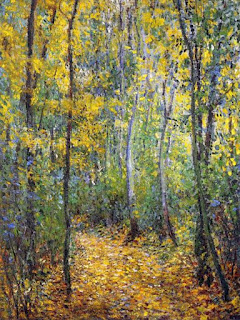
| Wood Lane, Claude Monet, 1876 |
🌳 Sometimes Cooper would talk about some unusual sights, like how, on one foggy dawn, a flock of wild pigeons alighted on the trees at the heart of the village (a rare sight!), and only after the fog has lifted, that the birds flown again. Some cows Cooper saw on her walk one evening, were returning home after pasturing along the road side or unfenced woods. They were left to forage by themselves, and usually came from different houses. They would leave home in the morning, and return home in the evening, one to this house, the other to that - all by themselves without anyone accompanying them.
🌳 Few more amusing things Cooper observed: Otters - these animals have one very strange habit: it is said that they actually slide down hill on the snow, merely for amusement. Then there is her amusing comment on singular leaf of a tree that dances merrily, moved by some light puff of air:
"A single leaf or two in rapid movement, all else still and calm; and one might fancy Puck, or some other mischievous elf, sitting astride the stem, shaking his sides with laughter at the expense of the bewildered spectator."
![]() |
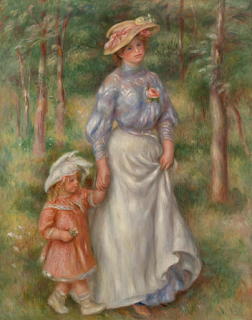
| La Promenade, Pierre-Auguste Renoir, 1875 |
🌳 I've just realized that the US named their rivers, mountains, or cities with Indian names: Michigan, Ontario, Mississippi, Potomac, and many more. Cooper beautifully put it into this reflection:
"A name is all we leave them, let us at least preserve that monument to their memory; as we travel through the country, and pass river after river, lake after lake, we may thus learn how many were the tribes who have melted away before us, whose very existence would have been utterly forgotten but for the word which recalls the name they once bore. And possibly, when we note how many have been swept from the earth by the vices borrowed from civilized man, we may become more earnest, more zealous, in the endeavor to aid those who yet linger among us."
🌳 Sometimes too, we get
glimpses of some village stories or legends. One of my favorites is of a pet
fawn, who, after being saved from haunting dog's chase by some people, was then
shot by a hunter because it approached him without fear. Another reminder to us
to let wild animals be wild!
🌳 I think from what I've
written and quoted above, you can see how I loved this book! For a person who
live in a tropical country with only two seasons: wet and dry, where the
flowers keep blossoming, and the landscape never changes its hue, Cooper's
journal provided me with invaluable glimpses of the four beautiful seasons I
wouldn't have witnessed. I loved every little change of the lake color, the
leaves, or the flower petals, from season to season. I'm a 'color' person, and
this has been a wonderful "experience" of a lifetime, though only
through Susan Fenimore Cooper's pen.
Rating: 4,5 / 5
Friday, February 17, 2023
Little House in the Big Woods by Laura Ingalls Wilder: A Review of an Audiobook
💙 The story is told from Laura's perspective, who, in this book, is four years old. The family consists of Pa Charles, Ma Caroline, Mary - Laura's older sister, and baby Carrie who was just born. They lived in a log cabin at the edge of Big Woods in Wisconsin. The Ingallses are busy preparing for the upcoming winter. They are butchering the animals and preserving the meat; harvesting fruits and vegetables from their garden to be stored in the attic. Everyone is lending their hands to the works.
💙 At night, when they are tired from the day hard work, Laura feels warm and contented by the blazing fire, the safety of their sturdy log house, the warmth of family love, while Pa's singing and playing his fiddle.
![]() |
| illustration by Garth Williams |
💙 The joy continues on next in spring, summer, and fall. Of course, there're scary moments too when one lives on the edge of a big woods, such as when Ma and Laura went out to the barn, and seeing the shadow of what they thought is their cow, Suki. Ma slapped the animal, which turned out to be not a cow, but a bear! I couldn't imagine how scared they were (including the bear... it might be more scared for it to be slapped by human like that!!) 🤣
💙 I enjoyed this book in audiobook version, narrated by Cherry Jones. Let me tell you, one of my favorites is Pa's fiddle. Every time there's a scene where he's singing and playing his fiddle, the narrator sings accordingly, accompanied by a fiddle play (played by Paul Woodiel)! That only enhanced the reading sensation; I felt as if I was transported to the Ingallses' log house by the big woods on a cold night!
💙 I loved also Pa's stories. The one when he heard a scary voice in the wood when he's a boy coming late from running errand, for example, which turned out to be a screech owl's! 🤣
💙 But the funniest one is Pa's story about grandpa & his brothers' sled riding when they were kids, and the black pig. One day they sneaked out of the house on a Sunday afternoon while their father fell asleep, and rode the sleigh down the hill, when a pig appeared suddenly in front of them out of the wood. They couldn't stop the fast going sleigh, so the pig ended up landing on the boy's lap and they sleighed down with the scared pig squealing, passing the house to the astonishment of their father!🤣🤣 That was so funny I had to stop the audio for a minute to laugh out loud!
💙 It was a so satisfying reading experience, that I planned to read through the whole series (I have only read Little House on the Prairie so far) from audiobook. Cherry Jones is such a perfect narrator for this series!
Rating: 5/5
Friday, January 27, 2023
The Woodlanders by Thomas Hardy: A Review (CC Spin #32)
🌳 Because I love nature, it's only natural that I tend to be attracted to books where nature poses as dominant aspect. The Woodlanders falls into this category, and that's why I loved it!
🌳 I was drawn, particularly, to the simple life of the woodlanders; their occupation, their view of life, and their intimate relation with mother nature. I was also interested in the spars making craft (I didn't know what a spar is until I googled it). And that was, actually, how we were first introduced to this book: a simple nineteen year old girl, Marty South, making spars in the dead of the night to get paid in the morning. That's how woodlanders had lived, and, but for some influences from "outsiders", they would all live contentedly. And that's what this book is about - greediness and ambition which wrecked the beautiful balance of natural life in a woodland village: Little Hintock.
🌳 As I have analyzed before, I see Marty South as the centre of this story. She is reserved, calm, hardworking, and possesses enough skill for improving her life. Then the outsiders' unnatural greediness or ambition starts to shake her world. First, Marty must sacrifice her luscious long hair to be sold for money, just because Mrs. Charmond, a rich widow with many lovers, wants to have it as a wig!
🌳 The hair symbolizes Marty's femininity. Without it, she loses hope of ever attracting Giles Winterborne, a woodsman whom she loves, though unrequitedly. Giles is in love with another: Grace Melbury, who has been "promised" to him by her father.
🌳 The ambitious Mr. Melbury had sent his only daughter Grace to be educated abroad to improve her future. He takes back his promise to Winterborne, as he thinks her daughter should marry higher than a mere woodsman. A young doctor called Fitzpiers, who is charmed by Grace, is the one Mr. Melbury believes as a more suitable husband for Grace.
🌳 What about Grace herself? It is interesting to see how she'd view the woodland after returning from abroad. Would she be contented with her old life (and lover), or would she view them as flat and boring, seeking more refined, more amusing life and husband? It was amusing to see her blundering through her choices, in Hardy's universe, which was always ruled by chances, bad timing, and errors. Could Grace escape it all unscathed? But more importantly, how would she re-shape the life of those who are truer woodlanders?
🌳 Hardy himself had classified this novel in the group of "Novels of Character and Environment" [source: wikipedia]. And I agree. The Woodlanders is about clashes between classes and different environments, poor marriage, adultery, wrong choices. It's not a cheerful story, but it's Hardy, you can't expect nothing more, right? But no worry, Hardy compensated the gloomy plot with his rustic settings of the woodland and his usual beautiful narration. And also, with one of the strongest 'heroines' I've ever read.
Rating: 4,5 / 5
Further reads on The Woodlanders:
- Character analysis of Marty South
- Book cover art analysis
- Hardy's poem on Marty South
Saturday, December 17, 2022
The Christmas Hirelings by Mary Elizabeth Braddon
🎄 His best friend, Mr. Danby, and his niece, Adella, have persuaded him to hire poor but respectable little children to liven up the Christmas at the mansion. An agreement was binding between the parties. Mr. Danby agreed to bring the hirelings, but Sir John should never ask about their background; while Sir John agreed to pay for everything on condition that the children leave the house immediately after Christmas - no strings attached!
🎄 Three little cute hirelings (a little boy and two little girls) arrive on Christmas Eve. The youngest girl, Moppet, instantly steals Sir John's heart with her sweet precocious nature.
🎄 Christmas celebration in the mansion is as joyful as one hopes; even Sir John's heart is warming up. But when he becomes quite attached to Moppet, something happens that threatens to take her away from him.
🎄 This story is the epitome of what true Christmas is about; joyful, heartwarming, love, forgiveness, and the chance to let go of the past, to right the wrongs, to start all over again with open heart.
🎄 A perfect Christmas read, that I might re-read again and again in the future - maybe as much as A Christmas Carol?...
Rating: 5 / 5
Saturday, November 5, 2022
Elizabeth and Her German Garden by Elizabeth von Arnim
✍🏼 Von Arnim wrote Elizabeth and Her German Garden as a mockery to German aristocratic society. It's a semi autobiographical novel, written as a diary of the protagonist, Elizabeth, who was developing a beautiful garden on the estate, though she knew almost nothing about gardening.
✍🏼 I enjoyed the book so much for three reasons: a) At times it's so hilarious, I had often to stifle my laughter while reading in public. b) It talks much about gardening, and though I'm not keen on the subject, I love everything concerning nature. c) I loved most of Elizabeth's unorthodox views on life and tradition, which I can well relate. I quote here some of her entries, which is bluntly honest and hilarious.
“I believe all needlework and dressmaking is of the devil, designed to keep women from study.”
"If you have to have neighbours at all, it is at least a mercy that there should be only one; for with people dropping in at all hours and wanting to talk to you, how are you to get on with your life, I should like to know, and read your books, and dream your dreams to your satisfaction?"
"I never could see that delicacy of constitution is pretty, either in plants or women."
"What nonsense it is to talk about the equality of the sexes when the women have the babies."
"To most German Hausfraus the dinners and the puddings are of paramount importance [...] but, I would humbly inquire, are there not other things even more important? And is not plain living and high thinking better than the other way about? [...] It cannot be right to be the slave of one's household gods, and I protest that if my furniture ever annoyed me by wanting to be dusted when I want to be doing something else, and there was no one to do the dusting for me, I should cast it all into the nearest bonfire and sit and warm my toes at the flames with great contentment, triumphantly selling my dusters to the very next pedlar who was weak enough to buy them. [...] is it not pathetic to find a young woman bravely struggling to learn languages and keep up with her husband?"
✍🏼 It's a short but entertaining novel, and I can't wait to read more of von Arnim. The Enchanted April is next. Maybe next year?
Rating: 4,5 / 5
Saturday, September 3, 2022
The Seagull by Anton Chekhov
First of all, I don't really like Chekhov's style of focusing on indirect speeches, instead of dramatic actions, in this particular play. If you haven't been familiar with it, it's like when someone wanted to tell you that a character is dead, instead of dramatizing the death scene, he would write a dialog (that is supposed to happen a week after, for instance), casually indicating that that character (X) is dead:
A: "I don't know how we would ever complete this task."
B: "I know, after X's death, I can't seem to handle anything."
You know what I mean, right? I believe it's called 'subtext'. I'm not a fan of it. It makes the play somehow seems vague or dreamy. Add that to the fact that The Seagull is a considerably short play, and, as usual, with its confusing Russian's names and nick names. In short, it's a confusing little piece that I can't really grasp the meaning. What's it all about? I have no clue...
What I remember from the play is, there's a playwright (Konstantin), son of a retired actress, who was desperately trying to make his mother proud of his theatrical talent, but failed. His last attempt was writing and producing an unconventional play - play within play - on a built-in outdoor stage. The audience failed to comprehend his ideas - especially his mother who continuously mocked him. The play was stopped midway, and Konstantin stormed out with humiliation.
Then there's multiple love affairs between the characters. Konstantin loves the actress performed at his play, Nina; but the actress loves another writer, whom is also loved by Konstantin's mother. Meanwhile, Masha loves Konstantin, but she eventually married the schoolmaster who loves her. Meanwhile, Masha's mother is having an affair with a doctor. Really confusing, and with the shortness of the play, I couldn't really relate to their feelings, or even to the main characters.
I haven't talked about the seagull itself. It is an important factor in this play, as it is meant to be a symbol of something - which I didn't get to solve. The gull was shot by Konstantin, and he gave it as a gift to Nina, who was horrified by the sight. Maybe Konstantin isn't really a bad playwright, but he's certainly a bad lover!
All in all, it's not an entertaining play, and now I'm wondering whether I should move on to Chekhov's other major plays? Or should I just bailed on him? What would you recommend?
Rating: 2,5 / 5
Monday, May 2, 2022
For a Night of Love by Émile Zola
💜 Title of this collection is lent by the first story, which is also the longest - it might have been between short story and novella: For a Night of Love (Pour une nuit d’amour). It tells a story of a shy and unattractive young post office clerk, Julien, who lives in a small flat, and loves to play tunes in his flute. Opposite his flat is a large building occupied by a wealthy family with a beautiful daughter. Julien often watches her from his window, plays his flute for her, and eventually falls in love with the girl. But the girl, Thérèse, usually ignores him. One day she throws him kisses from her window, and summons him to come; not out of love, apparently, but to help her getting rid of the dead body of her lover.
💜 This first story sets the tone of the whole book - or at least the first two stories - which is the excessive crave to be loved.
💜 Nantas is the title of the second story, but also the name of its protagonist. He's a poor but intelligent young man with huge ambition, who comes to Paris to reach his dream, but desperately unsuccessful. On the brink of committing suicide, someone offers him a huge sum of money to marry a prominent young girl who is pregnant from a married man. He accepts the "business proposal", makes himself the most powerful man in France, but is unhappy because his wife doesn't return the love he eventually comes to feel for her. This one is my favorite from the the three stories. It is written superbly, and the ending is quite unpredictable.
💜 The last story is rather anticlimactic and rather out of theme. Fasting is about religion hypocrisies. In a church, a baroness seems to be fascinated while listening to her favorite priest's sermon about fasting - except that she is struggling to stay awake. The priest, on the other hand, seems to be preaching earnestly about fasting - except that all he's thinking all the while is going to a concert and having dinner with a countess. It's rather a funny satire, which talks nothing of love. Or, maybe, this whole thing is not meant to be about romantic love after all, but more about unsatiable desire, Zola's main topic in most of his other books.
💜 I am never a fan of short stories, as I always find them lacking of depth. They are usually sharp, yes, but it's like when a thorn is pricking your finger - you definitely feel the pain, but an hour later you won't feel anything, and would completely forget the incident. Though I appreciate Zola's brilliant writing in this collection, I still think his novels are much better.
Rating: 3,5 / 5
Sunday, March 13, 2022
Martin Chuzzlewit by Charles Dickens
💰 Tired of his greedy and selfish family, wealthy old Martin Chuzzlewit lived a secluded life with only a companion - a pretty young girl called Mary Graham - to whom he said quite frankly that he will pay her wages generously, but she will not be left anything in his will. By this arrangement the old man hoped that she will serve him best without wishing him dead (in the hope of inheriting something).
💰 His grandson, young Martin Chuzzlewit fell in love with Mary (the feeling is reciprocated), but when he uttered this to his grandfather, the old man was enraged, and grandfather and grandson separated ways in anger.
💰 Then young Martin was apprenticed to a gentleman by the name of Seth Pecksniff. He calls himself a surveyor and architect, but all he ever produces are the works of his pupils which he claimed as his own. Yes, Pecksniff is what you call a sanctimonious person - a hypocritical swindler in a gentleman disguise. He accepted Martin because of his rich grandpa, but then banished him when the fact of their separation was known to him.
💰 Humiliated and poor, young Martin left for America with the jolliest young man on earth as his servant-slash-companion: Mark Tapley. Here is a chance for Dickens to reflect upon his own visit to America. And boy, didn't he smash those Americans with ugly picture of mean, selfish, greedy, hypocrite and opportunist people! Martin Chuzzlewit might be considered as Dickens' personal favorite, but I doubt if it would be an enjoyable read for American people. Is that one of the reasons why this book becomes one of Dickens' least favorite? Hmm...
💰 Anyway, the America period in young Martin Chuzzlewit's adventure changed him considerably when he touched English land months later. And meanwhile, we were introduced to another villain-even more evil than Mr. Pecksniff: the coward heartless scoundrel: Jonas Chuzzlewit, nephew of old Martin Chuzzlewit. The cruellest villain in Dickens' novel so far.
💰 Martin Chuzzlewit is a story about greediness, excessice pride, and selfishness. It is also the first appearance of a detective in Dickens' novel. It could have been a promising story, but like I said before, the first two third is rather flat, and only the last third is really enjoyable. It has some memorable secondary characters: Tom Pinch - the naive and tenderhearted pupil of Pecksniff who failed to see his hypocrisy; Ruth Pinch - Tom's little energetic sister; and John Westlock - another alumni of Pecksniff academy, and a kind-hearted young man. Unfortunately Dickens included too many characters in this story that he hadn't had enough space to develop them further.
In the end, while the story is conclusive enough to be satisfying, it's far from making it memorable. I have even forgotten some of the plots while writing it!
Final rating: 3 of 5
Monday, November 29, 2021
The Nutcracker and the Mouse King by E.T.A. Hoffmann
🎄 It follows a seven year old girl, Marie Stahlbaum and her brother Fritz, who get as their Christmas presents, a clockwork castle with mechanical people - handmade by their godfather Drosselmeier, a clock maker.
🎄 They soon get bored by it, though, so Marie shifts her attention to another present: an ugly nutcracker, and she is fond of it.
🎄 When the clock strikes midnight, a bunch of mice came to the house, led by a huge seven-headed mouse - the Mouse King, and suddenly all the toys/dolls inside the glass cabinet became alive. Led by the nutcracker, they all involved in a battle against the mice.
🎄 The next morning Drosselmeier told the children a story about Princess Pirlipat and Mouse Queen. Long story short, the princess was cursed by Mouse Queen, and the only cure is Krakatuk - the hardest nut on earth - cracked and handed on a certain ritual by a man who would become her husband. A young man called Drosselmeier was good at cracking nuts, but unfortunately he mis-executed the ritual, so the curse moved on him instead. That's how he became the ugly nutcracker toy which is now inhabited the Stahlbaums' glass cabinet.
🎄 Thanks to little Marie's selfless and unconditional love towards the nutcracker, the curse is finally lifted, and the ugly toy turns into a handsome real person of Herr Drosselmeier, the godfather's nephew.
🎄 It's not really a bad tale, really, as it inspires children to accept people, despite of their appearance. Yet, I found part of the tale rather disturbing. How can Marie - the 7 year old little girl - becomes a fiancée of a young man, to be married in one year, to become the queen of the doll kingdom? I mean, seven y.o...!
🎄 In the end, despite of the above unsettling part and (maybe) the mediocre translation of the edition I read, I think I can see why this tale becomes classic. I will perhaps love it more if I've had read it as a child. Still, I doubt how I would have reacted on the marrying part; my parents would have never read it for me, for sure!
Sunday, October 31, 2021
Lady Windermere's Fan by Oscar Wilde
🌸 Lord Darlington loves Lady Windermere, but she chided him for giving her much attention, while showing him her beautiful new fan, a gift from her husband, Lord Darlington. I believe the fan is a symbol. In this case, it symbolizes love and fidelity in marriage. It's a token of a happy marriage.
🌸 Then a Lady Berwick told her that Lord Windermere is having a mistress, a Mrs. Erlyne - apparently infamous as a lose woman. When confronted by Lady Windermere, he denied of betraying her, but couldn't say anything else. He even insisted to invite Mrs Erlyne to their party to help her back into the society.
🌸 Believing his husband is lost, Lady Windermere sought help from Lord Darlington, who took the advantage to propose elopement. She rejected it at first, but eventually relented, she wrote a letter to her husband and went to Darlington's apartement, but he's not at home.
🌸 Mrs. Erlyne, reading Lady Windermere's letter to her husband, followed her to Darlington's and persuaded her to return to her devoted husband. But Lord Darlington entered his apartement, together with Lord Windermere and other gents, which forced Lady Windermere to hide herself behind the curtain. However, she left her fan lying on the table, and the men interpreted that she, too, has been corrupted. Here the fan represents her (nearly) infidelity.
🌸 Mrs. Erlyne was quick to the rescue by claiming that it was she who has absent-mindedly brought Lady Windermere's fan there - putting the blame on herself, and thus sacrificing her own chance of restoration to the society. And finally, here, the fan represents two things.
🌸 First, the injustice that the hypocritical society imposed upon women. And most importantly it symbolizes how thinly the bar between good and bad. This play's complete title is Lady Windermere's Fan: A Play about A Good Woman. The question is, who is the good woman implied on the title? Lady Windermere? But she was on the brink of ruin, had not Mrs. Erlyne been in for the rescue! It's Mrs. Erlyne, then? But she's a self-centered woman, without morality, so to speak. Can one good deed compensate her many bad ones? I think it's just what this play is about, besides a critic against the corrupted society, where infidelity became a fashion; it is that good and bad are never absolute. In a bad environment, there could be one good element - pure and untainted. As it was in a bad person, there might be one kindness in him/her, ready to shine to protect the pyrenees of the good one.
🌸 It's been awhile since my last reading of Wilde's play - An Ideal Husband - if I remember correctly. I've been expecting this one to be as hilarious as either An Ideal Husband or The Importance of Being Earnest, but I was wrong. J is more subdued, full of secrets and mystery, but as poignant as always.
Rating: 4 / 5
Saturday, October 23, 2021
Lady Audley's Secret by Mary Elizabeth Braddon
👒 Lady Audley was Lucy Graham, a governess, before Sir Michael Audley was enchanted by her innocent beauty, and married her to become the lady of Audley Court.
👒 George Talboys is coming home to England after three years of gold prospecting in Australia, only to find that his pretty wife, Helen Talboys, has died.
👒 Robert Audley is Sir Michael's nephew, and friend to George Talboys. He brought his mourning friend to Audley Court, but Lady Audley avoided him. Nevertheless, he viewed a painting of Lady Audley when she's not at home, and seemed to be struck by it. Then, one day George Talboys disappeared on the next visit to Audley Court - leaving his friend, the listless Robert Audley, to solve the mystery.
👒 By the time Lady Audley tried to avoid meeting George Talboys, I thought I knew what her secret is. And when he's missing, I suspected that my lady's secret is way much deeper than what I've thought.
👒 For me, Lady Audley's Secret is a cozy and comfort reading. But I can imagine how sensational it was when first published in 1862. Though bigamy isn't extraordinary within the society of mid 19th century, I think it's considered rather daring when a woman openly wrote and published the subject in a novel.
👒 The story is believed to be inspired by a real event: Constance Kent case in June 1860, which became a sensation for years.
👒 Robert Audley, with his lazy, easy going manner, is easily my favorite character. I loved how he always treats Lady Audley tenderly and with respect, and how he considered what's best to do for her - when Sir Michael just left, ignoring everything with 'I don't want to know what you did for her' manner. I know he's terribly hurt, but how irresponsible and selfish it is!
👒 In the end, there's the question of Lady Audley's madness. Is she really mad? I personally don't think so. It is clear that she is self-centered and morally flawed, but I see her more as a trapped and scared animal in desperate attempt to free itself from the cage, and find a safe home. It's not madness; it's survival - desperate and persistent survival.
👒 And like any other women of that century, they were persistently belittled by men. In my opinion, George Talboys brings himself his fate when he left his wife just like that. For three years. Maybe his purpose is for improving the family financial - there's nothing wrong with that, of course - but how the wife is supposed to survive for years with neither explanation nor assurance? Men like Robert Audley or Sir Michael never blamed what George Talboys did to his wife, but of course Lady Audley's conduct is out of pardon, condemned without question.
👒 This novel is quite interesting, if not intriguing. The kind of reading I'd happily pick for comfort.
Rating: 4,5 / 5
Sunday, October 17, 2021
The Return of the Native by Thomas Hardy
🔅 Eustacia Vye was forced to live in the heath when her father moved there, though she hates it and prefers a more exciting life in a town.
🔅 When Clym Yeobright, a native of Egdon Heath, came home from Paris, where he'd been in the diamond trade, Euatacia sees a glimmer of hope. Marrying him would be her ticket of deliverance from the despicable place.
🔅 But in reality, Clym has returned for good, to open a school in Egdon. A fact that Eustacia should have realized, if she wasn't too obsessed by her dream of living in Paris.
🔅 Clym, too, should have realized Eustacia's longing, if he hadn't been focusing on his dream as a school principle. Anyhow, they both married, believing that the other must have wanted the same thing as him/her self. Misperception #1.
🔅 Egdon people - mostly illiterate - don't really like Eustacia because she's...well, different; the women even think her a witch! And so Eustasia despises them. She clearly doesn't belong there. But is it true that one can't live where one doesn't belong? How if one is forced to do so by circumstances; when one doesn't have enough resources to alter one's situation? What then? Surely one must try to make compromises. Yes, but that's only possible when one is independent enough to make the best decision for one self. Many people aren't that fortunate. Eustacia Vye, for instance, like many women in her era, can't afford that luxury.
🔅 I can well relate with Eustacia. I, too, was born in the wrong land. Tropical developing country with this crazy humidity and polution isn't for me. I despise it with all my heart! But I grew up here. My parents live here. What can I do? I compromise. I'm much more fortunate than Eustacia that, living in this era, I can be as independent as I want to.
🔅 To make it even unbearable, Mrs. Yeobright - Clym's mother - dislikes her daughter in law. She didn't even attend their holy matrimony because her son married the girl she didn't approve of. What a selfish, hypocrite mother! To be honest, I think Mrs. Yeobright is the main antagonist here, and an arrogant person who thinks herself higher and holier than others, truly deserves her tragic ending, which, by the way, is caused by a major misunderstanding.
🔅 Clym is the perfect copy of his mother. The way he treated his wife with arrogant accusation is disgusting. And it is one of the greatest ironies in literature, that all of the tragedies took place just because of one complex misunderstanding.
🔅 As usual, Hardy wrote how human's fate is influenced by Nature and circumstances. It's quite a dark novel with tragic heroine.
Rating: 4 / 5
Saturday, October 2, 2021
The Hunchback of Notre Dame by Victor Hugo
♦️ It's one of the hardest reads for me. Is it because I've read it during one of the toughest phases of my life? Or is it just because Hugo's isn't my cup of tea? (I struggled too when reading Les Miserables - the abridged one!)
♦️ Synopsis:
It tells the story of the beautiful gypsy Esmeralda, condemned as a witch by the tormented archdeacon Claude Frollo, who lusts after her. Quasimodo, the deformed bell ringer of Notre-Dame Cathedral, having fallen in love with the kindhearted Esmeralda, tries to save her by hiding her in the cathedral's tower.
♦️ Set in the 15th century, The Hunchback of Notre Dame (or originally: Notre Dame de Paris), talks a lot about Gothic architecture and passion. Hugo took pain to describe (or rather "preach") about the grand architecture of the church, and how architecture is an important thing in men's existence, which was about to be replaced by printing (Confession: I skipped most of these parts!)
♦️ The hunchback, who is supposed to be main character of the story, is Quasimodo, the bell ringer of Notre Dame, whose deformity from birth made him hated by the society. He was raised by Claude Frollo - an ambitious archdeacon - inside the Notre Dame church, and later on became its devout bell ringer.
♦️ Frollo, Quasimodo, and a gypsy girl named Esmeralda, are the three flawed characters whose lives were ruled by their passions. I can make excuse for Quasimodo, for he was cruelly marginalized by others, without opportunity to find sympathy and affection. When he became deaf, his world became narrower. Who can blame him for stubbornly loving a girl who was clearly ignorant of him and loved another?
♦️ Frollo is the antagonist here, that is clear. But what about Esmeralda? Is she a blameless victim? Not entirely. She sealed her fate when she flirted with Captain what's-his-name, and stubbornly loved him when she knew he's completely ignored her for another girl. Esmeralda is a clever girl, but she's controlled by her passion, so much so that when she finally met her estranged mother in the critical moment, her only focus was still the Captain. I wanted to strangle her so much when reading this passage - that's your mother who love you so dearly that she had sacrificed her life for you, you idiot!!
♦️ The only survivor of this tragedy is Pierre Gringoire, the poet. It's our reminder to not let our life be ruled with passion.
Rating: 3/5
Sunday, April 25, 2021
The Sin of Abbé Mouret by Émile Zola [Second Read]
Only on this second read did I see how this book plays an important role on Zola's Naturalism. If you are curious about Naturalism as literary movement, this book will throw you some lights. Naturalists hold on the power of Nature as supreme, and distrust any institution that (they think) restrain it - Church (and religion) is one of these, though I don't see why they thought so, while the Bible (Book of Genesis) says that men are created by God to manage the earth and everything in it. Of course I realize that the 19th century Catholic Church held different views from our modern Church (maybe after the Second Vatican Council in 1962? - I'm not sure - but I know that the Council did bring huge change on the Church). Nature and Church should not have been separated.
Zola's hatred of clerics
I think Zola's hatred of Church might have been, first, triggered by its clerics. There are two kinds of clerics in this book: The pious, calm Abbé Serge Mouret who denounces physical pleasure which he believes hindering him to the utmost communion with God; and the coarse, hypocrite, cruel Brother Archangias with his love of worldly pleasure, and hatred of women. Did Zola make Abbé Mouret "triumphed" over temptation and sin at the end as a warning to the Church of France? That it should be concerning its "own business", i.e. religion and morality, rather than interfering in politics and state business?
Zola's second reason of hating priests is perhaps related to his believes in procreation and fertility. He hated celibacy and might regard it as unnatural. But I think he's overreacting here. How many priests were there compared to the whole population? So what if few of them chose celibacy? It won't make any significant change...
What I still didn't get is, if Zola disliked the Church that much, why did he make it triumphed in the end? Abbé Mouret finally conquered his weaknesses, Albine was chocked to death by the nature, and the church, though in dilapidated condition, was still intact. Again, this book might have served as a warning to France, because Zola believed that the Church was opposed to procreation and science (and therefore against nature), so naturally it should or will one day crumble. It shows how Zola, despite his meticulous researches on the Church (the Sacrament, rituals, devotion, etc.), and his vivid portrayal of Abbé Mouret's spiritual struggles (you'd think he experienced it himself); he understood nothing about religion, or particularly, Catholicism. It's a shame that one so genius in writing, could not or refused to see beyond his own principles. I mean, one can disagree with some views other than one's belief, but at least one should tolerate others who believe in it.
Ironically, Zola's vivid portrayal of Serge's spiritual journey has been a sort of inspiration for me. It reminds me to never be proud of my spiritual "achievement" (whatever it is), since we will never be free of temptation. The more we think we are holy/pious, the bigger be the risk of temptation. And that's what made me love Zola. His principles might be far different from mine, but he's so dedicated to his writing, that he could inspire others to hold on a principle that is the very opposite of what he might originally want to aim. If I hadn't known Zola, and this is my first book of his, I might have thought he's a devout Catholic!
So how do I think about The Sin of Abbé Mouret after the second read? Let me see...
- The neverending description of the Mass is boring! It feels like after compiling tons of information about it, Zola'd thought: 'I might as well use it all - not gonna wasting my efforts!' - I am a devout Catholic, but reading it all like encyclopedia is really tedious.
- Abbé Mouret's spiritual journey to true repentance is inspiring.
- This is the best story that explains Naturalism as a movement.
After weighing all aspects, here is my final rating (and thus changed my previous) : 3,5 / 5
Sunday, March 28, 2021
Nicholas Nickleby by Charles Dickens | #NicholasNickleby2021 Wrap Up
Nicholas Nickleby is by far the most comical novel by Dickens I have ever read. The Pickwick Papers is another comic piece that guarantees to make you laugh, but I categorized it more as a series of picturesque journal of a club which were compiled to make a novel - it lacks a significant plot to make it a whole one. Nicholas Nickleby, on the other hand, is a wholesome novel with satisfying plot, memorable characters (even the minor characters are interesting and colorful), and, even though presenting a grim subject such as the cruelty of faulty schools in Yorkshire, it is highly entertaining with all the extremely hilarious scenes!
Summary of the previous chapters:
Chapter I - XI
Chapter XII - XXI
Chapter XXII - XXXI
Chapter XXXII - XLI
Chapter XLII - LI
The last sixteen chapters tells Nicholas' strategy to save Madeline Bray from her doomed marriage with Arthur Gride - a scheme by Ralph Nickleby to gain money, which Madeline's father owed him, as well as to snatch Nicholas' lover, and thus avenging him. It is nice to read how the rescue operation involves all the good people - Nicholas' friends. It seems to represent the battle of the bad v the good, of which, the good always wins. As usual, Dickens rounded up the ending of each characters "beautifully" for the good ones, and most especially for the wicked ones - though I think Sir Mulberry Hawk needs more sufferings before his death: some excruciating painful illness perhaps?... 😎 And then... there's the epic breaking up of the Dotheboys Hall - thanks to John Browdie! Apart from the wretched condition the boys must have been in after the breaking up, that was perhaps one of the most satisfying fictional "closures" ever!
Love is in the air, indeed, as three of the female characters finally meet their future husbands. Yes, I love how Dickens found a match for Miss La Creevy - not that she won't be happy without, because when you have love and gratitude, you'll have peace and happiness. I just hope that she'll keep her miniature painting business just to keep her busy while Tim Linkinwater is working at the counting house. That will give her the utmost happiness and satisfaction, which she fully deserves.
I've been discussing several topics covered by Dickens in the weekly update posts. The main topic is corrupted educational system in Yorkshire for unwanted children, which Dickens had write it so convincingly, that public investigations were held upon the real schools, and many of them were closed for good. Bravo Dickens! I'm more interested, however, in one minor topic which Dickens, unintentionally perhaps, has hinted in this book, that is: social treatment towards women in 19th century (and how the women perceived it).
Interestingly, five women are subjected to special interests from men throughout the book, though with different intensity: Kate Nickleby (from Sir Mulberry Hawk), Henrietta Lilyvick - neé Petowker (from old Mr. Snevellici), Mrs. Nickleby (from the gentleman with the small clothes 🤭), Miss La Creevy (from Tim Linkinwater), and in a way - Madeline Bray (talked of by a registry office clerk). When Kate Nickleby became the topic of free gossips by Sir MH in a drinking house, Nicholas Nickleby thought it abominable (and attacked the assailant). The same happened when Frank Cheeryble heard the clerk was talking (admiringly but perhaps jokingly?) of Madeline Bray in public. These gentlemen were indignant that the ladies are talked of publicly without respect. The clerk protested that he only praised Madeline's beauty, which was strongly supported by the bar maid. Two different classes view the case differently.
Then there is the indignant Mr. Lillyvick, who was angry with Mr. Snevellicci's openly flirt with his (Mr. Lillyvick) wife, while Mrs. Lillyvick accepted it as normal, and was even angry with her husband for being insensible, for it's only a joke (the same woman who later eloped with a man - poor Mr. Lillyvick!) Mr. Lillyvick, though comes from working class, is quite gentlmemanly-minded. The same subtlety is showed by the clerk Tim Linkinwater when wooing Miss La Creevy; he never forced himself on her, only using his affectionate tone (poetic and funny!) WHEN he's assured that the lady reciprocated his feeling. The very different manner is showed by the gentleman with the small clothes, who, ignoring Mrs. Nickleby's polite implore to leave her alone, kept forcing himself on her, though romantically hilarious. Mad as he was, I don't believe he'd be any better when he's sane. These instances only proof that honor doesn't always come with wealth nor class - it's something you can never earn by yourself.
Over all, Nicholas Nickleby is a very entertaining novel with satisfying plot, hilarious scenes, and most memorable characters. It instantly becomes one of my favorites.
I thank all of you who has participated in this Readalong, for your accompany, posts, and comments. It has been a memorable and also inspiring reading event. For you who didn't or haven't finished, don't be disappointed - it's just not your time yet, but I'm sure you'd pick it up again some other time, as it's really a fun reading. I wish I could wish we meet again in next readalong, but for now, I'm not sure at all there will be another. Let's just see!
Final rating: 4,5 / 5
Saturday, January 30, 2021
The Conquest of Plassans by Émile Zola (second read)
Abbe Faujas came from Bésançon with mysterious background. The mystery is never clearly revealed throughout the book, and that just emphasizes the faux of the priest (see how Zola named him Faujas on purpose?) He was sent specifically to Plassans by "Paris" to conquer the little town. Why Plassans? Who is this "Paris" actually meant? And why did he stay particularly ar the Mourets?
We know from The Fortune of the Rougons that Pierre and Felicité Rougons have conquered Plassans with the aid of their son Eugène, who was an important person in the Louis Phillipe's government of the Second Empire of France. Though the resurrection has been successfully uprooted from the town, the Emperor wants to have a clean sheet, especially from the Legitimists. It's nearly the election time, and it's crucial that whoever elected would be a Bonapartist supporter. By appointing Abbè Faujas as the conqueror, Zola wanted also to criticize clerical hypocrisy and involvement in the French politics at that time.
Who is Faujas' "master" from Paris? It's not clear at first; Faujas' arrival seems very innocent as a priest in a religious little town like Plassans. But it's soon clear that Felicité Rougon has been appointed by "Paris" to aid the abbé to perform his task. So, we can safely conclude that "a friend from Paris" which Felicitè alluded is most probably his son Eugène!
Plassans here served as a miniature of the Second Empire's political life in France. The petit bourgeois, the retired businessmen like François Mouret, have the most vague loyalty in their political views. They use politics rather to serve their own personal interest than to support any leader or ideology. They can easily switch from one party to another if it's more profitable for them.
But why an Abbé, in the first place? Here, Eugène (or Felicité? Or both?) has clearly done their homework. They know how difficult it would be to sway the bourgeois political views, so why not send a charismatic priest to impress the religious wives first? They would, in turn, influence their husbands to trust the abbé much more easily. First woman to be conquered? Marthe Mouret! - a not very religious woman, and wife of a retired oil businessman with neutral political view: François Mouret - whose house is situated in the middle of two important figure of Plassans with opposite views. Excellent!
Speaking about hereditary illness, Marthe is Pierre Rougons' daughter who was married by François Mouret - the son of Ursule Macquart and Mouret the hatter. François was Pierre's clerk - a quiet, sensible, diligent chap - who helped him in the oil and wine business, but then married the boss's daughter and built his own business. Born from the Rougon side, and having an intelligent and strong woman like Felicité as a mother, you would think Marthe will hardly catch the hereditary illness. François is more likely to catch it as he's half Macquart - though he's more of a Mouret with his love of works. But, here, Zola showed that you can't really avoid it. It's there inside you, even if you don't really realize it. Marthe would have been alright had she continues living harmoniously, peacefully, surrounded by her family, like in the opening chapter:
"There was an absorbed silence, warm with an unspoken tenderness in the pleasant golden glow of the sun that, little by little, was fading from the terrace. Marthe cast a loving look over all her three children n the calm of the evening, and plied her needle with long, regular strokes."
There's the air of satisfying existence - enjoying the deserved retirement after long hardworking. Had the Mourets maintain this stability in the house, they would very likely have retired happily. However, one bad decision of renting their second floor to a priest, had plunged them to "the fall of the house of Mouret"!
I was disgusted when I realized that it's Felicité who has brought ruin to her own daughter by placing Abbé Faujas at her house. It might be unintentional at first, but when she saw Marthe's passionate, feverish religious devotion, how could she not see something wrong? Or maybe she thought it's actually directed to Faujas, and it's better than her son-in-law? Whichever it may be, it only proves that Marthe did inherit the family illness - the insatiable desire, and it gets from bad to worse once it is provoked. While in François' case... well, that's an unimaginable crime to put... oh I can't even say it - it's too horrible. I'm half glad that Macquart did what he did in the end.
Should we even talk about the ending?? What was Zola implying by it? Devil clothed in cassock? What an ending, indeed!
Rating: 5/5


.jpeg)


