Showing posts with label Naturalism. Show all posts

Wednesday, June 7, 2023

Summer by Edith Wharton: A Review


💚 Charity Royall is one of just a few of Edith Wharton's heroines who didn't come from upper class society. She came from "up the Mountain" - a slum raked with poverty - but her mother gave her away to be brought up by a lawyer in a respectable house.

💚 Charity grew up with these two identities pulling each other inside her. In a way, she's ashamed of her origin, and grateful of her respectable house. But she also feels of not really belonging in the Royalls' family, and longing to be independent. That's why she takes a job as the village librarian in order to fulfil her dream, though she hates the job.

💚 When Lucius Harney - a handsome young architect, nephew of her boss - comes from the city, Charity is attracted to him. I think she's more attracted to the prospect of leaving her shameful past, than to Lucius himself. Or is it that she feels flattered to be loved by an educated man? Either way, Lucius is Charity's only ticket to freedom and more exciting life. The fact that Mr. Royall wants to marry her, and even made an inappropriate advance to her (ugh!) only strengthens her longing.

💚 As much as I'm excited for Charity's growing intimacy with Lucius, knowing that it is a Wharton's story, I was having trepidation along the reading. Wharton's naturalism meant that most of her heroines are unable to make a life of their own. Charity and Lucius' fourth-of-July cheerful outing is so good that I feared something terrible must awaits in the next chapter(s).

💚 Summer is a coming-of-age story. I'm happy with Charity's development into a matured and wiser woman. Maturity means that one can accept of one's self as it is, and thus, knowing what must have to be done and what's best for one's own.

💚 I have read this book in a very wrong moment, and that's why I didn't enjoy it as much as I should've been, though I realized it as one of Wharton's finest writings. I think I might have to stay away from Naturalist authors for some time. It's not good for my depression. At this moment I only need cheerful stories with happy ending, or fast-paced stories that don't require me to feel anything.

Rating: 3,5 / 5


Friday, April 21, 2023

The Ladies' Paradise by Émile Zola: A Reread from Audiobook


👗The Ladies' Paradise (Au Bonheur des Dames) is one of my favorites from Zola. It is less "raw" than the others in Rougon-Macquart cycle, so obviously, more cheerful. In this second reading, I realized that this book is the one where Darwinism struggle for existence is most strongly applied.

👗 Ladies' Paradise is the first department store in Paris (inspired by Le Bon Marché). It was first founded by Madame Hédouin (told in previous novel in Rougon-Macquart novel - which I didn't review - Pot-Bouille), where Octave Mouret has worked as a salesman. He was a charming womanizer, and at the end of Pot-Bouille, he married the widowed Madame Hédouin.

👗 The Ladies' Paradise begins a few years after Madame Hédouin died, leaving the store to Mouret. Besides being charming, Mouret was, apparently, a visionary and innovative business man. Under his management, Ladies' Paradise doubled its capital in a short time. Mouret's key formula was by 'tickling' women's senses and greedy desires, which was achieved through colossal artistic displays, enormous mass gatherings, sensational promotions, and generous discounts.

👗 I could imagine how fascinating it was for the Parisian women. A glamorous building, the adrenaline rush seeing the crowds (let's get those silks before the others take all!), then the beautiful colorful arrangements which makes one buy what she doesn't need. And the cheap prices too! It's enough to lure any woman to buy impulsively.


👗Moreover, Mouret strategically placed relatable departments far away from each other. It makes one who needs a dress and a coat, for instance, after buying the dress, must pass furniture, haberdashery, and children departments, before she could reach coat department. It resulted that she might be tempted to buy also a lamp, buttons, and a cute jacket for her daughter, which she didn't plan at all.

👗 Mouret could run those schemes at all because he knew women's character perfectly. Or he thought he knew, until Denise Baudu, a plain country girl who's just arrived in Paris to work, entered his life. His life changed (for the better) when he fell in love with Denise. Now, Denise is an extraordinary character - I have written about her character - she's nothing like common working-class girl, and her dignity surpasses those of bourgeois ladies. Moreover, Denise is intelligent and as visionary as - but more kindhearted than - Mouret. I imagine, if they join forces in the management, the Ladies' Paradise would become a truly formidable establishment!


👗 However, while the Ladies' Paradise enjoys its phenomenal success, many conventional shop keepers in Paris suffered from huge loss. They lost their customers because they couldn't compete with the department store, and many ended up with bankruptcy, or even ruined. This is where the Darwinism struggle of existence theme becomes relevant. These bourgeois have been used to just provide the clothing items on their store and sit relaxed behind the counters; customers would automatically come through their doors. When a rival came, they were indignant; lamenting, even cursing, but did nothing. Some, perhaps, couldn't do anything to compete with Ladies' Paradise, but few of them weren't as hopeless as they've thought. Monsieur Bourras, the umbrella shop owner, for example, could have done something to rescue his business, as I have suggested in previous post. It was, indeed, the struggle of existence - only the fittest would win.

👗 For this second read, I listened from an audiobook, narrated by Leighton Pugh. I'm glad I've done that, because the listening has enhanced Zola's picturesque description of the Ladies' Paradise to another level. Reading from printed copy might have been a bit boring (Zola's descriptions can often be dragging on and on!) But by listening, it surprisingly provided a vivid portrays of the scenes. Far from boring, I enjoyed it imenesely like I were visiting the department store myself. It was very rewarding!

👗 Finally, there is the love story of Mouret and Denise - the only romantic story you would find from Zola's Rougon-Macquart! On the whole, it has been a very satisfying reading!

Rating: 5 / 5

Sunday, March 27, 2022

The Custom of the Country by Edith Wharton


🔶️ I always believe that Edith Wharton is the female Émile Zola, in terms of the Naturalism movement in her writing. This remarkable novel, The Custom of the Country, is the perfect proof of it. Not that Wharton is less in writing quality compared to Zola, but because she applied the naturalism theme in a more subtle way, while Zola was more ferocious.

🔶️ Why makes me think that The Custom of the Country is the perfect proof? How about Wharton's other famous novels, like The House of Mirth or the one that gave her a Pullitzer prize - The Age of Innocence? It's because the significance of human's inability to resist their circumstances is portrayed in almost every character in this book. More significant than in The House of Mirth (which is relying almost solely on Lily Bart's character). How about The Age of Innocence? Well, to be honest, I've completely forgotten its story. And to this day I'm still puzzled over how that book could win Pulitzer, instead of The House of Mirth or, even, The Custom of the Country.

🔶️ Undine Spragg is a selfish spoilt girl from middle class background, but with an upper class taste. Her sole desire is always having the "best" in life. By the best, it means the most luxurious and glorious lifestyle. However, her perception of the 'best' keeps changing.

🔶️ Undine Spragg reminds me of a little girl who longs for a beautiful doll she plays with at her friend's. She'd do anything in the world to have that beautiful doll, and it's a happy day when she finally gets it and plays with it. Then, her other richer friend brings a Barbie doll with the most magnificent dress she'd ever seen. Now she thinks her present doll is ugly, and that having that Barbie doll would be her next sole purpose in life. And it's repeating again and again. Undine Spragg could be the grown up version of that little girl, but instead of dolls, her 'commodity' is social fortunes, and her means of procuring it is... a husband-no, husbands.

🔶️ Undine's first husband is Ralph Marvell, a pleasant young man from an old money family. She presumed at first, that this set of family is the highest in the society ladder. Soon, however, she found that the Marvells are too conventional, neither wealthy nor fashionable, and she began to despise her husband.

🔶️ From this first stage of her career we witness our anti-heroine's egoistic, heartless and ruthlessness. She never cares for anyone else, not even her own son. Undine whole universe is herself. And that would certainly bring ruins to people around her.

🔶️ Ironically, other characters in this book (particularly Undine's husbands) show the determinism in their inability to think or respond beyond the principle values in which they have been brought up. While in Undine's case, her determinism is in herself; while her values kept re-shaping.

🔶️ Edith Wharton had written this story brilliantly. The irony, the tragedy, and of course, her portrayal of the New York society in the turn of the century are poignantly beautiful.

🔶️ I am, probably, more captivated by the character of Paul (Undine's son with Ralph Marvell). Following the hereditary doctrine of Naturalism, Paul should inherit both parents' characters (flaws). But fortunately, Paul seems to disinherit Undine's, and is more like his father. His politeness, reserved manner, and fondness of books are all of Ralph's. Her mother might have left him the evasive and uprooted feelings in him, as a result of her ever changing world. I wished Wharton wrote another book about Paul Marvell - what becomes of him when he's grown up - it would certainly be an interesting book.

Rating: 5 of 5

Monday, February 17, 2020

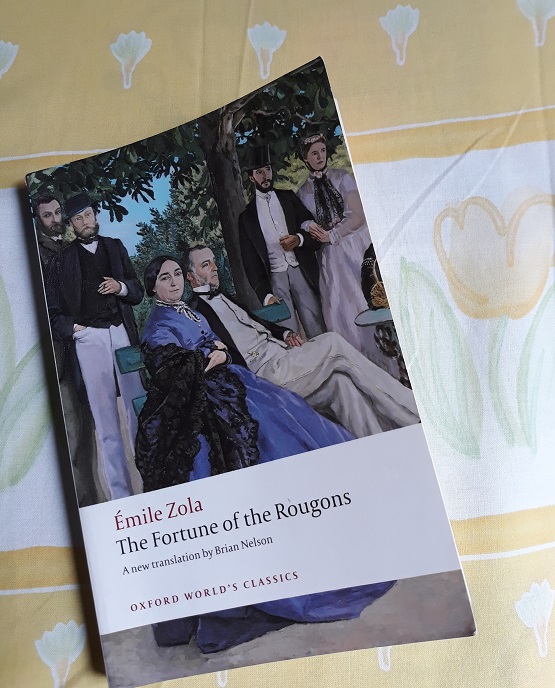
The Fortune of the Rougons by Émile Zola (second read)


o once commented on my first review, that The Fortune of the Rougons won't probably be considered great if it were a standalone novel. Its greatness lies in it becomes the first (the foundation) of The Rougon-Macquart cycle. I can't agree more. Fortune acted as the introduction of the whole cycle. From this book we get to know what Zola was aiming, which is to portray the disequilibrium of Second Empire of France, through the disordered two branched of a family: the Rougons and the Macquarts.

Basically, Fortune interweaves three stories into one frame:
1. The origin of the Rougon-Macquart family.
2. The historical account of the birth of Second French Empire.
3. The innocent love story of Silvère and Miette.

Published in 1871, Fortune takes place in a provincial town of Plassans. Adelaide Foque aka Tante Dide is an orphan girl of a merchant - a queer, nervous, imbalanced, passionate girl. She married the family gardener, the coarse, vulgar Rougon, and had a son: Pierre. However, she also had a lover, a drunkard good-for-nothing poacher: Macquart. Soon her husband and lover died, leaving her with Pierre and two illegitimate offsprings from Macquart: Antoine and Ursule.

Pierre is the perfect combination of his mother and father: crafty, ambitious, with insatiable desire. He married a local merchant daughter (though rumor has it she's an illegitimate daughter of a Marquis) Felicité Puech - intelligent, full of intrigue, envious, and ambitious. They had three sons: Eugène, Pascal, and Aristide. When their oil business didn't give them the wealth and respect they badly craved, they were full of bitterness.

In 1851, the Rougons, in the last attempt to gain respect, opened their yellow drawing room to some merchants and dealers to have meetings and discuss politics. These local conservative bourgeoisies secretly supported the monarchy as they're afraid of losing their privilege against the working class, if France continued to be led by the Republican. When the eldest son Eugène Rougon sent his parents reports about the upcoming coup d'état, Pierre & Felicité saw a brilliant way to gain fast fortune.

Antoine Macquart is almost a duplicate of his father - lazy, cowardly, alcoholic, egoist, hypocrite; while from his mother, he inherited very little - lack of discipline, and insatiable desire for pleasure and comfort. He married a hardworking and alcoholic woman, Fine, and they had three children: Lisa, Gervaise, Jean. Besides heredity influence, Zola also believed that guilty sex produces faulty behaviour in subsequent generations. The strongest result is in Antoine Macquart's family. Gervaise - we would follow her faith later in L'Assommoir - but here we get a glimpse of how she was brought up literally with drinks and by her drunkard parents. She was conceived when her parents were drunk, resulting to a delicate feature and a liking of drinks.

Ursule Macquart inherited more from her mother, than her father. She is shy, whimsical, melancholy, with sudden changes of nervous laughter and dreaminess. She married a respectable hatter: Mouret, and they had three children: François, Hélène, and Silvère. After Ursule died of consumption, Silvère lived with Tante Dide.

Fortune opens with the story of Silvère and his sweetheart, a very young girl called Miette. Theirs is an innocent relationship, almost childish. It was on the night of December 1st, 1851 - the night of the coup d'état. Together with Miette, Silvère, full of idealistic (more of a nervous hysteria, actually - inheritance from grandma Dide!) views of Republican, joined a group of insurgents which was marching towards Plassans. Fortune could be viewed as a miniature of the recorded history about the coup d'état. Louis Phillippe staged the coup; just as the Rougons, according to Eugène's secret letters, staged Pierre's heroic salvation of the city. And just as the bloody origins of the Second Empire, so did the fortune of the Rougons was paid for in blood.


As usual with Zola, Fortune is full of metaphors. In fact you would be surprised with how often the word "blood" or something represents it (red color in the flag carried by Miette and Miette's coat, for instance) surfaced from the entire story, especially near the end. The most obvious one is when Pierre and Felicité was in bed after planning their own "coup":


"They kissed each other gain and fell asleep. The patch of light on the ceiling now seems to be assuming the shape of a terrified eye, staring unblinking at the pale, slumbering couple, who now reeked of crime under their sheets, and were dreaming that they could see blood raining down in big drops and turning into gold coins as they landed on the floor."

Even Pascal, the naturalist self of Zola "could see, in a flash, the future of the Rougon-Macquart family, a pack of wild, satiated appetites in the midst of a blaze of gold and blood."

Another less obvious metaphor is how Zola described the cycle of life using "the door" built by Macquart the poacher to smoothen his adultery with Tante Dide. Dide has closed it after Macquart's death, but later on Silvére and Miette found and opened it once again for similar purpose, though theirs are pure and innocent. It represents how each generation was condemned to repeat the actions of the former. Here is a tinge of the determinism views not uncommon in 19th century.

But the last paragraph (my favorite) is the strongest of all, where Zola stroke his hammer for the last time with all his might:


"But the strip of pink satin fastened to Pierre's buttonhole was not the only splash of red marked the triumph of the Rougons. A shoe with a bloodstained heel lay forgotten under the bed in the next room. The candle burning at Monsieur Peirotte's bedside, on the opposite side of the street, shone in the darkness with the lurid redness of an open wound. And far away, in the depths of the Aire Saint Mittre, a pool of blood was congealing on a tombstone."

Another metaphor of cycle of life I found in the third paragraph of Chapter 1 - the cemetery:


"In 1851 the old people of Plassans could still remember having seen the walls of the cemetery when they were still standing, though the place had been shut for years. The earth, gorged with corpses for over a century,  exuded death... The abandoned cemetery had then gone through a process of purification every spring by covering itself with thick, lack vegetation.... After the May r rains and the June sunshine, the tallest weeds sprouted higher than the walls and could be seen as far away as the main road; while inside the place seemed like a deep, dark green sea bestrewn with big, strangely colored flowers. Underfoot, between the mass of stems, you could feel the damp soil bubbling and oozing with sap."

Life ends in death, and sometimes, death is needed to get a new life on top of it. So Zola opened the book with new life germinating from a cemetery - could the cemetery interpreted to be the dead of First Empire (after February Revolution in 1848)? Then the new stems should be the present Second Republic. Or is it the Republic that is dying, and the new life oozing from the damp soil is the germinating of the Second Empire? Either way, as with all Zola's novels, there's always hope and regeneration after each death.

In his preface Zola mentioned that Fortune, as the first of twenty novels, "could bear the scientific title Origins.” And with such a great origin, it's no wonder that The Rougon-Macquart turned out to be an epic tale of a disordered family during Second Empire of France. Or is it because I have read all the novels (except Doctor Pascal) that I can regard Fortune as great? It's true that when I first read it, I didn't see something special. It is true then what I have mentioned in the beginning, Fortune becomes great because it's an 'origins'. Hence, the title 'cycle' which we put to The Rougon Macquart. Bravo Zola!

Rating: 5 to 5

Thursday, October 31, 2019

CC Spin #21: Tarzan of the Apes by Edgar Rice Burroughs


Previous Classics Club Spin has introduced me to an interesting book – One Flew over the Cuckoo’s Nest - which I have dreaded, but glad (more relieved, actually) that I have read it at last. This time the spin brought me another surprise - a book I regarded as a romantic adventure of an ape man (I remember watching Tarzan on TV when I was a kid), but rather different than last year's, this book appeared to be more serious than just a teenage lit. Here is why…

Heredity theme

Regular readers of my blog must have been familiar with my 'obsession' with Émile Zola, and the heredity and evolution theme in his monumental works: the Rougon-Macquart cycle. Thus you can imagine how excited I was when realizing that Tarzan of the Apes is more than an entertaining adventure/love story, it is also an interesting (more interesting even, perhaps, than Zola's) analysis on the theory of heredity and evolution. A gentleman by birth, but an ape by education, Tarzan is. It is thoroughly exciting to see how he begins to realize by instinct his superiority compared to his peers, how he learns cunning tricks, how he starts making calculations and strategies, and of course, how he teaches himself to read and write, by help of books in the cabin - John Clayton's library.

Self learning

Tarzan taught himself to read and write from a shelf-full of books, which John Clayton has, thankfully, brought with him, when he and Lady Alice decided to sail to his new post in British West Africa. I can imagine, how little Tarzan spent hours in the little cabin, diligently memorizing words and syllables from picture books, until he could fluently structure sentences, though he have never heard the pronunciation. The first proof of his study was the note he stuck on the door of the cabin which was found by the group of Professor and Jane Porter, signed by "Tarzan".

Frankly speaking, this signature was where I have detected the first flaw in Burroughs' heretofore genius scientific facts in the story. Immediately I thought: if Tarzan was the name Kala and the other apes called him in their 'tongues', and he has never heard before English words pronounced, then how could he write his name as T.a.r.z.a.n ? You know what I mean? But, if it is a flaw, it is of no significance, compared to how much Burroughs has influenced and impressed us with a touching, humorous, and adventurous stories.

Man vs animal

"Being a man, he [Tarzan] sometimes killed for pleasure, a thing which no other animal does; for it has remained for man alone among all other creatures to kill senselessly and wantonly for the mere pleasure of inflicting suffering and death." How much truth there is in this sentence! How often do we boast of human's superiority from animal, that we might forget that we, human, often behave even worse than animal - above quote is the proof.

People are often picking animal for an insult or verbal abuse, or even for bullying others. So, next time someone does that to me or my friends, I'll remind him/her using above argument. Man could be worse than animal, when he chose to do so. Tarzan, as a man-beast, highlighted the good sides and bad sides of human beings. The conflict in Tarzan, between wanting to self-develop himself and being disgusted at moral corruption of his kind, is what eventually shape him to a noble character. So, real nobility is not what man is born into, but what man decides to be, when he has choices to be other than that.

John Clayton, the Lord Greystoke, and his wife Lady Alice, were the embodiment of the true nobility, and Tarzan, while being educated as and to be an ape, he also inherited this nobility from his parents. On the other hand, though he inherited human's cunning way of views from his biological parents, yet he grown up in the nature, and so, by combining these two aspects in him, he evolved to be an almost perfect human being.

Back to Nature

Tarzan is one reminder, thus, to the world, that man should have intimate relationship with the Nature to better himself. I believe that spending much time in the nature enables us to reflect on the simplicity of God's creation, and to remind us of what we were created to be, in the first place.

This book has been an easy and entertaining read, but at the same time, an unexpected one.

4 to 5


Tuesday, April 30, 2019

His Excellency Eugène Rougon by Émile Zola


Reading a political novel right after election (in Indonesia, where I live) is really not a good choice! But it's Zola, and I thought if there's any writer who could make politics - the most boring subject for me - slightly interesting, it should be Zola (he wrote about miners poetically in Germinal, after all!) I'm not entirely wrong, this sixth book of Rougon-Macquart cycle provides some enjoyable intrigues; but the rest are dry and boring. It is by far my least favorite of Zola's.

Eugène Rougon is the eldest son of Pierre and Félicité Rougon, who, in The Fortune of the Rougons has used his influence as Minister of the Republic to provide his parents with information on crucial political situations before the coup d'état in 1851. The novel opens when Eugène has just handed his resignation as Minister of the Second Empire regime, after having a conflict with the Emperor. This situation worried his political cronies, as they had hoped that Rougon could do their personal favors, using his influence. One of them was Clorinde Balbi, an Italian woman with dubious background. Clorinde knew that Eugéne was obsessed with power to control others. She shared this obsession, but unlike Eugène, as a woman, she could only work in the background. She seduced Eugène with a hope of marriage, but Eugène rejected her. Insulted, Clorinde decided to take revenge. She took side with Eugène's successor Cound de Marcy. Meanwhile, his cronies started to do lobbying to raise Eugène's popularity, encouraged by Clorinde.

The Senate in session

About this time, Eugène got an inside information about an assassination plan to the Emperor, but decided to do nothing. The plan failed, but it encouraged the Emperor to appoint Eugène to be Minister of Interior. Using his new power, Eugène rewarded his friends, and punished his enemies. But the ungrateful and greedy friends (of whom Eugène has made efforts to grant every favor) began to think he had done nothing for them, and even did harm to them. Clorinde did her best to ripen her schemes to throw Eugène down from the power, now that she has become one of the most powerful persons in the Empire, by becoming the Emperor's mistress.

This novel emphasizes how fragile and subtle the foundation of one's political entity is. To be on top, one depends absolutely on others' support and loyalty; and to buy these, one must obligingly do endless favors for them. There is no friend in politics, only supporter or enemy. Politicians are like wild animals, who, in any gathering must always keep an eye on each other; every gesture, every word, every eye contact can mean anything. People, who today support you to be on top, can dethrone you tomorrow. They can instill you with power, but can also rob you of it the minute you fail to satisfy them.


"These were the death throes of his power. Strong as he was, he was bound these idiots by all the work they had done together for their mutual benefit. As they withdrew, each of them robbed him of part of himself."

This is a novel about the hypocrisy and dynamics of political life, manipulation and cronyism during the Second Empire of France. Zola based many of his characters and events from historical facts. One of the most interesting is the baptism of the Prince Imperial. Zola captured the atmosphere perfectly as a journalist would when reporting a grand event live from the center of it. And indeed, wasn't he a journalist before he became a novelist?

While the topic might be uninteresting, Zola's style of allegorizing the protagonist's agony with the nature, as usual, spices up the story.

Here is Zola's portrayal of how the cronies have treated Rougon:

"They were all around him. They clambered on to his lap, they reached up to his chest, to his throat, till they were strangling him. They had taken possession of every part of him, using his feet to climb, his hands to steal, his jaws to tear and devour. They lived on his flesh, deriving all their pleasure and health from it, feasting on it without thought of the future. And now, having sucked him dry, and beginning to hear the very foundations cracking, they were scurrying away, like rats who know when a building is about to collapse, after they have gnaw great holes in the walls."

And here is how the weather fluctuates following Rougon's mental struggle following his last fall, and his subsequent resurrection.

[Right after the Emperor really accepted his "feigned" resignation – he must really resigned in the end – Rougon walked back to his Minister-quarter - from which he soon must move out]
"On the skyline, a storm was brewing. Below him was the Seine, an oily, dirty green coloured, flowing sluggishly between the embankments with their clouds of dust. In the garden, guts of hot wind shook the trees, whose branches then drooped again, their lifeless leaves hanging limp. He followed the path between the huge chestnuts. It was almost pitch dark. A damp heat was rising from a cellar."

"Paris, The Seine & Alexander Ili's Bridge" - 1896, Frank Myers Boogs


[At home, moved by the calmness of his wife after receiving the news]
"The storm was refusing to break. Reddish clouds filled the horizon. Huge thunderclap resounded down the Champs-Élysées. The Avenue was deserted. The thunder was like a series of cannons going off."
"By now the storm had broken. It was incredibly violent. The downpour was accompanied by heavy thunder. [..] The Champs-Élysées were now a lake of mud, yellow, liquid mud, stretching from the Arc de Triomphe to the Place de la Concorde as if the bed of a river had suddenly been drained of water. [..] In the sky, the storm had left behind a trail of tattered, coppery clouds, a low hanging, dirty mass covering the remains of the day, a cut-throat, sinister gloom."

"Les Champs-Elysees Lido Paris" - unknown


[Daydreaming about the future]
“In the miserable light of the copper-coloured sky, a procession was approaching through the slush of the roadway, on its way back from the Bois, the bright uniforms glinting in the darkness of the avenue. In the front and at the rear cantered a squad of dragoons. In the middle was a closed landau, drawn by four horses. At the doors were grooms in full gold-embroidered livery, impassive as the mud spattered them with each turn of the wheels. They were already caked in it, from their turndown boots to the tips of their helmets. And in the darkness of the closed landau Rougon could make out a child. It was the Prince Imperial looking out, his pink nose pressed to the plate-glass window, his ten little fingers spread out on the pane.”

"Bois de Boulogne" by jean Beraud


From these train of scenes, I could feel some hope in Rougon’s mind – and in whole France – of the better future of their beloved nation. And I can’t help but admiring how Zola could portrayed the Prince Imperial scene so vividly – it’s as if he has taken a photo when the landau passed the street, and he explained to a blind man, every tiny detail of the picture!

Overall, like I said before, it’s not an enjoyable novel for me, but I can’t help acknowledging how relatable it is to every nation’s political lives – and that’s why politics often disgusts me!

Score: 3,5 / 5


Tuesday, April 23, 2019

The Bright Side of Life by Émile Zola


The twelfth novel of the Rougon-Macquart cycle turned out to be the most autobiographical of Zola's. He wrote The Bright Side of Life when he was 44 years old, and was in one of his much mental instability cases caused by the death of his two friends – one of them was his mentor: Gustave Flaubert – then followed by his mother's. From age 30, Zola too has been suffering from necrophobia (irrational fear of death) and obsessive-compulsive disorder. From these few facts, you know what's to expect from this novel. Despite of the original title: La Joie de Vivre, there's also a balanced dose of pain and sorrow. In fact, The Bright Side of Life is all about paradox: life force vs death, health vs pain, optimism vs pessimism. But Zola's true aim is that optimism must counterbalance pessimism, which was spreading in France when he wrote it.

Our heroine this time is Pauline Quenu, the daughter of Lisa Macquart and Quenu (from The Belly of Paris). She is, perhaps, the most mentally-stable member of the Rougon-Macquart clan. From the first, Pauline is a cheerful, hopeful, loving, and persevering young girl. Whatever her condition is, she always brightens her surroundings, spreading positive vibes around her. Pauline was orphaned after Lisa's and Quenu's death. She was adopted and lived with Chanteaus family on the seaside village called Bonneville. She tended her uncle Chanteau, who suffered from gout, with extra tenderness. And with Lazare, her cousin, Pauline often played outdoor near the seaside. Now Lazare was Pauline's opposite. He was gloomy and pessimistic, and gradually it became clear that he suffered from obsessive-compulsive disorder. He had an obsessive fear of death (necrophobia) – yeah, he is Zola’s embodiment in this novel – and he could never settle his mind on anything. Despite of their huge age difference and character difference, Pauline and Lazare were attracted to each other.

Pauline inherited a large sum of money from her parents, and from the first Madame Chanteau insisted that she would keep the money intact in the drawer at her desk until Pauline come of age to manage it herself. However, with Lazare's incapability to earn money, Madame Chanteau began to borrow Pauline's money for daily household, which the girl was always too pleased to lend. Then Lazare would come up with an idea which he believed will make the family rich, but had no money to fund it. Pauline would lend her money for capital, of which the Chanteaus made sure of returning after Lazare's success. He failed eventually, the money evaporated, and the pattern repeated over and over again! Madame Chanteau, out of her shame and indignation of "begging" from her niece, eventually just took the money without consulting Pauline. Moreover, she shut down her conscience by turning the blame to Pauline. She made herself believed that Pauline has brought bad influence to the family, and began to treat Pauline with hostility. On the face of all this, Pauline felt sad, but persevered and maintained her loving and cheerful manner. Pauline and Lazare were about to be married (Madame Lazare's genius idea of legally robbing Pauline's money), but one day in came a sophisticated town girl called Louise, whose femininity attracted Lazare. So now, it's not only her money, they robbed her of love too. She has sacrificed everything for the happiness of others, yet she was treated badly.

"Le Joie de Vivre" copy in Van Gogh's "Oleanders" - 1888


I have been wondering through the story, why Zola titled this book the joy of life, while it is filled with sorrow and pain – Pauline's heartbreaking is nothing compared to Louise's suffering in her greatly painful labor (Zola pictured it too vividly, that I felt my stomach ached only to imagine it!) So, where is the "joy"? I think this is the most philosophical novel from Zola which I have read so far. It takes us to reflect upon life and its meaning. Why must we continue living and persevering if at the end death is inevitable? Is life all sorrow and hopeless, then? Through Pauline, Zola wanted to raise France from its pessimistic slumber. Life might not be full of joy, but the joy of life is in life itself – being alive, having survived through perseverance in one's daily routines, sharing, loving and sacrificing for others' happiness, that is the joy of life! That is humanity. I loved how Zola symbolized Pauline’s emotional struggles with another “living character” of this book: the sea! When Pauline is happy, the sea is calm and beautiful, but when jealousy outburst (the only family-inherited “flaw” found in Pauline) violently shook her, the sea, too, became dark, raging, and turbulent.

In a way this novel is very Zola, but at the same time, it's very un-Zola – in term of the writing style. You won't see any of his usual exaggerated (or as I prefer to call it: intense) narrative. It was actually Zola's intention from the beginning to create a "simple" story. "This is the novel I want to write. Good, honest people placed in a drama that will develop the ideas of goodness and pain. Then, it will all be down to how it is written. Not my usual symphony. A simple, straightforward story. Environment still playing its necessary role, but less to the fore; description reduced to minimum. The style direct, correct, forceful, without romantic flourishes. The kind of classical language I dream of writing. In a word, honesty in everything, nothing dressed up." ~Zola's preliminary sketches of this novel. To be honest, I rather miss his “dressed up”, powerful, intense style – a quality I rarely found combined with beautiful prose in any other writers. Nonetheless, it’s one of the most honest books I’ve ever read; it’s OUR lives, OUR journeys, and OUR struggles.

My score: 4 / 5

Tuesday, April 17, 2018

A Love Story by Émile Zola


Une Page d'Amour is the eight novel in Rougon-Macquart series, if you follow Zola's recommended order of reading. Helen Constantine titled this new translation published by Oxford World's Classics with A Love Story, instead of 'an episode of love'—the closest translation to Zola's original title—because she found that this book is not only about love affairs, but also represents Zola's love for Paris.

Hélène Grandjean (nee Mouret) is the daughter of Ursule Mouret (nee Macquart)--the illegitimate daughter of Aunt Dide (the matriarch of the Rougons and the Macquarts – The Fortune of the the Rougons). After her husband's death, she lives tranquilly with her sickly 7 y.o. daughter Jeanne. Their neighbors are a young Doctor Henri Deberle and his wife Juliette. Henri attends Jeanne when she's having a seizure. She is believed to suffer the 'hereditary lesion' as was her grandmother (Aunt Dide). A sexual passion then starts slowly to grow between Hélène and Henri.

On the other hand, an Abbe Jouve and his respectable but boring brother Monsieur Rambaud are regular visitors to Hélène's home. The Abbe has at first advised Hélène to remarry with M. Rambaud to protect her honor, but a passionless marriage—just what she had had with her late husband—does not interest her. One day, Hélène learns that Juliette Deberle too—as is many other women—is having an affair with another man. That encourages her to finally give up her modesty, and gives herself to Henri. Is that all? Of course not! It's just the beginning of an impending doom.

As I said earlier, this novel is not all about love story or love affairs. Two things have intrigued me during my reading. The first is Jeanne. She seems to share her mother's growing sexual tension. She becomes more and more suspicious and jealous on Doctor Deberle, and even feels ashamed and humiliated when the doctor saw her naked breast. And she is tormented during her mother's love making with Henri. She seems to know what is going on with the two lovers, and her anxiety grows parallel with the growing intensity of her mother’s passion.

Then, there was also the parallel between Hélène’s emotional condition and her views of Paris. Hélène lives in a suburb called Passy. From her bedroom window, she has a complete view of Paris. She and Jeanne love to stand by the window to look at and adore the city. There are a lot of passages where Zola described (or literally painted) the panoramic view of Paris. At first I thought it’s his passion for Paris that drove Zola to capture it in different conditions (sunshine, raining, starry, or blazing). But along the chapters, I began to realize that the current condition of Paris correlated with the current level of Hélène’s emotion. When her sexual desire began to kindle, Paris began also to ablaze with lights. That was just remarkable! I found an interesting piece from the Introduction (by Brian Nelson) about this: “[following Freud] …that a dream-landscape is most often a representation of the sexual organs. The female sexual connotations of the landscape are plain:  the focal centre of the city is the Seine, with Paris seen as an immense valley. The violence of the storm as it sweeps across the city matches the phallic significance of the Panthéon, in which Jeanne momentarily imagines her mother to be…

So… what is this novel really about? That’s my direct question after finishing it. I can only guess that it is a kind of psychological study on love and sexuality—how it grows, and many variations of it (I think Rosalie-Zéphyrin’s relationship serves as the opposite of Helen-Henri’s—the healthy v passionate relationship?) Or, is it a critic against the hypocritical bourgeoisie, who ‘condone’ a married woman of having love affair, but ‘condemn’ a widow of having done the same? Either way, this has been an interesting reading. Not my favorite, perhaps, but it’s still beautiful, as always…

My rating: 4/5

Wednesday, January 11, 2017

The Conquest of Plassans

Finally...another masterpiece from Zola! One of those that blow your minds.

The Conquest of Plassans follows the faiths of Marthe Rougon (daughter of Pierre and Felicité Rougon in The Fortune of the Rougons) and François Mouret (son of Ursule Macquart and a drunkard called Mouret—also depicted in The Fortune). They live peacefully with their children in a little town of Plassans, almost a perfect happy family. But one day Mouret has an idea to rent their second floor to a priest. Without their knowing, when Abbé Faujas arrived with his mother, the faiths of the Mourets have been sealed.

Little by little Faujas and his family—later on his sister and brother in law also live there—conquer Mourets household, just as Plassans being conquered by the Abbé. It all comes gradually, subtly, but cunningly, that no one realizes it until it is too late.

In this book Zola played a lot in psychological field, that is the process of madness. The seeds are already there by heredity, but it needs one trigger for it to start the process. I wonder, if someone with hereditary madness is living always a steady and peaceful life—thus never meets the trigger—could he or she be spared from the madness?

This book is very entertaining. What I like most is the way Zola patiently building the momentum. He let us know where it is going, yet we don’t know how or where it will end. And when the momentum came, it’s just…WOW! I savored the chapter of the madman very slowly, reading every sentence twice, and at the end it felt like I have had the best dinner in my life.

It was not the last chapter though… After so satisfying a chapter, I thought the last one would be slightly anti-climax (pardon me, M. Zola, for not trusting you completely!). But… lo and behold, the last sentence was absolutely unexpected. That was just brilliant! In the end I am so glad I can open this year with so nice reading experience. Again…. merci beaucoup Monsieur Zola!


Tuesday, September 15, 2015

The Fortune of the Rougons by Émile Zola

Finally I can get to where the Rougon-Macquart series starts: The Fortune of the Rougons.  The Rougon-Macquart is Émile Zola’s monumental study on heredity effect on human. He illustrated it in twenty novels about two families during French Second Empire. It all begins with Adelaide Fouque, an eccentric woman with mental illness who lives in Plassans (fictional town). She has one legitimate son from her marriage with a hardworking peasant: Rougon; and one illegitimate son and one daughter from the lazy and alcoholic poacher: Macquart.

Although growing up together with their mother after the fathers died, Pierre Rougon—being the legitimate child—feels superior to Antoine and Ursule, the Macquarts. Pierre’s fortune comes from the combination of clever and cunning maneuvers, while Antoine is too lazy to earn his living. Throughout the story, the two stepbrothers keep competing each other. On the other hand, Ursule marries a quite respectful man called Mouret. Her son, Silvère, lives with his grandma Adelaide. Apart from the eternal hostility between Pierre and Antoine, Silvère’s pure love for Miette. Pierre’s sons also contribute to the story, mainly through the trio Eugene the Napoleon’s intelligent, Aristide the left journalist, and Pascal the doctor and scientist. I believe Pascal represents Zola himself, the naturalist who was fascinated with how hereditary flaws could be descended to generations through families.

But what balances the disgusting acts of the Rougons and the Macquarts, is Silvere and Miette’s naïve love and heroism. The others’ greed to steal what they can from the coup d’etat, is counterbalanced by the young couple’s patriotic, though rather blindly, love for their republic.

The Fortune turned out to be quite entertaining story—much better than what I’ve expected. Its naturalism theme is distinguished here, as Pascal’s observation of the people is really Darwinist. And most interestingly, this book laid the foundation for the whole Rougon-Macquart series.

Four stars for Zola!

~~~~~~~~

I read Oxford World’s Classic paperback

This book is counted for: