Showing posts with label Indonesia. Show all posts

Wednesday, November 19, 2025

Genderang Perang dari Wamena (1972) by Djokolelono: An Indonesian Children Fantasy #NovNov25


πŸ₯ I have unexpectedly found this treasure while idly browsing through Google Playbook titles. It's a children fantasy novella by an Indonesian writer: Djokolelono. It has never been translated, so if you don't understand Indonesian, I can give you only my loose translation of the title. Genderang means drum; perang is war, and Wamena is a district in Papua. The story is told from point of view of two eleven-year-old boys: Adi and Yun (short of Yunanto). It's not clear where they live, but it is set in the 1970s. My guess is that they live in a small town. Adi has been living in the Netherlands; his father worked in a Dutch museum, and the family have only recently moved permanently to Indonesia. 

πŸ₯ Yun is playing at his new friend Adi's, and it is a gloomy rainy day. They can't play outside, so Adi suggests they rummage at the backyard shed. One might find interesting stuffs in the shed - don't we know it! And they do! Opening a box in which Adi's father kept stuffs from the museum, they found a little drum. It's a traditional music instrument from Papua which is usually called tifa. Playfully one of them starts to beat it, and a strange thing happens. The player can't stop beating the drum, his hand goes faster and faster, while the other can't stop dancing on the tune. Then a white mist fills the shed, and the shed suddenly turns into a jungle. The boys are time-travelling to the jungle of Wamena in Papua, in the 18th century, following a Dutch expedition consisting of four white men and some locals.  

πŸ₯ One of the Dutch men who was called Tristan van Allen, had stolen a drum, or tifa, a precious thing belonging to the chief of the tribe. The expedition leader told him to return it, as it would put the whole expedition in danger, but Tristan was adamant. Adi found from his father that the tifa came to his possession after being found years later by another group visiting Wamena, while the faith of the expedition itself was never revealed; they had just vanished. And now Adi and Yun are about to solve the mystery, as the tifa slowly reveals its history whenever the boys playing it. But it's not just a mystery, there's something menacing inside the tifa....

πŸ₯ It was an exciting adventure to read! I kept forgetting that Adi and Yun are just elementary school students, they somehow sound more mature to me - like 17 or 18 years old boy, perhaps? Anyway, I was more interested in their one quarrel (the tifa foreshadows what's about to come; on the day the expedition members quarreled for instance, Adi and Yun quarrel too). The topic is about Dutch colonialism over Indonesia. Yun is expressing his hatred to the greedy Dutch, but Adi, who had been brought up in Netherlands, is saying that not all Dutch people are greedy, and that colonialism happens only when the locals aren't smart enough to detect their false politeness. This infuriates Yun, as his friend's implying that Indonesian are dumb. Well, I couldn't but pondering a lot about it afterwards, because it makes sense. And why the writer put it as the cause of quarrel? It might be a boyish quarrel (they are friends again the day after), but that was too serious a topic for a children read, don't you think? Anyway, this has been a fun read for me, and I can't wait to read more of the series. This novella is the sixth book from Weird and Wicked series, by the way.

Rating: ⭐⭐⭐⭐


Read for:

hosted by Cathy and Rebecca


Wednesday, August 28, 2024

The Black Lake (Oeroeg) by Hella S. Haasse (1948) #WITMonth


πŸ–€ The Black Lake was first published anonymously in 1948 as Oeroeg. It was the Dutch author Hella Haasse's first novel, and was translated to English by Ina Rilke. Set in Indonesia during Dutch colonialism in 1940s, Oeroeg is a story about childhood friendship gone sour over political and ideological differences.

πŸ–€ The narrator (his name was never revealed) is a white boy, son of a Dutch Indies plantation manager in Sukabumi, West Java. He was born in Indonesia, and being an only child, his only playmate is Oeroeg. Oeroeg is a native boy, the same age as the narrator's. He's the son of the plantation's mandor (leader of the workers). Despite of their totally different backgrounds, the two boys spent their childhood together and were quite inseparable.

πŸ–€ Then an accident happened, triggered by the drunken and irresponsible white men led by the narrator's father, whose reckless amusement on board of a inadequate raft on the Black Lake, caused the raft fell apart. Oeroeg's father died while saving the narrator's life from drowning. Because of that, the narrator's father sent Oeroeg to the same school and boarding house as his son. The seeds of disruption began at this point.

πŸ–€ Oeroeg began to realize his inferiority from other students. He began to try imitating the white's style and seemed to be ashamed to be a native. Despite all that, the two students still studied and hang around together, though not as closely as before. The consciousness of the gap laid between them has finally dawn upon these adolescents.

πŸ–€ Graduated from secondary school, the narrator was sent by his father to study in Dutch. This was the last straw of their friendship. While he's away, huge things happened. Indonesian youths began their resistance movement against Dutch colonialism; the narrator joined the army during World War II; and Oeroeg joined the Indonesian nationalist to fight for the nation's independence. When the narrator happened to return with the Dutch army to Sukabumi, everything has changed so drastically. He no longer found it the home he used to be rooted to, and most of all, he lost his best friend Oeroeg....

πŸ–€ I found this novella quite thought-provoking. Growing up often means restricting our heart to so many rules and ideologies, that we often forget the human being underneath these thoughts. My heart ached over Oeroeg and the narrator's last scene. I understand Oeroeg's hatred towards the nation that had caused sorrows to his people. But how could he forget the one friend that at one time had shared his happiness?

πŸ–€ I'm also wondering the roots of Indonesians' inferiority complex towards Western people. Is it a characteristic that is attached to our people? And made us so easy to be colonized by the European for centuries? Or is this character the result of centuries of colonialism? After more than 70 years of our independence, Oeroeg's behaviors still reflect on our modern people - trying to be identified as European, but also hating the Western.

πŸ–€ All in all, this is an intriguing bildungsroman of friendship and identity searching, set in a turmoil era of colonialism, and loosely based on the author's experience of growing up in West Java during the same era.

Rating: ⭐⭐⭐⭐⭐

Read for:

Women in Translation Month #WITMonth
hosted by womenintranslation.org


Monday, February 19, 2024

Cigarette Girl (2012) by Ratih Kumala #IndonesianLit


🚬 I'm proud to say that Cigarette Girl is the best Indonesian historical fiction I've read so far. A highly entertaining story with good plot and pace. Most importantly, it is unpretentious, unlike most of others in the same genre from the same country. This is my second read, and I enjoyed it as much as before.

🚬 Whether we, Indonesians, like it or not, cigarette is always part of our culture. For me personally, the aroma of tobacco sticks to my memory. It is something I grew up with. My late father was a smoker until many years later when he stopped smoking. The tobacco smell coming from my father's body or clothes always associated to me the sense of love and protection. No matter how hard life is, it will be okay because my father will there for me. God, how I miss those feelings right now! Nowadays people might condemn cigarettes as silent killer etcetera, but I always have a soft spot for cigarettes, tobacco, and cloves. But enough about me, now about the story itself.

🚬 Tegar, Karim, and Lebas are the offsprings of a wealthy cigarette business owner Soeraja. They are summoned home as their father is dying. Unexpectedly, on his death bed, Soeradja mentions a woman's name they've never heard of, but enrages their mother: Jeng Yah ("Jeng" is a respectable address to a woman, similar to Ma'am). Who is Jeng Yah? And why does their father want to meet her? The brothers decide to solve the mystery and look for the answer by taking a trip to M town, where it all began.

🚬 Parallel with the present line, Ratih Kumala brings us to the past. It all began in the early 1940s when the Dutch was still colonizing Indonesia. A visionary ambitious young man called Idroes Moeris was working as a cigarette roller, but longed to produce and sell his own cigarettes. His time came when the Japanese arrived in 1942 and confiscated Moeria's boss' belongings. Fortunately the boss still keep some cloves and tobacco in stock, which Moeria then bought for his first venture in cigarette industry.

🚬 Soedjagad was Idroes Moeria's colleague, and close competitor, not only in stealing the heart of a pretty girl called Roemaisa - daughter of a scribe - but also in buying the boss's cloves. Roemaisa rejected Soedjagad's proposal because she fell in love with Moeria; and we know who eventually got the cloves. These brought bitterness to Soedjagad, and from then on he was like a thorn in Moeria's flesh, a shadow that shrouded his life.

🚬 Both competitors thrived as two big cigarette industries, but Moeria was always leading with his genius business inventions and good taste in concocting delicious sauce for his clove cigarettes. Soedjagad, meanwhile, was always copying his ideas, but lacked Moeria's secret recipe of the sauce. But it would all change in the hand of their successors.

🚬 Moeria and Roemaisa had two daughters. The elder one is the most beautiful and intelligent. Her name is Dasiyah, but people called her Jeng Yah. The enigmatic Jeng Yah. Dasiyah inherited her father's knack of cigarette making, and was soon entering the industry. How did she meet Soeraja, and what happened then, is an engaging mystery to unfold!

🚬 What I liked most from this book is how Ratih Kumala alternately and proportionally tells the story from the point of view of characters from both the past and present, and was able to connect them so seamlessly, yet we still distinctly perceive the time difference. It is equally amazing how she could explore each character - present and past - beautifully in just under 300 pages.

🚬 I love mostly the portrayals of the three Soeraja brothers. Tegar was made the heir from childhood, but envied his brothers for happily living their childhood, while he was forced to learn about family business. Lebas, the laid-back child, on the contrary, envied Tegar for being with their father all the time, while he and Karim played together alone. And Karim, the calm trustworthy Karim, who later becomes the mediator between the two opposite-pole of his brothers, is satisfied to work for their family business. Lastly I'm satisfied with ending, with the way the three brothers react to the revelation of Jeng Yah and their family secret history.

🚬 On the whole, it is a story about two most important events in Indonesian history: Japanese occupation which led to independence proclamation in 1945, and the 1965 genocide. They are nicely presented through the intricate stories of love and jealousy, ambition and struggles, business intrigues and betrayals, as well as the interesting history of clove cigarettes industry. Cigarette Girl has also been made a Netflix series, currently playing. I haven't had chance to watch it (some people had recommended it), but I'm pretty sure that the book, as usual, would be much better.

Rating: ⭐⭐⭐⭐⭐

Read for:


Monday, May 8, 2023

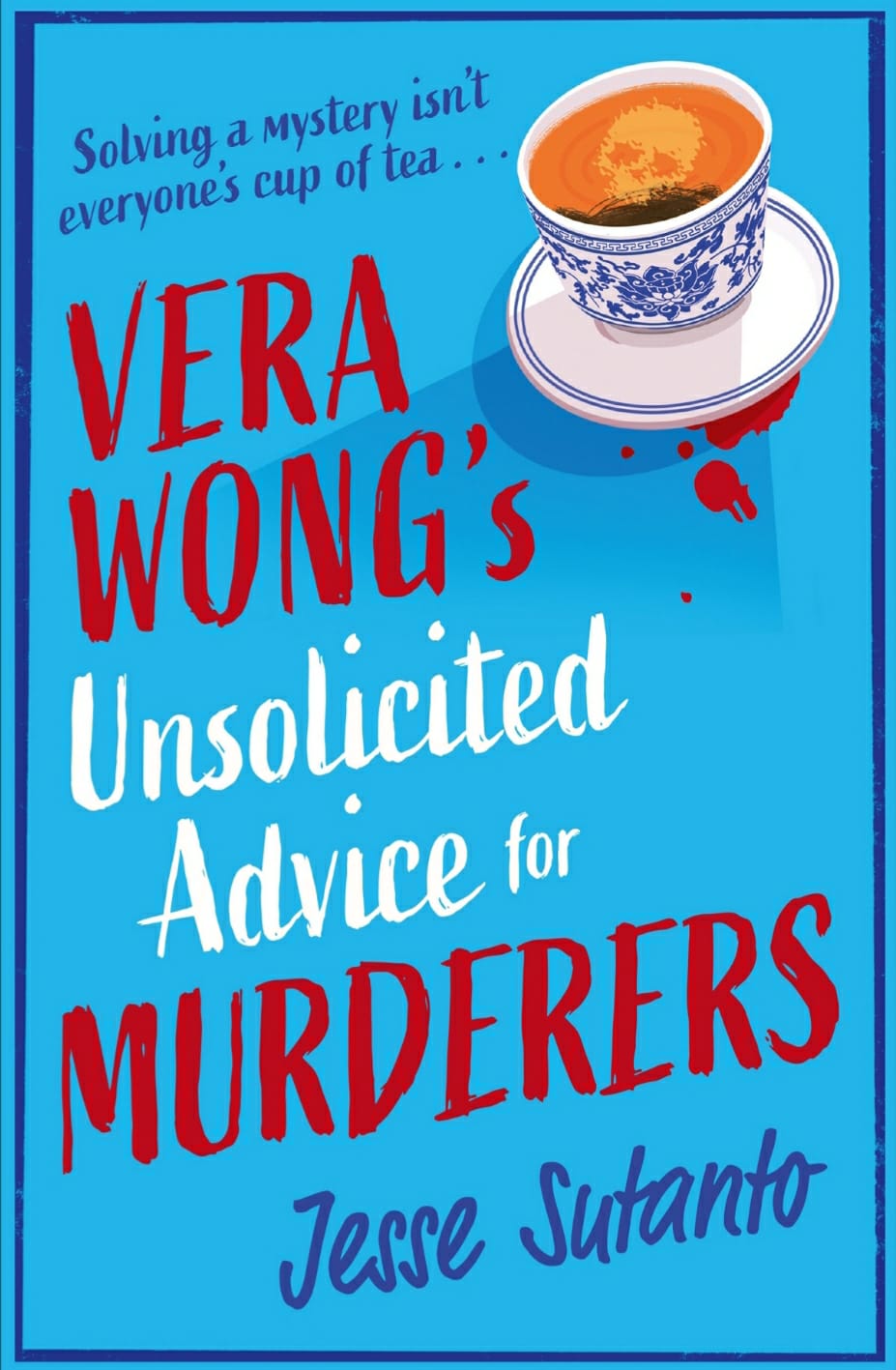
Vera Wong's Unsolicited Advice for Murderers by Jesse Q. Sutanto: A Cozy Mystery


"Vera Wong Zhuzhu, age sixty, is a pig, but she really should have been a rooster. We are, of course, referring to Chinese horoscopes."

πŸ’š With that first line, I was instantly hooked to this cozy mystery by Jesse Q. Sutanto, the first ever of the genre from an Indonesian writer (that I’m aware of). Moreover, I, too, am a pig - still referring to Chinese horoscopes, mind you. I am what people call Chinese-Indonesian - though my Chinese part is certainly very small in proportion. I even have a proper Chinese name, though I never use it, nor people ever call me by that name. Sharing the same Chinese horoscope to Vera Wong, added my enthusiasm to read this mystery. It is guaranteed to be relevantly funny too, judging by that first line!

πŸ’š Vera Wong lives in the Chinatown of San Fransisco. She owns a tea house: VERA WANG'S WORLD FAMOUS TEAHOUSE. I wasn't mistyped Wong to Wang, neither did they who made the sign board. Vera had conveniently (and deliberately) put the famous designer's name for her tea house! Cheeky old darling, isn't she?πŸ˜‰

πŸ’š
Vera is a bold, brave, disciplined old woman who lives alone up her shop, after her husband Jinlong died and her only son Tilly (Tilbert) moved out. Her business nowadays is decreasing, only one of her customers, Alex, loyally comes to enjoy Vera's special concoction almost every day. Vera always knows which leaves her customers need in every situation.

πŸ’š One morning as she went downstairs to open shop, she found a dead body of a stranger lying on the floor! But don't worry, Vera has watched enough CSI series that she knows what to do. She didn't touch the body at all, well... maybe only a tiny inch when she's taken the flash drive from it?... And while waiting for the police to come, she even drew a mark round the body as the police always do (again from CSIs she's watched). But when the police came, they said it's just an accident and even throw her out of her own house. Vera was adamant, as she's sure it's a murder! First there are scratches on the man's face, then there's the flash drive - but this she didn't mention to the police! Alright, as the police can't do it properly, she determined that she, Vera Wong, will solve the murder herself!


πŸ’š Vera knew that murderers usually return to the crime scene to make sure they didn't left traces. So, she waited patiently in her tea house. And sure enough, one by one they came - all with different 'motives'. “Here they come - my four suspects!” - thought Vera. They were Riki Herwanto, Sana Singh, Oliver Chen, and Julia Chen with her cute little daughter Emma.

πŸ’š The dead man, Marshall Chen, was, apparently, a scoundrel. Little by little, through her soothing tea concoctions, delicious foods, and warm heart, Vera managed to - not only unfolding each suspect's involvement with the dead man - but also to make them feel loved and accepted. They grew fond of each other in no time - especially Riki and Sana (ahem), and Oliver and Julia (who were Marshall's brother and wife, respectively). The four of them had one bond: one way or another, Marshall had, separately, manipulated them. And Vera slowly becomes like their mother or grandmother, with whom they can tell everything, struggles and all. And Vera always knows how to cheer them up and bring them new hope.

πŸ’š It's not an easy task for Vera to do her job well. How could you put four lovely people into suspects when you loved them like family? But Vera Wong wouldn't budge, not even when somebody ransacked her tea house!

πŸ’š This is a jolly hilarious cozy mystery, with a depth of humanity. It's heartwarming with love and friendship, and... there're numerous feasts of mouthwatering dishes, which reminded me of my grandmother. Whenever we came to her house, there're always at least four or five different dishes at the table. It's just the ordinary Chinese family meals.

πŸ’š How about the murder mystery? It's not disappointing. You would or wouldn't guess the murderer, but it is a bit of a twist, and the ending is satisfying. I loved the book so much, and earnestly hope Vera Wong would investigate yet more murders to come! She might possibly be, considering that Warner Bros. TV has just acquired this book rights, with Oprah Winfrey's and Mindy Kaling's production houses to produce a TV series! Yay to Vera Wong, and bravo to Jesse Q. Sutanto!

Rating: 4,5 / 5

P.S.
Which cover you like most? My e-book copy has the blue one, but I think the black one with an old lady peeping through the blinds is more adorable, and somehow fits the book. And in the blue one, the writer's name is missing 'Q', which is rather annoying.

Wednesday, March 15, 2023

Ronggeng Dukuh Paruk (The Dancer) by Ahmad Tohari: An Indonesian Classic


πŸ’ƒπŸ» Srintil and Rasus, our protagonists, were born and grew up in a small village in Indonesia called Dukuh Paruk, which, geographically, is quite isolated. It can only be reached from the outside by traversing the network of dikes bordering the wet rice fields. This isolation, I believe, has contributed to the illiteracy, poverty, obscenity, and superstition of its people.

πŸ’ƒπŸ» Set in the year 1950s-60s, Dukuh Paruk's pride is in their Ronggeng. Here's my previous post where I talked about Ronggeng and its little similarity with Geisha. They believe that when a Ronggeng spirit inhabits a little girl, she is destined to grow up as a Ronggeng. Srintil is this little girl. She loves to sing Ronggeng songs while playing with a boy called Rasus, her best friend. Like her, he is also an orphan, due to a tragic poisoning case which took their parents' lives. Becoming a Ronggeng, thus, is Srintil's obsession, though without fully understanding of what it truly is.

πŸ’ƒπŸ» Rasus, on the other hand, longs for a mother's affection. He's often wondering how his mother looks like, and innocently he took Srintil as the perfect image of a mother he never knew. When Srintil is 11 years old, it's time to initiate her to be a Ronggeng. The initiation includes a rite called 'Bukak Klambu' (freely translated as opening the mosquito net, which is usually hung around the bed). In other words, it's when her virginity is sold to the highest bidder.

πŸ’ƒπŸ» This rite enraged Rasus - not so much because he cares about Srintil, but more because it shatters the image of his unknown mother, which he hitherto portrays in her head like Srintil. He left Dukuh Paruk - but not before having sex with Srintil, as she has rather offered her virginity to him than to the highest bidder of Bukak Klambu. Not a proper gentleman this Rasus man, I know.

The Ronggeng dance in the adaptation of Ronggeng Dukuh Paruk, 2011


πŸ’ƒπŸ» 1960s marked a dark turmoil in Indonesian politics, as I have slightly alluded in previous post. Rasus becomes a soldier, while Srintil becomes a famous Ronggeng of Dukuh Paruk. When she doesn't perform on stage, she receives men who wishes to have sex with her, all arranged by an old couple who serve as Srintil's agent slash pimp.

πŸ’ƒπŸ» Due to Dukuh Paruk people's ignorance, Srintil is unwittingly involved in the revolutionary's event. Srintil and her group were caught and imprisoned, accused of being supporters of communist party, while their village was burnt down. The imprisonment itself is already bad, but not as bad as the label then applied to ex-political prisoners after they were released. They were banished from society, and viewed as the main cause of the tragedy, though many of them, including Srintil, didn't even understand what it was all about.

πŸ’ƒπŸ» The imprisonment changed Srintil's view of life considerably. She refused to perform as Ronggeng, as well as serving men. Instead, she's inspired to be an ordinary but respectable house wife. Rasus' return to Dukuh Paruk (now a respectable soldier) provides a new hope in Srintil. Not only her, all Dukuh Paruk people fervently hope they will eventually marry, and thus help reviving their village. But no, marriage isn't Rasus' inclination, though there's no doubt that he loves her still.

πŸ’ƒπŸ» After Rasus, came Bajus, a polite handsome young man from Jakarta. He pays attention to Srintil, and gentlemanly paying court to her. Now he is Srintil's last hope. He will prove to be, either her great salvation, or the crushing blow to her already battered soul.

πŸ’ƒπŸ» Ronggeng Dukuh Paruk quite surprised me. I didn't expect to love it, though had been rather intrigued by the Ronggeng theme (I have thought it's about dancer, never expected to be disgusted by prostitution!) Political tragedy is not appealing to me, nor the grossness of most of Dukuh Paruk people. The only thing that made me keep reading, though, is Tohari's poetic prose and his beautiful portrayal of the rustic village landscape. I was transported to the peaceful and calm life in the village, to the sounds of birds, the shady trees, or the melodious music of traditional instruments. It's a perfect portrayal of a humble small village, before the touch of modernization enters it.

πŸ’ƒπŸ» I officially crowned Ahmad Tohari as one of the best Indonesian writers I've read so far. Many people worship Pramoedya Ananta Toer perhaps, but I have read two books of him, and don't quite agree. He was a good story-teller, but rather melodramatic and sometimes exaggerating. While Tohari's prose is perfectly proportional; brutally realistic, not overwritten, but beautiful at the same time. Ronggeng Dukuh Paruk has been translated to English by Rene T.A. Lysloff, titled “The Dancer”, and published by Lontar Foundation in January 2013.

Rating: 4,5 / 5


Sunday, March 20, 2022

Orang-Orang Bloomington (People from Bloomington) by Budi Darma


πŸ”·️ Budi Darma is one of Indonesia's prominent modern writers. He graduated with an MA from Indiana University Bloomington in 1976. His experience and observation during his college days are the inspiration of this collection of seven short stories, titled Orang-Orang Bloomington, or People from Bloomington in English. Now Penguin Classics is translating this book in English, and it is due to publication in April.

πŸ”·️ Orang-Orang Bloomington is a realist book, tinged with absurdism in several of the stories. Though all of the stories are told from an anonymous narrator's point of view, it is clear that each has its own narrator (or at least there are more than one narrator). Nevertheless, they seem to have some similarities in personal character; they are all inquisitive and lonely. Indeed, loneliness seems to be the single theme that connect all the stories.


πŸ”·️ First story: The Anonymous Old Man (Pak Tua Tanpa Nama) sets this tone for all the rest. Residents in the houses and apartments are mostly individualists who lack touch of human compassion; they mind (too much) their own businesses, full of cold suspicion and prejudice, and some, even, have violent temperament.

πŸ”·️ The narrators aren't perfect either. The one in Joshua Karabish, for example, shamefully claimed his dead friend's poems as his. Another in Keluarga M (M Family) cowardly attacked a small boy in burst of rage after his car was scratched at the parking lot. But the worst is probably the narrator in Orez - it's way too cruel for me, though the one in Ny Eberhart (Mrs. Elberhart) is no less heartless either - bullying an old woman?! Though in the end they realized their mistakes and perhaps felt sorry, it's only a silent proof that the society of Bloomington (which represent our own modern society) aren't okay - there's a latent hatred and evil hidden beneath our struggles in life.

πŸ”·️ My favorite of all is the first story. The last two or three stories are too absurd for my taste, and the last one - I felt it inconclusive. I really admire the crude beauty and poignancy in Budi Darma's writing (he reminds me of John Steinbeck - but Steinbeck's is way more eloquent), but not his absurdism side.

Rating: 3,5 / 5

Monday, February 11, 2019

This Earth of Mankind by Pramoedya Ananta Toer (An Indonesian Clasic)


Finally, I came to read this book which is considered one of the highest achievements in Indonesian literature. Set in the end of 19th century during Dutch colonialism in Indies (Indonesia), this book highlights the injustice imposed upon Indonesians (particularly the Javanese) by the Dutch for three and a half centuries.

Before continuing to plot summary, let me explain first about the ladder of social status at the time. On top, of course, was the Pure Blood - Dutch or other Europeans who lived in Indies. Below them was Indo - children who were born from European and Native (most are illegitimate); while the bottom are inhibited by the Natives. These statuses set their rights in all life aspect, from education, cultural, to legal.

Pramoedya Ananta Toer, who first 'wrote' the story orally to fellow prisoner when he was a political prisoner by Indonesian government, told the story from Minke's perspective, a Javanese - thus a Native. Descended from a prominent family with royal blood, Minke was able to study in H.B.S (the Dutch school), which at that time were exclusively attended by Europeans or Indos. One day he met a proud and remarkable woman: Nyai Ontosoroh. Nyai means Native concubine of a Dutch man. When she was a young girl of fourteen, Nyai Ontosoroh was sold, without her consent, by her father to Herman Mellema, a Dutch businessman. Her Humiliation encouraged the Nyai to passionately teach herself of science, business, and literature, under the guidance of Mr. Mellema. She soon became a cultured and intelligent woman, far superior even from any European or Indo women.

Minke was impressed by this enigmatic woman and her wisdom; and from his frequent visits, he soon fell in love with Annelies, the daughter of Nyai Ontosoroh and Herman Mellema. Through his study at H.B.S. and his involvement with the Nyai, Minke became an open minded person. He believed more and more in the equality of men; and unlike most Natives (including his own family), he was bold and confident towards Pure Bloods or Indos; whereas before, he had a slight inferiority towards his school buddies or teachers. Minke also proved that he was a good writer. His future seemed bright, especially after marrying the beautiful Annelies. Now he had everything that others could only envy.

Nyai Ontosoroh & Annelies - from the upcoming movie
this year


Then a tragedy came, and like a snow ball, it shattered and smashed all the liberal people's lives and hopes, one by one. Annelies, that poor fragile woman, must endure the pain of being separated from her beloved husband not long after their marriage. And although their marriage was authorized by Islam law, it was later considered illegal by Dutch law. Their lives and happiness were torn apart by a mere piece of legal paper authorized by the colonial government. As much hope as Minke and the liberals have ever put for a better future of the Natives, this tragedy reminded them of their complete helplessness under the colonialist. This Earth of Mankind criticized the abuse of humanity because of ambition, arrogance, and greediness of the colonialist; because one nation regarded itself higher than others. 

This book might not be my favorite, but it struck me of how far the colonialism had shaped Indonesian character as a nation today. We have had our independence 74 years ago, but most of us are still so much alike the Natives in this story: the inferiority towards European (or foreigners), the laziness, the ignorance, and shallow-mindedness. Would we be like this if history had been kinder to us? Or has it already been like that far before the colonialism era? We might never know...

One thing I liked from this book is the way Pram created divers characters to portray many different views and interests of those who were involved in the colonialism era. There's the liberal Pure Blood such as Magda Peters, Jean Marais, and Doctor Martinet, whose views were beyond race, but more on personal qualities; while other H.B.S. teachers and most of the Dutch considered the Natives as low as animals. Then there was the snobbish Indo such as Robert Mellema, who hated the half Native blood in his veins and wanted to be taken as European; while Jan Dapperste, the Native who was adopted by European parents, hated his name, and even run away from his parents when they wanted to take him to Europe, because he preferred to stay in his native land. Pram let us "live" in the heart of colonialism era through his characters - that's the main interest of this book, compensating Pram's writing style which, though vivid and bold, is not very special. I hated, though, the scene where Minke chased Darsam to the neighbor's house; I couldn't understand why Pram ever wrote it ridiculously similar to a cheap soap opera scene! That scene alone deserved one star off of what I have intended to give this book.

Minke met Annelies for the first time

On the other hand, I could mostly relate to Annelies's character. In Goodreads, many readers slander her personality as spoiled, weak, and egotistical. But I happen to know at least one real person who is similar to Annelies: my own dearest mother. I don't know what you call that... hmm.. symptom, illness? But like Annelies, my mom is never able to live independently on her own; she needs to cling to someone who loves her and accepts her as she is, and whom she trusts. As a young girl my mom was very depended on her ailing older sister. Then when she (the sister) died, my mom was so depressed and unstable, that the psychiatrist advised my father (who at that time has been attracted to my mom) to marry her very soon, as to give my mom a new solid "pillar" to cling to. What I tried to say is that there are some people in this world who are very dependent to others, not out of laziness or childishness, but because of their mental deficiencies. Annelies, I suppose, is one of this kind. And if we tear this kind of people off their "safety net", it would damage their mental balance. They tend to be suicidal too, which make it more dangerous. On this story, Annelies has also gone through these symptoms, from her calm but dispirited, into her subservient manner, before the Dutch brought her abroad. You can imagine how I was shudder while reading through this part! I kept screaming inside my head: "No, no, please don't do that, have mercy!" For it reminded me very much of my own mother; I imagined, if this should have happened to her, I know she would have never survived. And so, if Pram really knew about this mental problem, I predicted Annelies would have either gone crazy or committed suicide in the next book. Oh, have I told you that This Earth of Mankind is the first book of Buru Quartet

Considering all the strength and weakness of this book, my final score is:

4 / 5


Tuesday, April 11, 2017

Max Havelaar by Multatuli

Multatuli is pseudonym of Eduard Douwes Dekker, a Dutch civil servant of The Netherlands during its colonialism in Indonesia (then Dutch Indies) on 19th century. He was an assistance resident in Lebak (the Bantam residency of Java—now Banten) when he began to see—and growingly disgusted by—the abuses of Dutch colonial system. Dekker began to openly criticize (and later oppose) his government, which ended with his resignation. But far from ending his opposition, Dekker began to publish his writings exposing the scandals he had witnessed. Not having enough exposure with the newspaper and pamphlet, he wrote a satire novel under pseudonym of Multatuli: Max Havelaar: Or the Coffee Auctions of the Dutch Trading Company.

If you think this is a dull historical journal about coffee auctions and colonialism by a boring ex-civil servant, you are wrong! I have thought so in the past—hence have never considered reading it. But when I started reading, I found that Multatuli is really a talented and witty writer. Though implied by the title, this book is NOT about coffee trading; it is a satire about the injustice suffered by Indonesian people because of the colonial policy.

As an Indonesian myself, I was interested in how the colonialism have ever started, and why it took so long before the whole nation started to revolt. It only proved how clever the Dutch was at learning Indonesia’s archipelago and rich culture; to use the isolation of so many islands (with many different languages and cultures) to their advantage. Not only that, the Dutch knew one typical character of Indonesians: humble, obedient, inferior. And with our rich soil, no wonder any superior nation—if not Dutch, others would—could easily take advantage of Indonesia as their slave.

Back to the book, Max Havelaar (fictional character which is clearly representing Dekker) is a newly appointed assistant resident in Lebak. He was young, vigorous, brave, and honest. Soon after being appointed, he found out the practice of the regent (“bupati” in Indonesia) in employing local people or taking their animals by force, without paying, as a pretext to preserve his dignity. Instead of protecting local people to be burdened by these thieving, while they still had to pay taxes, Havelaar’s colleagues seemed to close their eyes of these injustices. They chose to please the regent to gain their support, and in the end to create an “all-is-good” report to the government. Other than that, the local people are also forced to grow coffee and sugar on their land, to be shipped to Europe, instead of growing rice for their food. In the end they became poorer and suffered more. Havelaar protested to Dutch government about these cruel treatments; writing many letters which eventually became a manuscript.

Interestingly, the book is narrated by two different persons with two different ways of thinking. The most dominant is a hypocrite, pompous coffee merchant named Mr. Droogstoppel. Max Havelaar’s manuscript accidentally came to his possession and—thinking that its coffee auction subject would be useful to promote his business—instructed his apprentice, Stern, to rewrite it into a book. Being a romantic young man, Stern, instead of writing about coffee trade issues, decided to take another course, that is Havelaar’s effort to fight the injustice done by Dutch government. It was really funny to read how Droogstoppel was furious and indignant of Stern’s romantic idea, while bragging about his hypocritical views. Finally, near the end, Multatuli took over the pen himself to write his own opinions, and closing it with sharp threats that he was going to expose every dirty detail if the government kept silent.

Max Havelaar might not be a great classic—in fact, if it’s not about my nation, I might have not picked it at first place—but we cannot ignore its big influence in Indonesian revolution in 1945 which ended Dutch colonialism, as well as colonialism at some other nations. It was such that the Indonesian greatest writer Pramoedya Ananta Toer called Max Havelaar as “the book that killed colonialism”.