Showing posts with label Autobiography. Show all posts

Monday, May 29, 2023

Agatha Christie: An Autobiography | An Audiobook Review


"To be part of something one doesn't in the least understand is, I think, one of the most intriguing thing about life."


🧡 Dame Agatha Christie is one author whose books I continually read since I was 11 years old. Yet, I didn't really know much about the author herself. Until I read this book, her autobiography. From now on, I would call her Agatha - or Aunt Agatha - because that's how I felt about her after reading this Autobiography, as intimate as an aunt and her niece!

🧡 Agatha wrote this autobiography at the age of 75. It covers her life from childhood (about five y.o.) to the time she wrote this. It is by no means a chronological account of her life. Instead, she wrote from memory. Scattering bits and pieces of bygone events and perceptions which came to her memory as she's writing, she told it us; adding sometimes her views on certain subject, or comparison with her present situation.

🧡 Just imagine listening to your grandma telling you stories about her past: "I remember one day when I was about five or something..." - it's that kind of stuffs. But from these stories, and Agatha's comments on the events, we came to know much about her. Just like how you would've known your grandma more intimately after listening to her for half an hour every day during one summer holiday. You would feel you've known her all your life. And so, this review would also be bits and pieces of what has impressed me from this book.

🧡 Agatha's father was a caring, generous man with sense of humor, and liked by many people. Her mother was shy, impulsive, and melancholic. And she was a good story teller. Her stories was always different. One of them was The Curious Candle - a detective story! Her mother, however, didn't allow her children to read before age 8. Nevertheless, Agatha taught herself to read from story books. She could read at 5 y.o., and loved story books (and telling stories) ever since.


🧡 Agatha first ever story-telling in childhood was when her friend Margaret lost her front teeth and made her speech incomprehensible. Agatha daren't say she didn't understand what she said, but didn't want to not having conversation either, so she invented a story about fairy. Later, when Agatha didn't have friend at same age, she invented imagery friends and instilled different personalities into each. She would chat with them while playing outside. And that's how the seeds of a novelist was sown, I believe.

🧡 Agatha first wrote a detective story (The Mysterious Affair at Styles) was due to her sister's challenge. But later after her father's death and financial problem, she began to write as a profession (though 'till the end she never embraced her status as a succesful author). But, as we all know, monetizing hobby could be an unwholesome job. To divert from this, Agatha loved writing plays, and do it wholeheartedly.

🧡 Besides writing, her other passions were travelling, archeology, and houses. Agatha is one of the most adventurous persons I've ever known. She always tried to do new things, and almost always found them interesting. Either it be her work at the dispensary during War (where she got to know several poisons for her murder cases), or being assistant to her second husband Max Mallowan during their excavation gigs.


Max Mallowan & Agatha Christie during excavation gig at Ur, 1931


🧡 Speaking of husband... I hate Agatha's first husband: Archie Christie! When her mother died, Archie didn't accompany his wife during her grief because he couldn't stand sorrows and miseries. He then returned to their home asking for divorce because he's in love with another woman, who was there for him during his wife's absent. Dude, she was grieving her mother's death! How do you expect her to amuse you? It's you who should've been there to support your wife in those difficult times. Didn't like funerals? Nobody did! But that's life. Are you human or not?! Actually I didn't like him from the first. He seemed to be egotistical person. And it turned out he was.

🧡 Though I enjoyed every second of my listening to this book (I listened to audiobook), as a reader, my favorite part is when Agatha's taking about her favorite books, her writing and publishing books I've read, and various inspirations of them. Agatha's favorite character from Dickens' Nicholas Nickleby was the man who courted Mrs. Nickleby by throwing vegetable marrow. Did this where Poirot's throwing vegetable marrow in The Murder of Roger Ackroyd came from? (She said "maybe", but I'm certain it did!)
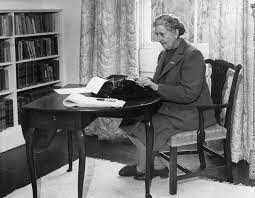


🧡 Many of her unique novels were mostly inspired (or persuaded) by her acquaintances. The Pale Horse, for instance, was inspired by a chemist (Agatha's instructor during war). Death Comes at the End was the result of Agatha's friend' persuasion that she need to write a murder story set in ancient Egypt. A colonel (Archie's boss) 'asked' her to put him as character in her novel -The Man in the Brown Suit was the result. It's fascinated to learn this backstory of her many novels!

🧡 Of Agatha's own favorite writers and books: her Walter Scott's favorite was The Talisman (didn't surprise me considering her fascination of the Middle East), while Bleak House was crowned as her favorite Dickens. She also loved Dumas (my face too!), especially 1st volume of The Count of Monte Cristo. But her most favorite author was perhaps May Sinclair.

🧡 I listened to this audiobook almost every day for about 6 or 8 weeks, and those were happy days! I loved Judith Boyd narration, though her "excitement squeals" were rather unpleasant. But overall, it's been entertaining as well as inspiring. Agatha lived her life the fullest, and she always found joy in everything she did. My readings of Agatha's books will forever change after this! What a life, and what an autobiography!

Rating: 4,5 / 5


Monday, January 26, 2015

The Confessions of St. Augustine by St. Augustine Hyppo

Actually I have meant to work this book out for my WEM project; I have even started with the summary (book 1 – 9). However, after finishing it, I just realized that The Confessions is more philosophical and theological than autobiographical. The last four books (book 10 to 13) were so engaging, I have even forgotten what I’ve been through in the earlier nine books. It seems like the four last books are the real core of The Confessions. Thus I decided to not continuing the usual three levels inquiries, and to write a (hopefully) decent review for this inspiring book, instead. Oh, I don’t even know how to begin the review, but I’m trying….

In the autobiography part, Augustine analyzed his former life; from infant to adolescence; how he has sinned; and how he struggled to find the ‘Truth’—you can read the chronology in my summary post. One of the most interesting things from this part is that Augustine believed that man has sinned even from his infant, when he is only one day old. Infant is demanding; it strives to get what it wants by crying. Augustine thought that baby’s weakness is in its body, not (yet) in mind. That is an extreme thinking, but it’s not fully nonsense either. Children are egoist; they only think of their own needs. Isn’t that the early stint of human selfishness? Isn’t human an individual creature? And aren’t we still inheriting Adam’s sins before we are baptized?

About baptism, Augustine also blamed his parents for not baptizing him as early as possible; for he believed baptism would at least help him fighting his ‘wickedness’ as teenager. I agree with this; although baptism doesn’t always keep someone from falling to sin as it depends also on his education and the society where he grows up. But early baptism, when followed by strict guidance in moral and faith, increases the chance to fight against the evil influence.

Augustine’s biggest weakness, besides his thirst of knowledge, was in sexual desire. For twelve or fourteen years (I forgot the exact number) he lived with a mistress whom he loved very much. In Italy, it occurred to him that a marriage would save him from this carnal lust. His mother, Monica, also rejoiced in his decision, as she has been continually praying for his repentance. But for the marriage, the woman he loved must be torn from his embrace. And this caused him a severe broken heart; although in the end Augustine never married any other woman, as he gave his soul wholly to God and His Church. I have actually just browsed a novel by Jostein Gaarder, Vita Brevis: A Letter to St. Augustine right after finishing The Confessions. Gaarder claimed that he had found an old manuscript which was believed to be originally written by Augustine’s mistress, a woman called Floria Aemilia. This would be an interesting reading, as she questioned Augustine’s theology and philosophy, and her views could be taken as an early feminism. But I would review it separately later….

Back to The Confessions, starting from book 10 Augustine slightly switched his writing from autobiography to philosophy and theology, although they were still read as his confession. Book 10 contains his motives of writing The Confessions and the path he has taken to finally admit that only through the mediator of Jesus Christ can men find and have unison with God, as men are so weak they could not do it by their own power. In book 11 Augustine was philosophizes a lot about mode and time of creation as is in the book of Genesis 1:1. He ponders a lot (and quite tediously) on time: past, present, and future. Book 12 is the best part of all, as here he interprets God’s creation of ‘heaven and earth’. He uses many allegories which enable the readers to follow his thoughts. He admits that men have interpreted God’s creation of the universe in many opinions, and no one can know the truth except God grant him it, but this is his idea (if I understood him correctly):

When a singer sings a song,
  • His body produces sound, while his soul forms it into tune.
  • So sound is formed in order to become tune.
  • But sound and tune exists at the same time.


That is an allegory of Creation ala Augustine. In order to understand it, let us replace sound with spiritual heaven and earth; tune with corporeal heaven and earth; and body with God.

St. Augustine at the moment of his religious conversion
by Jose Garcia Hidalgo
According to Augustine, heaven and earth in Gen 1:1—“In the beginning God created the heaven and the earth”—speaks about two different existences. One is spiritual—the heaven of the angels etc., the other corporeal—that is our earth (heaven here could perhaps be taken as sky). So, the creation according to Augustine could be perceived like this: God created the spiritual heaven and earth at the same time as, and in order that, He created the corporeal sky and earth. If only God’s creation could be explained as simple as that…. Still in book 12, Augustine also discussed about the meaning of other creations: water vs dry land, fish, fowls, the dark abyss and the light. He has completely changed my view towards those verses; I was grateful to have read this book as I was preparing that verses for my lector task on Easter vigil mass.

One post would not be enough to share all my thoughts, but I must stop here at last. One thing is sure: this is a very important and intense reading; tough but beautiful. One can read this many times, and would perhaps form different opinions on each reading. This book would also provide many materials for interesting debates.

The Confessions was written in 397 – 400 AD, and St. Augustine’s thoughts have provided great influence over the medieval era, when Roman Catholic Church was the center of institution. In all aspects in which he analyzed his former life, Augustine always viewed his actions and thoughts from God’s view; whether He approved this or that, and how he has offended God by doing some sins. In one chapter he would lament over his wickedness and ask God’s forgiveness, while in the next chapter he would praise Him and rejoice because God has helped him to repent. The relationship of God and human was still intimate; it was time when intellectual people pondered much over religion and God’s existence.

Five stars for this outstanding piece!

~~~~~~~~~~~

I read the Dover Thrift paperback edition

This book is counted as:


Tuesday, July 1, 2014

I Know Why the Caged Bird Sings

In honor of the late Maya Angelou—the honorable author, poet, and activist—who died on May 28, 2014, I decided to read her beautiful autobiography: I Know Why the Caged Bird Sings. Really, before actually reading it, I have never realized that this book is really an autobiography of Maya Angelou, not just an autobiographical fiction. I just realized my fault when Marguerite told how her brother, who loved her so much, used to call her Maya (from Mya sister). It was then that I realized that is has been Maya Angelou herself who was telling her story.

Maya was only three years old when her parents divorced. They sent her and her big brother Bailey (four years old) to Stamps, Arkansas, by train, with only a porter to accompany them, to live with their grandmother. This journey (and the sense of abandonment) wounded both children. In Stamps, the grandmother, Annie Henderson, lived with her crippled son Willie (Uncle Willie). It was the two of them who raised Maya and Bailey. Momma Henderson (Maya’s appellation for her grandmother) ran the Store where the Blacks (mostly very poor cotton pickers) shopped their daily needs. Mrs. Henderson was a strong and respectable woman, and the way she maintained her dignity against the Whites’ insults was tremendous. During her life in Stamps, Maya witnessed the struggles as well as the bitter hopes of the Blacks amidst the Whites dominion. All these built the inferiority (if not hatred) in little Maya towards the Whites, although she almost never saw them in reality. She even felt guilty of having Shakespeare as her favorite author because of his whiteness.

When Maya was still nine or ten years old, her father came to Stamps and brought the brother and sister to St. Louis, to stay with their beautiful mother. One day Maya was raped by her mother’s boyfriend, and this changed her life completely. She became very quiet, and suddenly Maya grew much more mature than her age. I think Maya’s turning point optimism of being black was in her eight grade graduation, when Henry Reeds led the audience to sing Negro National Anthem with pride. It was then that Maya started to realize of her own value, as a Black, and as a human being. Her visit to her daddy’s home was another phase of Maya’s transformation, where she eventually found her own strength.

I liked this book from the first page; in fact, it did not feel like reading an autobiography at all. Maya Angelou was certainly a great story teller, and her way of re-telling her own bitter past was filled with hope and optimism, instead of condemnation or lamentation. As a title, “I Know Why the Caged Bird Sings” offers a deeper meaning of Angelou’s sight of her people. I found an interesting article about this, which revealed that the title was taken from a poem by an African poet: Paul Laurence Dunbar—and it is a beautiful poem! When the world has not been free from prejudices and discrimination—even until now—what the oppressed must do is to maintain hope, and to keep in mind that as long as they think they are free, no one can snatch that from them.

A beautiful and inspiring reading indeed! Four stars for Maya Angelou!

~~~~~~~~~~~

I read Ballantine Books Mass Market edition

This book is counted as:


Friday, September 27, 2013

The Life of Saint Teresa of Ávila: Review

I haven’t read many autobiographies, so I was rather gambling when I bought this autobiography of one of the most famous Catholic Saints: Teresa of Ávila. Firstly because autobiography is usually serious; and this one, particularly, is religious. Tough combination! But I don’t know why, this one is tempting me since I put it in my WEM Project, and so….I dared myself to read it. In the end, it is so worth it! Although Teresa’s writing is not quite chronologic—she used to return to the past things related with the current issue that she might have forgotten, or which she thinks now is important, while is wasn’t then—and she seems to have difficulties to make things more clearly. But maybe this is because she had restriction (from God or from her superiors at that time). But above all, her autobiography is really inspiring.

I usually do the three levels inquiries for WEM, but this time I go directly to review. I will still do the inquiries after this, though :). Now about the book…..

Teresa of Ávila (Teresa de Cepeda y Ahumada) was born at Ávila in 1515, into a family with good virtues, which I believe is the solid foundation of her own devotion to God in the age of six or seven. Her mother taught her to pray. Unfortunately, at age 14, Teresa began to lose her virtues through bad friends’ influences and amusements of the world. Scared that she might fall to sin, her parents took her to a convent, although with her bitterly aversion. The secluded convent seemed to bring back Teresa’s virtues, however she began to suffer from heart disease, and this forced her father to bring her out, and put her in her relative’s.

Teresa took the habit at the Convent of the Incarnation on 3rd November 1536, when she was 21 years old. Here she began to have great joy to serve God. Meanwhile, her health got worsened, and so she must be brought out of town for treatment, which unfortunately didn’t work as expected. It seemed that God deliberately sent the illness for her to endure, and she did endure it with patience. She was paralyzed for almost three years, yet she endured the great torment with joy. At this stage she regretted her former sins, and took St. Joseph as her advocate to God. However, once again she fell to sins because the convent provided too much liberty for a restless nun like her. One day Christ appeared before her, looking severe, telling her that her friendship with her current friend displeased Him. While she still disobeyed, God appeared in another vision.

Teresa was weary of her sin, that she lost her previous joy in virtuous things. She abandoned her communing with God (meditation). Through her confessors’ guidance, Teresa returned to her prayers, but she still lived two lives: the earthly and the divine ones. But during those times, God never ceased to veil her sins from public, as He knew that Teresa, deep in her heart, always longed to serve Him. For twenty years Teresa fell and rose in her spiritual life, again and again; this state disturbed her, but thank God, He gave her courage to keep praying, because praying helps us to be nearer to Him, as He will bear so long for us to come to Him.

Reading St. Augustine’s Confessions has helped her to incline more to spiritual graces and to stay away from things that did her harm. She taught us that there are four stages in prayer; the higher the stage the more intimate we would be with God. After 5 or 6 years exercising to 3rd stage of praying, Teresa was being accused and attacked by people who said that it’s only her innovations. She was disturbed by this fuss, and fell again to sins, until a Dominican Friar woke her up from it, and she realized how God is never tired to forgiving sinners.

Teresa now often had an ecstasy, when God enraptured her. She was afraid at first whether it was not a deception from the devils, however in many visions and appearances God convinced her that it was from Him. God gave her favours in the raptures and visions; He even brought her to visit Hell and Heaven. The ‘tour’ to Hell was very horrible, that she couldn’t even describe it in words. Not only the tortures to body—she felt greater pain than she had ever endured on earth—but also the torture of soul, which was still much more painful than of the body. With these favours, Teresa began to incline to save souls, with the guidance from God.

God commanded her to found a convent of St. Joseph’s. Through so many obstacles (that distressed Teresa so much, since, as usual, she was torn between God’s promise that everything would be OK as this was His wish, and her own thoughts that she was deceiving herself and others—which was clearly came from the devils), the convent was finally founded on 1562. During the process, Teresa received much opposition from others, including her colleagues and superiors, and even her confessors. However, as this was a work from God—and God was extra patience to convince the stubborn Teresa about it—the new convent was finally established. People opposed it because it was a reformation of convent’s standard system. St. Joseph’s convent took poverty as its main rule, and this they did not accept dowry from new members—as the standard of convents at that time—and strictly closed the convent from outer world so that the nuns could focus their devotion mainly to God. It really fitted Teresa, whose sins were mostly from her connection with the outer world.

---------

From this autobiography, I learned that Saints are ordinary people like us; that although they have achieved higher step in spirituality: 1) They still sinned every now and then. 2) It doesn’t mean that the devils stop tempting them; the tighter your relation with God is, the bolder the devils would tempt and attack you. They become even more aggressive now that the chance to snatch the souls from God is smaller. The only consolation we get from God, is that He won’t let us fall if we put 100% trust in His protection and keep on praying. That is very relieved, but we almost always forget it during trials! :)

People who oppose Catholic and other Christian Church often attack us by saying: If God loves us, why, while we are so devoutly to him, that He let the devils tempt and attach us, that we must suffer much? Oh yes, God do let them do it, as I read from Teresa’s words. God allows the devils to do that to test our strength and to make us realize of His power to save us from harm. That’s why, we mustn’t retreat from our virtuous life when trials come, but strengthen it with more prayers and with humility.

One important fact that astonished me is the powerful effect of Holy Water. Teresa told us that one day a devil appeared to her when she was praying; she was afraid, so she raised a cross to it, and it soon went away. However, a moment later it re-appeared. Teresa did the same action twice more, but the devil kept coming. So, Teresa reached for Holy Water, and sprinkled it to the devil, and this time it vanished and never returned. So great is the power of the Holy Water!

There are so many valuable things I got from this inspiring book, a book which Teresa has written by the guidance of God. Teresa then submitted the manuscript to a Reverence to be published. She died on October 1582, but not before she founded many more St. Joseph’s convents (the Carmelite nuns). Forty years after her death, Teresa was canonized by Pope Gregory XV, and was named a Doctor of the Church by Pope Paul VI.

Last but not least, here’s a lovely quote to help us all living this hard lives….

“For in this life we cannot always remain in the same state. Sometimes we are fervent, and at other times not; sometimes we are restless and at other times calm in spite of temptations. He told me to trust Him and not be afraid.”

In fact, Teresa’s life was like that, she was not a perfect human being, but she kept loving God, did her best to please Him, and put her trust in Him. We are not perfect either, and we might not become Saints, but we can do our best to reach the eternal life as long as we put trust in Him to guide us.

Four and a half stars for this autobiography, for although it is very inspiring, but so tough in reading, with the small fonts and Teresa’s inconsistent writing and sometimes full of ramblings.

~~~~~~~~~

I read Penguin Classics paperback edition

*This book is counted as:*


5th book for Baca Bareng BBI – September theme: biography