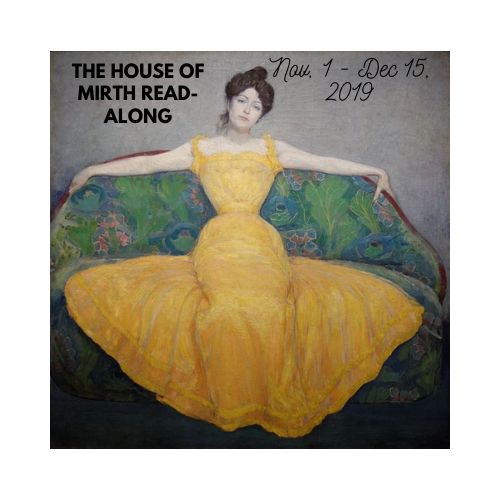
I've been meaning to post more of 6 Degree of Separation - a monthly meme hosted by Kathy - and only waiting for a book which I have actually read, and is interesting enough. The time has finally come, here it is...
The Turn of the Screw by Henry James
In this gothic story, a young woman (a governess) is placed in a country house, where she experiences mysterious and supernatural things which threatens to shatter her sanity. A similar condition is experienced by another young woman in...
The Mysteries of Udolpho by Ann Ratcliffe
Emily St. Aubert, a young heroine of this (another) gothic tale, also experiences mysterious apparitions, and even more than that, while staying in the Castle of Udolpho. These misfortunes befall her after the death of her father that made her an orphan. There is another (more) misfortunate young lady, who is left alone in the world after the death of her father. She is the heroine of...
The Deerslayer by James Fenimore Cooper
Judith Hutter might be stronger and braver than Emily St. Aubert, but she lacks Emily's pure innocence. She is cocquetish and regarded as too liberal at that era (18th century). Notwithstanding her diligent efforts to redeem herself from her follies, the society stamped her fate as fallen woman. This particular aspect of The Deerslayer is too much in common with the main theme of...
The House of Mirth by Edith Wharton
Lily Bart must have, perhaps, worked harder than any woman of her time to get a husband. Why? Because, after her family's ruin, she belongs to the working class. She hates poverty, so she desperately (though not too diligently) worked to belong to the higher class - the same case as in....
The Great Gatsby by F. Scott Fitzgerald
Poor Jay Gatsby... For a man to love a girl from a class higher than himself, is almost an impossibility. You're not alone, old sport, in this struggle. Another hero shares your agony in this book:
All the Pretty Horses by Cormac McCarthy
Grady Cole is a ranch worker who has the audacity to fall in love with the rancher's daughter. His fate is very similar to that of Jay Gatsby. This is the sixth book, and at this point I have to stop the chain.
Interestingly, Kathy has set a freebie theme for November, picking the last book on October chain to start next month's. See you then!
"When you reread a classic you do not see more in the book than you did before; you see more in you than there was before." — Clifton Fadiman
Showing posts with label The House of Mirth. Show all posts
Sunday, October 18, 2020
Monday, December 16, 2019
The House of Mirth Readalong Week #6: Book 2 Ch. 10 - end
=Rosedale
isn't that bad after all
I can see
now that, compared to the other men in Lily Bart's set, Rosedale isn't that
bad. He had ambitions, yes, but at least he also possessed compassion towards
Lily. He's the only one who still regarded Lily as a friend, while her former
'friends' all denounced her. That he could not relinquish his selfish ambition,
it's in accordance with Wharton's theme of determinism - the Naturalists'
formula. And it struck me also that Rosedale is actually very similar to Lily,
in regards of their struggles between two passions.
=The battle
of influences - which will triumph?
Chapter 11
reveals again Lily Bart's heroism in her persisted rejection of Rosedale to the
end, despite of her longing to be freed from poverty. In the end, I should say
that Lily's inheritance from her father, sharpened by Selden's republic of the
spirit, has finally (slightly) triumphed over the influence of her mother's
upbringing.
=Lily and
Selden - is it possible?
Selden and
Lily loved each other - theirs is the only relationship that is pure, without
concession. So, why couldn't they be together? I think there's two reasons:
1. On
Selden's part:
It's because
Selden and Lily came from two different world. Selden was attracted to Lily,
but he also 'judged' her as the member of her world. He couldn't marry her
because he hated her crude passion for money. This is also Selden's personal
struggle between two influences: his love for Lily, his longing to save her;
and his critical view of her world. It's so difficult to put trust on something
you have taught all your life to hate. So, when, after hearing so many rumors
about Lily, Selden saw Lily in Gus Trenor house, how he supposed to think about
this suspicious situation? How was he supposed to believe in Lily, when she
herself was always swayed to the world she started to hate? No, it's almost
impossible on Selden's part to be 100% percent sure of Lily. And Selden has
been enjoying his life all along, why would he sacrifice it, when Lily herself
rejected him twice (or thrice?) when he heroically proposed to marry her?
2. On Lily's
part:
Her world
was her habitat, so she clung to it to the end. That's why, though Selden's
world was much attracted, and part of her longed to live in it, she couldn't
uproot herself from her world.
Then, when
her case started to look hopeless, I think it's also partly her pride that made
her shrinking from Selden's humble offer altogether.
In the end,
they are not destined to be together. If this were Victorian novel, things
could be different. Selden perhaps, would brave himself to marry Lily at
critical moment, and Lily would be touched, and relented, and... a happy
ending. But, this is a Naturalist fiction, and we were not supposed to
'triumph' over the force of nature.
=Suicide or
accident?
Should you
even ask? Of course it's suicide. Every sentence in the last chapter leads to
this conclusion. Lily was terribly unhappy for the time being, and in chapter
14 she has lost all hope. Suicidal person doesn't deliberately end his life
just like that, because human instinct is always to survive, to cling to life.
It is a mental process, which at the end, when he or she did not see any tiny
spark at the end of the tunnel, then the most natural step is just added a
little drop of the drug. It's a decision one takes when there's nothing to lose
- death becomes more and more alluring. And so at the end, the mind gave up to
the mental.
It always a
devastating read, The House of Mirth
is! But, what a beautiful vivid writing from Edith Wharton! I always nickname
her 'the female Zola', and how appropriate it is!
I must thank
Cleo @ Classics Carousel for hosting this readalong. It has been fun and
wonderful, though I have not as actively participated as I have hoped, due to
my works, but it's always amazing to read a piece of magnum opus like this with
some friends. :)
Monday, December 9, 2019
The House of Mirth Readalong Week #5: Book 2 Ch. 6 – 9
Chapter 6 & 7
I'm glad
that Lily wasn't tempted to take revenge to Bertha through George Dorset, even
when she just needed to say "yes" to him to activate it. And the
persistent way she rejected Rosedale is rather admirable, though I still think
that Rosedale isn't as evil and selfless as the other men in Lily's set. He's
clearly in love with Lily (his jealousy over Selden is one proof), though he's
also ambitious. But isn't Lily too? Here, again, I saw the "shadow"
of how her mother's education (to follow the money) and her father's character
(to seek subtlety) have influenced Lily - from which she was always torn
between two impulses, without being able to compromise them. And that explain
Lily's indecisiveness and contradiction from the beginning. Poor Lily... I was tired
just of reading about it, let alone she who must live it through!
Chapter 8 & 9
=Will Lily
ever get married?
We have come
to the stage, where Lily's only possible marriage was either with Rosedale or
Selden. Rosedale had the money but not the subtlety. His scheme regarding
Bertha Dorset's letters disgusted Lily. Okay, then how about Selden? He had the
subtlety, but not the money. In her present situation, that's the best thing to
accept. But no; if she was disgusted with Rosedale, she felt ashamed to Selden
- one thing I don't quite understand. Was she trying to prove to Selden that
she's different from the society he detested? Why did she always imply to
Selden that she did not need his help, every single time she really needed it -
and Selden's ready to give it? Was she too proud? I began to think, her pride
has made her situation going from bad to worse.
Lily should
have known that with Selden she would be a free woman, an equal in the
marriage. Wasn't it that that she thought after? Well, without the large
drawing room or the jewelry, perhaps, but, hey... one can't always get
everything in life, right? Or maybe, that's Lily's real problem - that she has
brought up by her mother as a spoiled brat, who always gets the best of
everything?
If so, then
she is a child-woman who never grew up. She had a vague sense of better
qualities she inherited from her father - that she deserved to achieve more in
life. But she had no father to guide it. And she certainly needed her mother to
guide her through the slippery stairs of society. But on top of everything,
it's a rotten society, where a girl does not have chance to improve by herself
and be independent.
I have
actually read through chapter 10, but I think I'd better stop here, because
after this we'd come to the hardest part of the story, and I need to brave
myself!
Monday, December 2, 2019
The House of Mirth Readalong Week #4: Book I Ch. 13 – Books 2 Ch. 5
Book I
Chapter 13
=It’s payday,
the broker came to collect his commission.
It's quite
incredible that an adult woman like Lily did not understand that money cannot
multiply by itself. It's true that she, like many other people of that era, was
ignorant about investment market. But she must have been realized that men in
her set could not have expected nothing but little coquetry when she received
from him regular money. She, of all girls, could have seen Trenor's
expectations long ago before it's too late. But, again, the crude passion for
money she inherited from her mother, forced her to ignore these facts.
Chapter 14
=The power
of rumors upon women
I kept
regretting Lily's cold ignorance towards Selden after the tableaux vivants. Otherwise, their intimacy would, at least, have
stopped any rumors about her and Trenor, even if she did not instantly paid her
debts. Because it's clear that Lily's downfall mostly came from rumors. When
Selden, even after Lily's cold reception, came (perhaps) to propose to her, saw
her rushed from the Trenors', it instantly dawned on him what people has
hitherto talked about Lily. At least, he thought he has seen the proof. And who
could blame him? Selden was attracted to Lily because he knew she was different
from others, so her being alone with Trenor, why, it justified her being still
embracing the corrupted society. First her cold reception, then the proof, it's
enough to make a man like Selden fled away.
The rumors
eventually ruined also Lily's chance of Mrs. Peniston's inheritance (by which
she could have paid her debts and bought her independence). Do you believe
she's ignorant of the rumors? She might have known that rumors are bad for
girls' reputation.
Chapter 15
=How long
will she survive the challenge?
Rosedale's
proposal came when Lily still had a tiny hope that Selden would help her. At
that point, what do you think she would do if she knew Selden has left her? I
believe she would be rejected nonetheless, though without fully closing the
door to Rosedale. I think the inherited passion issue (from her mother and
father) went both ways in Lily. It's only a matter of which would triumph over
the other.
Book II
Chapter 1
=Selden is
what Lily would be if she were a man
It struck me
that Selden was actually "made" with similar ingredients as Lily. He
ran away from Lily because he was disappointed that Lily still failed to detach
herself from her set - which he detested. However, he was also fond of the
entertaining luxury the same set offered. And he inherited that taste also from
the mother side.
The only
thing differs him from Lily, is that he could detach himself anytime he wants
to. He could act as mere spectator, or just a little involved (even flirted
with somebody's wife), and others won't mind, he's still respectable. With
Lily, they imposed upon her certain rules, as if saying: if you want us to
receive you, you have to always be charming, but not too charming that our
husbands get attracted to you.
As Lily said
in chapter 1, it is acceptable for men to wear shabby coat, as long as he
amuses others with his wit, but women must look charming all the time, because
their only function is to entertaining men's eyes.
And finally,
Selden's means of his detachment is his professional career - the ultimate
means of independence women at that era didn't have opportunity of!
Chapter 2 & 3
=Personal or
inherited flaw?
If Lily Bart
has one negative quality which was not inherited or influenced by the environment,
it was her shrinking from (ugly) obligations, as Wharton wrote in this passage:
"Moral
complications existed for her only on the environment that had produced them;
she did not mean to slight or ignore them, but they lost their reality when
they changed their background."
After the
Trenor incident, and especially when she knew to what extend Bertha could ruin
her, how could she fled to the Riviera with the Dorsets?
Then, after
Bertha's too-obvious-scandal, Lily should have seen the hints from Bertha's
accusation to her of having an affair with her husband. Couldn't she predict
that somehow she could be in danger? Selden could, and people said women's
intuition is better than men's... She should have stayed away right then and
there!
Chapter 4
=Lily Bart's
original qualities vs inherited flaws
It's said
that one's true character will only appear when one's in hard situation. Her
humiliating defeat has actually revealed Lily's true capacity of toughness. Her
maintaining her dignity at the testament reading, and her manner towards her ex
friends at the restaurant, are truly heroic!
Chapter 5
=Lily's
waning (marriage) chance
Now she even
gave serious thought on Rosedale. :( It's so sad to think that there was time
when girls have no chance of happier life outside marriage.
The next
chapters are the most interesting because we'd get to see how Lily would settle
her final choice!
Monday, November 25, 2019
The House Mirth Readalong Week #3: Chapter 7-12
Blunders,
Force of Nature, Corrupted Society
From chapter
7 on we saw how Lily was 'jumping out of the frying pan into the fire'. It
seems that one blunder led to another (worse) in rapid succession; it's like
watching a snow avalanche. But are they really her blunders, her series of
personal bad decision? Could she have avoided them? Here are my random thoughts.
Chapter 7-8
Lily trusted
her money investment to Gus Trenor. Okay, to escape poverty she needed to have
money fast. Solution: investment. It's perfectly understandable. She couldn't
do it by herself, so she used her charms to induce Gus Trenor to help her. I
cringed at this, but then, what can a woman in her position do to get
assistance from men? So, okay, she had an income now, replenished her wardrobe,
and back to the game again. The problem is Lily's 'crude passion for money'
which she inherited from her mother. She has become a gambler, who couldn't
stop at the right moment. She should have stopped when Trenor began to charge
for "commission"! So... yes, it's a blunder.
Chapter 9
She
shouldn't buy those letters from the char woman. Better save the money for
emergency - but how she supposed to understand that, when her mother has taught
her from childhood to spend, spend, and spend. It's a force of nature-the
cursed inheritance things, then, though perhaps indirectly related to her downfall.
Still, did she really think she could get even with Bertha Dorset with the
letters? Haven't she learned enough of the power of money? Or did she do it for
Selden's sake? Nah, I don't buy it. It's just her defense to soothe her
reasons.
Chapter 10
And she
shouldn't spend money lavishly on charity, either, especially when it was for
pure selfish purposes! But, again, Lily hasn't been taught of saving money, so
again... put the blame on her mother. Or, on the corrupted society where she
grew up in.
Lily, who
has hitherto prided herself of the wide knowledge of men's psychology had
miscalculated (or more precisely: neglected) the "Rosedale
consequences". Blunder no. 2.
By the way,
I loved Wharton's nature symbols of the bluebottle:
"Because a bluebottle bangs irrationally against a window-pane, the drawing-room naturalist may forget that under less artificial conditions it is capable of measuring distances and drawing conclusions with all the accuracy needful of its welfare."
Chapter 11
As was with
her miscalculation on Bertha Dorset, Lily well understood men's vanity, to use
it for her advantage, but failed to recognize the same in women. Yes, I am
talking about Grace Stepney's poisonous story to Mrs. Peniston. Of course, Lily
wouldn't have known its huge implications with her dear hypocrite aunt, so it
doesn't really count as blunder, right?
Chapter 12
I have
always wanted to lecture Lily on this chapter, so I'll take this opportunity to
pour it out here.
"Lily,
you have once technically turned down Percy Gryce - which was perfectly understandable,
because that's not what you have wanted. But don't you realize that you're not
getting any younger, and the possibility to find a suitable [rich and respectable
in her circle] suit gets thinner and thinner? So when a guy who, though hitherto
seemed reluctant to marry you, is now smitten by you - DON'T THROW HIM AWAY!
He's your last chance! And what if he's not as rich Percy Gryce? He has a quite
comfortable professional career. And though is out of your circle, he still
loves to attend the parties and enjoys the luxury you love once in a while, and
they respect him. You could still charm them with your skill. What more, he is
funny, intelligent, and with him, you will achieve the freedom you have dreamed
of. He's the most suitable man for you! And most importantly he loves you,
understands and respects you, and will never treat you like a trash - like some
men! And you love him too, so what more do you expect? Now when he finally made
up his mind to love you - and even has sealed it with a kiss, for Heaven's
sake, Lily... TAKE IT!"
Oh... this
chapter is so heartbreaking to read, I must stop for a while. After her
'triumph' in the tableaux vivant, and
topped with Selden and Lily's romantic moment in the "almost midsummernight's dream" garden, Lily's declaration of: "Ah, love me, love
me - but don't tell me so!" always gets me. Why Lily, why can't you?? And
this, I think, is the worst or biggest blunder Lily Bart has ever did (the rest
is just the snowball effects). She could have done it, or at least could
nurture Selden's love a bit longer before saying ‘yes’. To "throw the door
on his face" so soon is terrible, terrible mistake!
Well, after
this, The House of Mirth began to be
uncomfortable, and even painful in the last chapters, to read. But one must get
on, because it also gets interesting. So... I’ll brave myself ‘till next week!
Monday, November 18, 2019
The House Mirth Readalong Week #2: Chapter 5-6
Chapter 5
Sundays at
Bellomont means going to church. Like in many other societies, attending the
church gives them sense of honor. No matter what they do on the other six days,
going to Church on Sundays seemed to neutralize everything, and they got out of
it clean and pure again, to go back to your corrupted life the next day. What a
hypocrite!
Anyway, the
last touch of Lily's conquest of Peter Gryce would have been for her to put on
her grey dress, bring a prayer book, and go to the church with him. She
certainly knew it, as she have known how to "woe" the shy Mr. Gryce
on the train. But instead, she played truant and went for walk with Selden. Is
it really Lily's strategy to whet Gryce's appetite - as Selden's suspicion (and
Lily's defense to her own conscience)? I don't believe it. I think, Selden has
shed new light on her view towards her circle of society. She could see now how
freeing the outer side of it was. Her procrastination is not of laziness, but
because she dreaded the dull and monotonous life she would lead on marrying
Gryce (or anyone from her set). She delayed because she wanted to know more
about her alternative - which she hitherto only saw vaguely; she was still
weighing the choices. Unfortunately, she miscalculated the Bertha Dorset
factor. Lily's wide knowledge on human psychology, apparently, didn't touch
much on that of her own sex.
Chapter 6
The most
important chapter of the book - the center of the story, where Wharton poured
her personal view towards the corrupted society.
=Selden and
Lily
Selden's
attraction to Lily started with amusement. Selden the spectator perhaps admired
her subtle skill to climb the society stairs, and - you got to admit it - it
was almost heroic, her continual struggle to get out of poverty!
Lily's attraction
to Selden was because of his detachment from her circle. She admired his
freedom and easy going manner, while she must calculate every step through the
slippery stairs as she belonged to the circle he despised. But their leisure
walk changed everything. It was the turning point for both, but most of all for
Lily.
Now Selden
realized that Lily was not thoroughly shallow like her friends, and not that
haughty as he thought she was. Also after he detected her "weakness",
he was flattered to be "the unforeseen element in (her) career so
accurately planned".
On the other
hand, Lily viewed Selden as the representation of freedom; and because he was
"as far removed as possible from any assertion of personal advantage"
and "being able to convey as distinct a sense of superiority as the
richest man she had ever met." Shortly, they attracted to each other
because Selden and Lily were both different from the others.
=Wealth vs
happiness
The
priceless philosophy from Wharton: the republic of the spirit. Through Selden,
Wharton criticized how society saw money as the highest achievement of life,
and a means to buy freedom (it is merely illusion, because rich people
eventually became the slave of their money). She wanted to remind us that the
real freedom is when you personally feel free to lead whichever life or role
you want to lead, whether you were rich or not, and no one can dictate you, or
impose on you rules to obey. She wanted to emphasize that money only brings
corruption; especially when "so much human nature is used up in the
process". That was the core of this story; that was what The House of Mirth is about.
=Who was the
real coward?
The
character of Selden-Lily's relationship could be concluded in this passage -
beautifully crafted by Wharton:
'Why do you do this to me?' she cried. 'Why do you make the things I have chosen seem hateful to me, if you have nothing to give me instead?'
'No, I have nothing to give you instead', he said, sitting up a d turning so that he faced her. 'If I had, it should be yours, you know.'
She received this abrupt declaration in a way even stranger than the manner of its making: she dropped her face on her hands and he saw that for a moment she wept.
People
always discuss on who is the real coward, Selden or Lily, as they called that
to each other in this chapter. Well, for years I have been switching opinion
from Lily to Selden. But this time I can give my definite answer, that neither
of them is a coward.
Selden
couldn't marry Lily, unless he succeeded to convert her to his "republican
of the spirit", otherwise he couldn't afford her. On the other hand, Lily,
though despised her society, could not bring herself to denounce her
"natural habitat". It is in accordance with the theory of determinism
of 18-19th century, which was based on the idea of heredity and environmental
influence on human's behavior. So, in this theory, Lily was not a coward -
she's a victim of the corrupted society.
I have
actually read through Ch. 7, but just didn't have time to put my thoughts into
this post. Until next week, then.. ;)
Monday, November 11, 2019
The House Mirth Readalong Week #1: Chapter 1-4
"It's
all coming back to me now!" - was how I felt when first plunging into this
one of all-time-favorites of mine, on my third read. And with it, I also saw
things I haven't noticed previously. Here's my train of thoughts on the first
four chapters.
Chapter 1
=Lily stood
apart
From the
train station scene, where Selden saw Lily Bart standing uncertainly on the
platform: Lily Bart always "stood apart from the crowd", and
"always roused speculation". I questioned myself: is it her
exceptional beauty? The next sentence answered it: "that her simplest acts
seemed the result of far-reaching intentions". And I instantly felt sorry
for Lily. For the upper classes it's like a fun show, where they sit
comfortably on the top, watching her climbing up the society slippery stairs to
reach them. They might cheer her along the way, or might even bet on her, just
to see whether she'd make it or not, and if not, aah... it's been a fun show;
then go home thinking nothing of it. Even Selden, who isn't really their set,
also found Lily Bart 'interesting'. Indeed, you could find in ch. 1 only, the
word "amused" quite often attached to Selden, concerning Lily.
Chapter 2
=Naturalism
And so it
reminded me that Edith Wharton was one of the prominent Naturalims authors in
19th-20th century. And this treatment to Lily Bart is typical Natutalism
literature, where we are brought to analyze how a character would react under
influence of heredity and social environment. As is Doctor Pascal in Zola's
Rougon-Maqcuart cycle, so is Lawrence Selden in The House of Mirth - though I
admit that Selden is more deeply involved into the story than Pascal (I guess,
because I haven't read the last novel in the cycle, LOL).
Wharton also
used animal-on-hunt analogy for Lily's approach towards Percy Gryce: "She
began to cut the pages of a novel, tranquilly studying her prey through
downcast lashes while she organized a method of attack". Animals hunt to
survive, and so does Miss Bart!
Chapter 3
=Inheritance
Still on the
naturalism theme - Lily inherited her mother's "extravagant aptitude"
and crude passion for luxury, while from her father, a refined mind and taste.
And so Lily is always torn between these two poles. It will be much easier (and
happier) for Lily if she was just like her mother - and marry Percy Gryce; or more
like her father - and marry Selden (for I am convinced that Selden would marry
her if she has given him the chance).
Lily knew
that in order to survive, she must get Gryce, but at the same time, part of her
revolted at the idea of being a mere trophy to a man. I think what she truly
wants is marriage for happiness (an equal marriage), but Lily has been brought
up in the environment of upper classes; it has became her habitat, that she
couldn't do more than marrying money. And that's why Lily forbade Judy Trenor
of inviting Selden to Bellomont, for she instinctively knew that her conquest
would be faltering when Selden is present.
Chapter 4
=Choices and Guidance
Lily's
situation reminded me of my mother's advice years ago. No, I have never hunted
for husband... LOL. But, as Wharton classified husband hunting as career, I
then compared it with my own. Mom told me that one cannot always get the best of
everything in life. So you must set your own priorities in your career - do you
seek money or comfort? If you're lucky, you can find a job which pays well, and
with nice atmosphere. But mostly you can only choose one of the two. I have
left my first job with high salary, to move to my present (with lower salary)
because my first job was full of intrigue, and they did not trust me. And now
I'm so grateful I have listened to my mom in the first place; I have made the right decision. But not everyone
is fortunate enough to have a good mother or family who could guide one through life. Poor Lily
is one of these.
=Laziness and Procrastination
Chapter four
was the turning point of Lily. Just when everything went smooth, and the target
was within her reach, entered Lawrence Selden, bringing with him everything
that Lily has been praising deep in her heart. Why do you think she stayed
single at 29 years of age, with her beauty and "skill"? I think it's
because Lily never felt sure she would be happy by marrying money, but she did
not have enough strength to do otherwise. And so she kept delaying her decision
to marry. I think she inherited too, from her father, the laziness to face
uncomfortable truth. We don’t know for sure how Mr. Bart came to his ruin (the
process, I mean, not the cause – for that we knew that the Barts spent more
than what they could afford – and was he not a gambler? I vaguely remember…
maybe Lily inherited that too?) But I imagined that Mr. Bart felt powerless
while seeing his fortunes drained day by day, with the luxury they were
enjoying, until the inevitable fact hit hard on him. I noticed that Lily did
the same in chapter one after the Rosedale “accident”. Along the chapters we’d
see that she had the habit of procrastinating important and “ugly” things, and
let the thought passed “for the time being”.
Have you
finished the first four chapters too? How is it so far?
Friday, March 31, 2017
The House of Mirth: The Second Reading
Reading your
favorite book for the second time can sometimes be quite risky. You can end up
either liking it the more, or disliking it. Because on second reading, you
would be reading more thoroughly; examining the characters more closely,
analyzing and calculating every cause and effect. Maybe you would still love it
because the author wrote it beautifully, but most probably you would see the
characters differently. Then you only focused on their fates, but now you might
also see their flaws. It happened to me when giving Wharton’s The House of Mirth a second reading.
I still love
it, yes, and perhaps even love it more now, as this time no curiosity on the
plot obstructed me from savoring Wharton’s beautiful prose. But, as I delved
more deeply, I began to question my (blind) judgment on a character I used to
praise then. I’m talking about Lawrence Selden. Until last month he seemed
almost perfect to me, now I began to see his flaw; that is his lack of trust in
Lily when he saw her fled from Trenor’s house that night. But that didn’t make
me dislike him; on the contrary, it made Selden more humane. Though I kept
thinking how everything might have been different if Selden kept his plan.
On my first
reading, my focus was on Lily Bart, whom I analyzed for WEM project.
Now I had the leisure to take on Selden. I begin to feel that Selden is the
motor of the whole story. It all begins and ends with him. Maybe Selden is
Wharton’s own view of the society at that time. I haven’t had close study on
her, but from wiki I learned that though growing up in upper class society,
Wharton was one of its hardest critics. Selden, too, enjoys the privilege of
being with the upper class, but he also ‘disgusted’ with them.
One of the
most interesting things about Selden, is his theory of “the republic of the spirit”—the
freedom of having choices to make; not being helplessly dictated by society.
Wharton also rejected the standards of
fashion and etiquette that were expected of young girls at the time, intended
to enable women to marry well and to be displayed at balls and parties. She
thought these requirements were superficial and oppressive [Wikipedia]. Instead, she was eager to have higher education.
I think this is what Selden’s idea with his republic
of the spirit—something that Lily Bart envied him for.
Another
interesting point is, throughout the novel, there is a sense of ambiguity in Lily’s
character. Lily Bart is introduced as an intelligent woman, who is able to skillfully
read human characters to use it as a weapon for her advantage. She has maneuvered
geniusly to attract Percy Gryce—though she failed in finishing it. Yet, she
failed to predict her aunt’s reaction to her (rumored) scandal. I agree with Carry
Fisher, that the cause of Lily’s fall is laziness and her longing of freedom
and happiness (thanks partly to Selden’s influence!). In the Percy Gryce
failure, it makes sense, but how can she be lazy when her whole life was
depended on her aunt’s legacy? I just don’t get it.
All in all,
I am grateful I have given The House of Mirth a second reading; I love it more
now, and would one day revisit it again. Thanks to Adam for hosting the
#CBAM2017, and to you all who have been reading this treasure with me.
For more
about this book, you can browse my analysis and review on my first reading.
Labels:
#CBAM2017,
19th Century,
America,
Edith Wharton,
The House of Mirth
Wednesday, September 10, 2014
The House of Mirth: Final Review
I think I
have just found a favorite female author, who can be juxtaposed with Zola’s
genius, intense, and beautiful naturalist style: Edith Wharton. The House of Mirth was my first book by
her, and I loved it so much!
Lily Bart is
29 years old, and in the turn of the century, a girl of her age should have
married. Lily is very charming, but she is a poor orphan girl who depends on
her conservative aunt’s generosity. Nevertheless, she can make her way in the
socialite world. Since it is her only world; she has grown up and was brought
for one aim: to get a rich husband and live comfortably. The problem was not
that no one attracted to Lily; on the contrary, she was charming and
intelligent, and had many admirers. Lily’s difficulties started because she
could not make her mind of what she really wanted. On one hand she needed to
marry a rich man to support her luxury taste, while on the other, she yearned for
the freedom of choosing her own life. Through the book she constantly had this
doubts; and as she was too lazy to make decision, she kept putting the problem
behind, until it exploded, and drown her down.
It might not
become too bad if Lily has lived in our modern era. However—and this is what
Wharton wanted to emphasize—in the late 19th century, American high
society only cared for money and fame. Whoever had one or both would be
welcomed to the circle; they didn’t care about morality. Friendship and love
were often depended on status; one would praise immoral men and women if they
had influences, which one could benefit to step higher on the ladder of so
called society. In this circle did Lily accidentally hurt a rich and influenced
woman, and in order to take revenge—and to divert attention from her scandalous
affairs—she spread negative issues about Lily to ruin her reputation.
In the midst
of hypocrite society, a girl would certainly ruinous just because of one vague
scandal, no matter whether she really guilty or not. And since Lily was poor
and did not know other life apart from what she was brought up for, she could
not runaway from the ruin. Her friends knew that she was innocent, but they
could not help her lest their ‘patron’ abandoned them too.
Like Zola, Wharton
was a naturalist too; their style has a strong similarity, although Zola’s is
stronger while Wharton’s a bit softer. Like in Zola’s, I loved Wharton’s
metaphors and her beautiful prose, like in this passage. In terms of
naturalism theory, The House of Mirth
tells us how human being is produced and shaped according to their natural habitat.
Wharton also pointed out the moral corruption on the early 20th
century, while stock market was being introduced and many people became
suddenly rich by it. They were worshipping money and status, but neglecting
humanity (you can read more of my analysis of the theme in my WEM posts).
And Wharton crafted them in a beautifully-flowing prose.
Five stars
for The House of Mirth! And I would certainly read Mrs. Wharton’s other novels.
~~~~~~~~~~
I read Penguin English Library paperback edition
This book is counted
as:
5th book for Back To The Classics 2014 (Woman Author)
78th book for The Classics Club Project
77th book for 1001 Books You Must Read Before You Die
Labels:
20th Century,
America,
Edith Wharton,
Review 2014,
Social,
Society,
The House of Mirth
Thursday, September 4, 2014
The House of Mirth: Rhetoric Stage Reading
Do you sympathize
with the characters? Which ones and why?
My sympathy
goes to Lily. She is the innocent victim of the society determination which
dictates how women should live, and beyond that, they would be crushed. Lily
becomes what she is now, because she was born in that society, and was brought up
by her mother with one determination: not to be poor, because poorness is
disgusted; to love luxury; and to achieve it she must attract a rich man to
marry her. Lily Bart’s small world contains of politics and business, money and
power. You have it, you win; you lack of it, you lost. How can an orphan,
inexperienced girl like Lily could have survived in the world like that?
Does the writer
technique give you a clue as to her “argument”—her take on the human condition?
If using
nature objects can be called ‘technique’, I think Wharton, as a Naturalist,
argues that human is shaped by how he is brought up: environment, education, society,
culture. It would be difficult to adapt with another different ‘habitat’; just
as animals could not survive, and might even extinct, when they are plugged
onto different habitat. There might be few who can survive, but cubs would need
their mother to guide and protect them. In this story, sadly, Lily does not
have anyone to guide her.
What exactly is the
writer telling you?
Wharton
wants to criticize the injustice practiced by the society upon women; they
restricted women’s movement by prejudices. She also pointed out their
hypocrisy. Married women (and men) could do anything immoral as long as they
were protected by money and marriage institution; whereas single women would be
banished forever if they ever had scandal, no matter whether they were really
guilty or not. They were guided by the power of money and fame, but ignored
morality.
In what sense is the
book true?
Some of the
problems in this book exist today in our modern world; the hypocrisy, the power
of money and fame which become magnet for many people; that true friendship
begins to be mere concept. However, nowadays women have more influence than
before, and their place is almost equal—almost!—with men’s.
~~~~~~~~~~
Labels:
The House of Mirth,
The House of Mirth WEM
Friday, August 22, 2014
The House of Mirth: Logic Stage Reading
What does the central
character want? What is standing in her way? And what strategy does she pursue
in order to overcome this block?
Lily Bart
wants a happy, independent, and luxurious life. Unfortunately she is
orphan and poor, and the society she lives in does not provide any means
of independent income for women. On the contrary, it crushes poor women to make
way for the rich ones. Her only option is to marry a rich husband, no matter
she loves him or not. (who said women didn’t do business and politics at that
era? It’s just more delicate than what men did!).
Who is telling you
this story?
Wharton told
it from third-person objective. I don’t know why, but she sometimes
called the heroine as Lily, but at other times, Miss Bart. Was it just for
variation, or did she mean something with it?
Images and metaphors
I found many
imagery of water in this novel; the words like: wave, flood, sink,
drowned, ocean, floating, etc. They usually represent Lily Bart’s unfortunate
events, as if to highlight her helplessness against the powerful society movements,
just like a tiny object in the ocean—it is swayed and crushed without the power
to fight back. This object could not survive because the ocean is not its
habitat. The same applied to Lily Bart; she does not belong to the society she
was brought up for. One of the water metaphors:
“Over and over her the sea of humiliation
broke – wave crashing on wave so close that the moral shame was one with the physical
dread. […] His touch was a shock to her drowning consciousness.”
Beginnings and
endings
This book is
opened with passivity and stagnation. Lily talks with Selden about how a
girl with her ambition must force herself into the society, and marriage with a
rich husband is a must. There is also a sense of imprisonment; I can feel from
the opening that Lily is a free character; she knows what she must do (marrying
a rich husband), but she is reluctant to make the commitment.
The ending
is a resolution.
Whether Lily has intentionally ended her life or not, even Selden knows that
she won’t be happy if she had lived. Her dream is not correspond with the law
of society at that time. Selden and Lily distinguish from the others because
they have uncorrupted moral; but Selden survives because he is financially
independent, whereas a girl does not provided with that privilege.
~~~~~~~~~~
Labels:
The House of Mirth,
The House of Mirth WEM
Wednesday, August 20, 2014
The House of Mirth: Grammar Stage Reading
![]() |
| [source] |
Lily Barts’
Battle to Freedom: How a poor but sophisticated girl struggles to make money
without submitting herself to men’s dominion, keeps suffering under social
determination, does not fit in working class, excluded from any social place, and
finally gives up in solitary tragic death.
Book 1
Lily Bart is
trying to catch a husband at her 29 years of age; the richer the better. Lawrence
Selden proposed to her, but she rejects him for not being rich. Her pick is
Percy Gryce—very rich but boring—but instead of sealing the case immediately,
she let herself wavering from him. Gryce married another girl after Bertha
Dorset spreads bad things about Lily. Then Gus Trenor introduced the innocent
Lily to the stock market; invested money in the girl; insisting to get sex for
exchange, which she disgustingly rejects. Her conservative aunt hears about her
bad conduct, and she only left her small money, only enough to pay her debt to
Trenor.
Book 2
Simon
Rosdale and George Dorset also want to marry Lily and promise financial safety,
but she rejects them all. Instead, she departs to Mediterranean with the
Dorsets, only to be humiliated by Bertha Dorset, and banished from her social
circle and most her former friends. She tries to climb the social ladder by
attaching herself to new riches, only to be associated by another scandal.
Finally Lily enters the worker life, but fails too. Selden tries to help her in
marriage proposal, but she relinquishes her past, and ‘accidentally’ takes
overdose sleeping pills.
~~~~~~~~~~
Labels:
The House of Mirth,
The House of Mirth WEM
Wednesday, August 13, 2014
Scene on Three (9): The House of Mirth
I can’t
explain why this long passage from Edith Wharton’s The House of Mirth has caught my attention, without spoiling the whole
plot (for those who have not read it). It’s lovely, so vivid, and memorable, and Wharton captured the moment in
a beautiful narration, I almost recognized some Zola-ish style here… I have not
finished the book yet, but I believe I will remember this scene forever,
whatever the end would be.
“Selden had
given her his arm without speaking. She took it in silence, and they moved
away, not toward the supper room, but against the tide which was setting
thither. The faces about her flowed by like the streaming images of sleep: she
hardly noticed where Selden has leading her, till they passed through a glass
doorway at the end of the long suite of rooms and stood suddenly in the fragrant
hush of a garden. Gravel grated beneath their feet, and about them was the
transparent dimness of a mid-summer night. Hanging lights made emerald caverns
in the depth of foliage, and whitened the spray of a fountain falling among
lilies. The magic place was deserted: there was no sound but the splash of the
water on the lily-pads, and a distant drift of music that might have been blown
across a sleeping lake.
Selden and
Lily stood still, accepting the unreality of the scene as a part of their own
dream-like sensations. It would not have surprised them to feel a summer breeze
on their faces, or to see the lights among the boughs reduplicated in the arch
of a starry sky. The strange solitude about them was no stranger than the
sweetness of being alone in it together. At length Lily withdrew her hand, and
moved away a step, so that her white-robed slimness was outlined against the
dusk of the branches. Selden followed her, and still without speaking they
seated themselves on a bench beside the fountain.
Suddenly she
raised her eyes with the beseeching earnestness of a child. "You never
speak to me — you think hard things of me," she murmured. "I think of
you at any rate, God knows!" he said.
"Then
why do we never see each other? Why can't we be friends? You promised once to
help me," she continued in the same tone, as though the words were drawn
from her unwillingly.
"The
only way I can help you is by loving you," Selden said in a low voice.
She made no
reply, but her face turned to him with the soft motion of a flower. His own met
it slowly, and their lips touched.”
*Scene on
Three is Bzee’s meme of posting your captured scenes or passages, and
explaining why they are interesting. The ‘three’ means that we should post them
on the dates with ‘3’ in it: the 3rd, 13th, 23rd,
30th, or 31st.
Subscribe to:
Posts (Atom)