Friday, June 21, 2024

The Wheel Spins (1936) by Ethel Lina White #20booksofsummer24


πŸš„ Iris Carr is a spoiled English girl who is on holiday with her friends in Croatia. They are the type of noisy and selfish tourists that annoyed others. When her friends left the country, Irish stayed behind. Now she'd had enough with this foreign country, and can't wait to go back alone to England by train. At the station, however, she's knocked down by something or other, and is unconscious. Fortunately she's revived just in time to catch the train anyway. We never know what had struck Iris down at the station, was it really sunstroke as she thought, or other more sinister cause? She didn't know, and we don't know either.

πŸš„ Iris found herself sharing a compartment with a snobbish foreign lady - a baroness - and her compatriots. Fortunately there was another English lady, a plain looking spinster called Miss Froy, who had worked as governess in the baroness' house. She's the type that is chattering all the time. Irish found her irritating, but Miss Froy was very kind to her. As Iris' headache got worse, she took a pill and was asleep. When she woke up, Miss Froy was nowhere to be found - she's just vanished.

πŸš„ Iris experienced a nightmare since then, since neither passengers nor crews acknowledged that a spinster governess had ever boarded the train. Was Miss Froy only Iris' imagination or hallucination, due to her sunstroke? For if she does exist, where would she's been hiding on board a running train that long? Suicide was impossible because Miss Froy was the most cheerful person you might imagine, plus she's been longing to come home to her lovely parents and dog whom she missed so much. But if not voluntarily, it means something sinister - a lot sinister - was happening here.

πŸš„ Even the two English men Iris got acquainted with and were gentlemanly enough to try helping her, were at last skeptical too. Now it's up to Iris alone to solve the mystery and letting free Miss Froy from whoever's been capturing her and, no doubt, wanted to get rid of her. The question is, can Iris do that, what with her headache, self doubt, and psychological strain?

πŸš„ This is a psychological thriller, rather than mystery. And thus, if you are focusing in the denouement, you might be a bit disappointed. For until the end, I'm still in the dark to what or who really struck Iris at the station. Is it sunstroke as Iris thought? And what crime did Miss Froy had inadvertently witnessed to cause her enemy to get rid of her? No, in term of solving a mystery, the ending isn't satisfying at all. But as a psychological thriller, it was superb! I also loved the little back story of the Froys, a simple, loving, and happy family of an old father and mother, and a faithful dog. They reminded me a little of my parents. That's how I imagined their excitement were whenever I went abroad (very rarely, but still).

Rating: ⭐⭐⭐⭐

Read for:

hosted by Cathy @ 746 Books


Wednesday, June 19, 2024

Death Comes As the End (1944) by Agatha Christie #20booksofsummer24


🐍 This was the only historical mystery story Agatha Christie had ever written. I remember from her autobiography, that she took her friend's challenge to write a mystery in Ancient Egypt (2000 BC), while the friend provided facts and knowledge of the daily household and cultural background. I have been wondering whether I could relate to it as much as her contemporary ones. But I am not disappointed, because this one could have just been any other Christie's mystery, except that the characters and setting are not of our time and background.

🐍 Also, its premise and characters reminded me a lot of Hercule Poirot's Christmas. It follows a family of a Ka Priest (someone who had authority to perform funerial rites to the deaths) in Thebes. Imhotep is a bit tyrannical widowed father to four siblings. The eldest son, Yahmose, is Alfred in Hercule Poirot's Christmas, an always obedient son; while Sobek, the second son, is the rebellious Harry. Renisenb is the only daughter, the most intelligent and stable of the children, while Ipy is the youngest and most passionate son. Then Yahmose's and Sobek's wives and children, together with Imhotep's old mother, and a family retainer called Henet, completed the household.

🐍 The family's rupture began with the arrival of Imhotep's young, proud, and very beautiful concubine, Nofret. Nofret is really the trigger, the seeds of dissatisfaction, and for one of them, silent evil, were already germinating there among themselves, unnoticed. Nofret's malice presence has just unleashed them. She was the first victim, of course, we know from the beginning it would come. Except for Imhotep, they all hated her. But then Yahmose's wife was murdered, and then somebody else. Someone within the family is a murderer, but which one?

🐍 If you are familiar with Christie's books, you'll recognize this trope of bottled up pressure snapped into murder which she used pretty often. And that's what I always love about her, the psychological effect of a murder. By choosing a large household as the setting, Christie played beautifully with the characters' psychology, which was the central point of this mystery, rather than the plot.

🐍 For me, this psychological element is the main attraction of this book. I couldn't relate very well with the setting, as it feels like it's just an unimportant accessories. The crime could have happened in the 20th century England all the same.

Rating: ⭐⭐⭐1/2

Read for:

hosted by Cathy @ 746 Books


Monday, June 17, 2024

The Bookshop (1978) by Penelope Fitzgerald #20booksofsummer24


πŸ“š Florence Green is a middle-aged widow lived in a small English seaside town of Hardborough, in the 1959. Alone in the world, Florence was forced to do something she knew she's capable of, in order to have a comfortable life. She was aspired to open a bookshop, something that the secluded town didn't have. She had formerly worked in a bookshop, so she knew enough how the business work, so, why not?

πŸ“š Her first step was buying the premise, an abandoned damp place called the Old House. She had a difficult task of convincing the patronizing bank manager for a loan, but in the end she persisted and won. But that wasn't her only problem. The most influential lady of the town, a Mrs. Gamart, tried to persuade her to change her mind, as she had her own plan to use the Old House as an art centre. We all know why Mrs. Gamart did that - etty jealousy! If she, indeed, wanted to have an art centre, she could have proposed to use any other building, right? Why must an old damp haunted house be her only choice? And why now? It's simply that she's afraid that Florence would have become a more important figure in town than herself.

πŸ“š At last Florence got to open her dream bookshop. Amidst all the obstacles - namely the 'rapper' (poltergeist) and some slow furnishing process, Florence was on business. She hired a local girl as helper. Her first - and in the end proved to be the only one - is a recluse who admired her brave action, and even suggested of starting a library. Her enemy, though, hasn't ended her subtle yet relentless campaign to defame the bookshop.

πŸ“š In the end, the presence of a new bookshop and library, which the town needed very much, was nothing compared to the cheap small town politics, just because an arrogant woman couldn't endure being outshone by another woman. Florence should have been wiser in treating the lioness - customer is, nevertheless, always the king - she should have remedied what her staff has done to Mrs. Gamart. Though, I believe, the lioness would have won her cause anyway, whatever Florence done.

πŸ“š My only regret is that Florence's only benevolent supporter's heroic action had gone unnoticed, especially by Florence. It would have meant a lot to her. All in all, this novella is a sad and thought provoking satire of the power of small town politics.

Rating: ⭐⭐⭐⭐

Read for:

hosted by Cathy @ 746 Books


Friday, June 14, 2024

Blitzcat (1989) by Robert Westall #ReadingtheMeow2024 #20booksofsummer24


🐈 Lord Gort is not the ordinary sort of a lord. In fact he's not even a human being. Lord Gort is a black ordinary pet cat, and he's actually a 'she'. At the start of WW2, her beloved human, a British wing-commander in the RAF left home to fight the Germans. Unable to cope with her mistress (whom she don't really like)and the noisy new baby at home, Lord Gort set out on a journey to track down her human.

🐈 Of course Lord Gort didn't really know where Geoffrey Wensley, her human, really was. She only used her instinct. She felt that he was moving away to the north, fir instance, then she would direct her way there. Her human kept moving to different directions all the time, and she'd always turn diligently the same way. Along the way, she met with many adventures, touched many people's lives, and experienced many degrees of the war. In short, through her eyes, we are brought to witness people's struggles as well as resilience against the war.

🐈 Lord Gort, by the way, was named after a British commander whose troops were trapped in Dunkirk, when she's a kitten. Her humans foolishly thought she's a tomcat. Her name caused a funny incident that opens the story nicely, a clever way to plunge us into the middle of war in a lighter way than it could have been.

🐈 As a domestic cat, Lord Gort depended on kind people to get food and shelter. So, for a time, she would stay with someone who cared for her. But when she sensed that her human was moving further away, she would just leave her current temporary person, to continue her journey. Unintentionally, the cat often brought luck or salvation to the people she had stayed with. Her acute sense of danger saved one woman from bombing, and inadvertently forced the other to get up from her fear.

🐈 When Lord Gort was staying with a rear-gunner in the RAF station, the gunner named Tommy believed that the black cat brought him luck, so that he always brought her whenever they flew away to shoot any German's airplane. I found it quite funny at first, because here in Indonesia, especially in Java island where I live, black cat is superstitiously believed to bring bad luck. I didn't realized that in some other Western countries, it's the opposite. Superstitious aside, I think Lord Gort the black cat is just an ordinary cat. She just happened to be at the right place at the right time when people need hope and distraction during the darkest times of war. I loved her nonchalant way of just leaving behind her temporary persons, and focusing to her one and only purpose.

🐈 On the whole, it's a wholesome read for me. It's not too bleak for a war story, as it's sprinkled with chuckle-worthy scenes here and there. And it's not overly sappy for a cat-themed story, for there's deeper emotion of human struggles and triumphs in it too. It's just the kind of cat story that I love and enjoy very much!

Rating: ⭐⭐⭐⭐⭐

Read for:

hosted by Mallika @ Literary Potpourri


20 Books of Summer 2024
hosted by Cathy @ 746 Books


Thursday, June 13, 2024

The Strange Case of Sir Arthur Carmichael by Agatha Christie #AgathaChristieSS24 #ReadingTheMeow2024


🐈 First of all, I don't know why I had thought this was an Hercule Poirot story, while it's not. It's another of the "no detective stories", but what a story it had been! It has an element of cat, so I included this to my #ReadingTheMeow2024.

🐈 Sir Arthur Carmichael is a twenty-three year old young man, an heir of his father's estate, who hasn't been well these last two weeks. In fact, his case so perplexed his doctor, that he invited his colleague Doctor Carstairs, a renown psychologist, to give his opinion. What the problem was, the doctor didn't tell his friend so that he would form his own impression after seeing the patient by himself.

🐈 Arriving to the estate, Carstairs saw a young girl, Arthur's fiancée in fact, with a grey Persian cat walking by her legs. But why did his friend grew pale when he mentioned the cat? And not just the doctor, the others at the house were automatically silent when he mentioned the grey cat, which he continually heard at night meowing or scratching at his door, but there's no one around when he opened it. And no one saw it either - or rather, there had been a grey cat in the house belonged to Arthur's step mother, but it's been dead two weeks ago!

🐈 But the doctor put it aside for the time being, and he soon got to the mysterious condition of the patient. The young man wasn't himself, and Carstairs noticed that his manner had become so similar to.... a cat! He behaves exactly like cat, even pounding over a mouse! So, there's a cat that no one but Carstairs saw, and there's a healthy young man who turned into cat. What mystery lies beneath it all

🐈 It's actually quite an interesting read, though not surprising, considering the era's fascination over occultism and superstition. Agatha Christie herself had elaborated these themes with the Mr. Quin stories. I quite enjoyed it, the solution of the "murder" might be unusual, but on the whole, it's quite entertaining.

Rating: ⭐⭐⭐1/2

Read also for:

hosted by Mallika @ Literary Potpourri


Wednesday, June 12, 2024

The No. 2 Feline Detective Agency (2014) by Mandy Morton #ReadingtheMeow2024


🐈 I have read quite a lot of cozy mysteries with a variety of partnering amateur sleuths, from teenagers to septuagenarians, from human couples to human-animal ones, but never of... cats. This is a story about cats in a world where cats live and think like human beings.

🐈 Hettie Bagshot has buried her past as rock and roll musician (the story is set around the 1960s), and, now being broke, tries to build her future by founding a detective agency: The No. 2 Feline Detective Agency, with her friend Tilly Jenkins. Their first case came from Furcross, an institutional home for slightly older cats. Three of the residents' dead body were stolen from their graves.

🐈 If you're hoping that this book is a sweet funny murder mystery, you'd be disappointed. There are some funny elements in it, like naming the characters from some famous personages in the 1960s like Coco Channel and Elizabeth Taylor. There are also endearing moments in the lives of Hettie and Tilly, like their daily routines in their home and office, how they manage the household in a rented upstairs room of a bakery, where they used coupons to procure meals, and how they count upon free lunches or dinners from their client. Tilly's love of cardigans and dream of possessing television set is also sweet. But the mystery involved some macabre facts which gave the story a contrast vibe.

🐈 The mystery itself is rather confusing and also unsettling, and the investigation runs halfheartedly, as what Hettie thinks most of the time is just how to get free meals. But maybe it's just as well, since the detectives are cats? Anyway, the plot twist in the end seems unnecessary. And it seems weird that there are no law institutions in the cats' world, so everyone seems to just do whatever they want. Moreover, the cats think like humans, but physically they are still cats, need grooming and all. But through the book I kept thinking, how they could button their shirts or cardigans with their paws? I know this is an anthropomorphic book, but I just couldn't really relate much with the characters. My only consolation from is just the mouthwatering foods often mentioned throughout the story. Furcoat's Jamaican cook is becoming Hettie and Tilly's friend, and she's a wonderful cook.

🐈 All in all, it's a weird story, that I could have managed to finish it at all was because I wanted to see Tilly gets a happy ending she really deserves. Other than that, this is a series I would definitely NOT read further.

Rating: ⭐⭐1/2

Read for:

hosted by Mallika @ Literary Potpourri


20 Books of Summer 2024
hosted by Cathy @ 746 Books


Monday, June 10, 2024

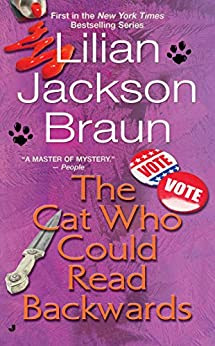
The Cat Who Could Read Backwards (1966) by Lilian Jackson Braun #ReadingtheMeow2024 #20booksofsummer24


🐈 Jim Qwilleran, an award-winning crime reporter, started his new job as feature writer for the Daily Fluxion, specializing at artists profile, though he knew very little about art. Desperate to move out from his current uncomfortable flat, he grabs the offer from the paper's infamous art critic George Bonifield Montclemens, to rent a small apartment in his building.

🐈 Qwilleran's landlord is well known for his ruthless critics of modern artists, making him a hateful character amongst the art people. But Qwilleran begins to be warm towards his quirky landlord, as besides a comfortable though tiny living quarter, he also enjoys, occasionally, Montclemens' delicious cooking of fine-dining quality of foods, and the company of his extraordinary Siamese male cat called Kao K'o-Kung - or Koko to Qwilleran.

🐈 Indeed, Koko is no ordinary cat. Apart from his elegant regal demeanor, his hobby is reading newspaper - yes, reading! - but backwards. Koko has a delicate taste in food, and his favorite game is a mouse toy. When his master's busy or not at home, he even lets Qwill to have him as company.

🐈 At this point you might start wondering whether this is a murder mystery after all as we don't see one yet? It is! An art gallery owner was murdered in his office, while some paintings at the gallery were destroyed. But Qwill noticed something else that only few people could have known. A painting of ballerina that used to hang in the office is missing. Has the murderer stolen it?

🐈 As Qwilleran has been warming his way through the art world, he has the most advantage and enough inside knowledge to solve the mystery. Then, when Montclemens is also murdered, Koko joins paws with Qwill to reveal the truth around the murders. Koko led him to find some clues, not purr-posely of course, but unintentionally. Like when Koko takes Qwill to where his favorite toy - Minty Mouse - was last put, Qwill found interesting facts that helped him in his investigation.

🐈 All in all, it's a highly entertaining cozy mystery with interesting premise - the art world. I loved Koko-Qwilleran's budding chemistry in this book, and hope to see them together in further cases. I also loved them each as character. The whole story has a humorous and intelligent vibes with plausible and proportionate interactions between cat and human, while the mystery has an interesting plot. No need to say, it's a wonderful beginning of a series, which I would definitely continue to read!

Rating: ⭐⭐⭐⭐1/2

Read for:

hosted by Mallika @ Literary Potpourri


20 Books of Summer 2024
hosted by Cathy @ 746 Books