Showing posts with label Nature. Show all posts

Thursday, November 26, 2026

The Backyard Bird Chronicles (2024) by Amy Tan #NonFicNov26


I saved this one for last for Nonfiction November 2026, since this is a memoir about birds and nature journaling; two topics that are currently my interests. I started it with much delight, since, like me, Amy Tan began her bird-drawings also in her middle age (she took a John Muir Laws course for it - and I have intended to read one of his books). Indeed, she shared a lot of her drawings and journals throughout this memoir; and they are all really good and seems pretty alive. I learned much about her technique, and intended to practice it myself very soon. Unfortunately, I also had a bone to pick with her right when her love of observing birds had turned to an obsession. I will explain more in the next paragraphs. But before that, look at this wonderfully drawn picture of a bird; the details are amazing, and it seems like you're looking at a live bird, isn't it?


As you probably know already, Amy Tan is an American author (best known for her novel: The Joy Luck Club - I haven't read that one, but read few of her other novels in the past). Overwhelmed by how the world was going through social media, Amy Tan took refuge by observing birds in her backyard. She began to sketch the birds she saw daily, and put them in journal. Just like any other birders, Amy began to put a feeder or two around her porch; and she took delights observing the birds' feeding behavior. Little by little, Amy Tan became more obsessed by the birds. Putting one or two feeders and filling it with seeds or suet weren't enough anymore. She even took pain to buy large quantities of live mealworms, putting it in the refrigerator (she's lucky her husband is so tolerant to that!), and sorted it out (imagine feeling it wriggling inside you palms - eww!!), and served it to the birds. By the end of the memoir she had put a lot of feeders of various sizes, models, and types, making her backyard a sort of bistro for birds. Indeed she often calls it Amy's Bistro... :)


But then, her obsession towards these birds grew to a little unhealthy obsession. I mean, it's good to have curiosity, and keep asking questions about birds - how they breed, feed, or nestling, etc. It made us a sort of nature detectives. However, if to answer those curiosities we became interfering with the course of nature, I think we have overstepped our role in natural world. And that's what Amy Tan has done. Like, for instance, in this picture she drawn herself:


If I were the bird, I would have been alarmed if a human being watched me so intensely from so close a proximity. Worse still if the bird doesn't, it means it has been tamed enough around human (especially one who constantly supplies food) that it would be dangerous if another human with bad intention approaches it. Wild birds should have stayed wild, or else, we, human, have put them in far more danger than mere hunger or thirst. And what would happen to them when we couldn't feed them any longer? 

Another example, when some crows in her backyard seemed to be alarmed about something, Amy Tan revealed the reason:

Okay, I admit I placed the dummy crow hanging upside down on the rail next to the patio. Our yard was becoming a crow hangout, which scared the other birds. They were making a mess, knocking the feeders every which way to shake out seeds.

You see what she'd done? That is something I would never endorse in ornithophile (that's what a person who loves birds is called :D). It is natural and can't be helped that we get to love one species more than the others - for various reasons - but to my believe, it shouldn't make us taking initiative to "help" that favorite bird against the others. That is intervention - and it's always bad for wild creatures.


Rating: ⭐⭐⭐⭐

Read for:

Nonfiction November 2026
hosted by Heather, Frances, Liz, and Deb


Friday, November 13, 2026

The Comfort of Crows: A Backyard Year (2023) by Margaret Renkl @NonFicNov26


🐦 This nature journal is just the perfect read to kick off my #NonFicNov26! As I have said before, this month I picked nature-related topic as the main reading theme. I am sick of being cooped up at home all the time, and these nature-related book make me feel like being outdoor again, breathing fresh air and listening to birdsong. Margaret Renkl did a fabulous job of both writing and narrating (I listened to the audiobook) her backyard creatures and plants over the year. It's divided into 52 chapters, each following Margaret's observation of both her personal and the backyard lives. 🐦 This book isn't all about crows, there's quite a nice biodiversity in Margaret's backyard in the southern of USA. She keeps a pollinators garden at the back of her house; keeping it more to the wild side than the current fashion of manicured green lawns. She calls it her messy yard, and I liked it. For instance, Margaret loves tiny wild flowers that people call weeds - just like me! In one of my nature journals, I was excited over a tiny weed called Tridax Daisy I found on the roadside; it even taught me about resilience. You can read more of it here. What some people think as pestilence, is actually created by God as equal as any other plants. I therefore endorsed Margaret's disgust of her neighbors using poisons, pesticides, and what not, to keep their gardens "neat", which could kill or harm other unintended creatures like insects, birds, or even, humans.
"What you call the wild flowers will tell you who you are."
🐦 Intertwined with her observation of the backyard garden, Margaret also reveals many anecdotes; they are both from her current life as amateur naturalist, as well as - and these are my favorite - from her childhood in Alabama. One of these anecdotes is the one when she found something spherical-shaped on the deck, which looked like owl's pellet - or was it coyote's dung? Hot discussion emerged on the naturalist group in Facebook. But it's Margaret's husband who finally found the truth - and it was so unexpected and hilarious, that it felt like a plot twist in a novel! I also liked her story about growing toads with her brother, back when they were children in Alabama; or how she rode miles to her brother's house just to watch his night blooming cereus bloomed - I could almost feel the growing anticipation, and finally the serene moment of watching it bloomed. 🐦 I think what I love about this half memoir half journal, is Margaret's poetic narration and her beautiful storytelling. One of my favorite chapters is And Then There Were None - well, you know perfectly well why the title caught my attention in the first place - but more than that, I loved Margaret's admission of her regret of having rescued a bluebird chick, rather than leaving the nature took its own course. I always believe, that leaving wild creatures being wild with least intervention from human being is the best course to take. Another of my favorite is when Margaret witnessed a caterpillar changed into a butterfly under her own eyes, and let it fly, after she rescued it from wasps. It's what I love about reading nature journals - moments when we feel the awe about how natural world works, and how that experience make us appreciate more of our own life, and our Creator.
Rating: ⭐⭐⭐⭐⭐
Read for:

Nonfiction November 2026 hosted by Heather, Frances, Liz, and Deb

Monday, November 9, 2026

Old Herbaceous (1950) by Reginald Arkell #NovNov26


🍓 Two of my most exciting reading events are currently happening: Novellas in November and Nonfiction November! And here is my first read for #NovNov26. First I might mention a little about my current life, here where I live in Surabaya, Indonesia. The Godzilla El Niño has been here since early October, meaning that Surabaya is terribly hot - I can't stay out of air-conditioned or powerfully-fanned room for more than 5 minutes, or I would be profusely sweating. Since I always hate heat and humidity, the hot weather did nothing to improve my temper either, LOL! Combine that, the terrible heat, and the chaotic life I have been having since last month, meaning that I must stop going outdoors for either birdwatching or nature journaling (I typed this while seeing my abandoned nature blog with a deep sigh...) You might also hear about the wildfires currently going on in Kalimantan (Borneo). While Surabaya is in Java, I believe the wildfire in Kalimantan has, nevertheless, a tiny impact on our air too. Well, in any case, my daily checking on Iqair apps shows that the air is often highly polluted and unhealthy. So, to compensate my lost of going outdoor, I picked several nature or bird-related books for #NovNov26 and #NonficNov26. Old Herbaceous is, therefore, a perfect choice for kicking off November!

🍓 Old Herbaceous is a nickname for one legendary head gardener of a country manor house, called Bert Pinnegar. This novella tells us how Pinnegar came to that point of his life, when the villagers given him that moniker, which suited him very much. It starts from the beginning, Bert Pinnegar as an awkward orphan child with a limp - one leg is shorter than the other. While his friends were engaging in playful games, little Bert picked wildflowers in the field, while dodging angry farmers who own the fields. He won a prize at school for his wildflower arrangement, because one of the patrons, a beautiful Lady, endorsed his ingenuity. When Bert was out of school, it is natural that he should work as under gardener at the Lady's house. And, as you may call it, the rest is history. Bert Pinnegar's passion for flowers and garden made him a quick learner, and by the time the former gardener retired, Bert was the perfect choice to replace him. He did wonder by wonder to the garden, and the Lady - who also loves gardening - soon became more a friend than a boss to him. 

🍓 Pinnegar was much praised for serving strawberries very early in April, and for growing a blue flower that his Lady has been dreaming of owning, after a trip to foreign countries. After single-mindedly working hard all his life, now in his old age, Herbert Pinnegar could comfortably reflect on the respect bestowed on him from his peers, his boss/friend/protector - in short, the whole village. What else can an ordinary man hope in life?

🍓 I always love men and women who love their works, and draw satisfaction from it. When one focuses on what one could do in one's work, there's so much one can achieve. And one should be indifferent to others' sneer or jealousy, for the satisfaction of having do one's utmost to complete a job is the one comfort one needs. The respect and fortune are merely a bonus one would be grateful to receive, knowing perfectly well that one really deserves them. Needless to say, I love this novella, it's a very comforting, soothing, and satisfying book to read.
Rating: ⭐⭐⭐⭐1/2


Read for:

Novellas in November 2026
hosted by Cathy & Rebecca


Tuesday, November 3, 2026

October, October (2020) by Katya Balen


🌳 Hello friends! I miss you, and this blog, a lot! You might have been wondering - or not? :P - where have I been this month? Apart from the three books I have read for #1949Club, this was the only book I have managed to read in October - and what an appropriate title it has, isn't it? Well, the reason of my absence, if you care to learn anyway, was too complicated to explain. In short, I have been chaotically busy  beginning the second week of October. Apart from having to do all the house chores by myself, due to my mom's weak heart (she's relatively okay, by the way, just too weak to do her usual activities, and she sleeps a lot); I have had to study for a tax certification exam - which I failed and must do another end of this month :(. On top of those, there's a tax audit going on at work, that my friend and I must prepare all the documents required (which means that our own jobs have been neglecting and we must catch up a lot). All combined together, the result is: exhaustion and stress! Luckily, I have all the books in the world to read and listen to, without which I'll certainly have a nervous breakdown one of these days...

🌳 Anyway, October, October is a middle-grade fiction about ten year old girl who has been brought up completely in the nature. She was named October by her parents, and has lived in the forest since childhood with her father, in a house that the father built. They eat food from their own vegetable patches, or by foraging from the woods. To October, the trees, the bushes, the animals are her true companions; and she has become a wild child. Her mother left them when she's a little child, as she doesn't love the wild as much as her husband and daughter. She (the mother) lives in the suburbs, and would only occasionally visits her family in the forest. October loathes her mother - terribly. She even calls her "the woman who is my mother" throughout the story. That is one thing I failed to grasp - the deep-rooted hatred for one's mother. OK, children hate mothers who abandoned them, but October's mother didn't. She just chose to not to share the wild life style October and her father love. She (the mother) is a kind and affectionate mother, too.

🌳 I think, in a way, this book is a kind of warning to parents, to always introduce their children to the "normal" world. It's okay to be different; to like different things from the world; but at some point the child would have to emerge to this "normal" world from time to time. One must teach a child to be adaptable, even to the unpleasant environment. October lives comfortably among the trees; the woods is her home. But one day, her birthday in fact, a terrible accident befell her father. October's mother arrived in the forest bringing birthday gift, and October ran away from their cave to avoid her. Her father chased October, up to a tree which she climbed like a monkey. But he fell! Now, when the father was "on the mend" at the hospital, the mother brought October to live with her in the suburbs. The wild child must leave the wild behind, and adjusting to the "normal" world of the city - school, noises, and all. Would she "survive"?

🌳 On the whole, October, October - which is, by the way, how October's father used to call her; a nice way to be called, right? There is a poetic quality in it - is a nice read for middle-graders. It connects you with the natural lives, a good way to introduce the charm of nature to teenagers. To adults, parents in particular, like I said before, it's a good reminder to expose children to all the options of life. I wish October's dad hadn't spoiled her that much; he should have been trying to take her out from the woods from time to time; and to make her understand that it's okay to like different thing; that it doesn't mean someone (the mother) doesn't love you by being different. I personally felt sad for October's mother. What's her fault, anyway, to be treated like dirt by her own daughter? She's entitled to like different things from her husband (and daughter). Enough to say, she's the only character in this book I could relate; and my least favorite is October herself. :D Fortunately, I love nature, and this book brings a lot of that aspect to lift up a little of my stress during the read.
Rating: ⭐⭐⭐1/2

Tuesday, July 14, 2026

A Secret Garden in Paris (2024) by Sophie Beaumont #ParisinJuly2026 #20BOS26


🌺 Paris and gardens are two of my favorites subjects, so of course I was delighted to win this book from #ParisinJuly2025 - thanks Emma! This book is about three women who have two things in common - they are in struggles, and they love flowers or gardens. First, there's Australian Emma who is grieving over her mother's death. There's a secret of her mother's past which she had had no time to tell Emma before her death - a secret about Emma's biological father's identity. Now, sad and wondering, Emma is staying at her Parisian grandmother's; and to busy herself, she decided to make over the garden, which had been neglected after her grandfather's death. One day, she visited a flower stall at the Marché aux Fleurs, located at île de la cité - a site which is actually in my "go-to" list of Paris (fingers crossed that I would have chance to visit one day, but if not, let me just dream about). 🌺 Arielle Lunel, a young widow with two little children (twins), works as florist at one of the stall, and she's an unusual one. To Arielle, flowers are not just plants, but they are also representing human emotion. That's why many of her customers visits the stall regularly whenever they need a flower arrangement. Just like this young man, David, who visits everyday, either to buy flowers for his mother's grave, or for ehm...other personal reason, who knows? Arielle's problem is related with her controlling parent-in-law who are proposing trying to take away the twins. Last but not least, there's Charlotte Marigny, a successful middle-aged garden designer with a marriage problem. Her husband Tom has been gradually reserved and withdrawn from his wife and children. Distressed, Charlotte fled to Paris; and during one of her wanderings, she visited Arielle's flower stall. 🌺 After presenting each of these three women's cause of troubles, which lead them to fruitful friendship and beautiful journey around flowers and gardens - their mutual passion - the story dwindles a little. The solution to each problem is too easy and too sudden, and felt rushed. I get the idea of using Paris and gardens for a healing point, but still, they are too suddenly resolved. Emma's garden, for instance, despite the fact that she's never been gardening before, and only learns from internet and book, yet the embryo of the garden 'miraculously' emerged just like that. Charlotte's husband also 'miraculously' awaken from his previous reserve - I had even thought it a much more serious case, like the beginning of Parkinson's disease, for example, which often changes the sufferer into a more reserved and withdrawn personality. 🌺 Fortunately, the gardens provided a much better angle for this book. My favorite part is when Emma had to take a friend of a friend (a tourist from Australia) on a garden tour (visiting gardens around Paris, in place of the usual tourist landmarks). It was her grandmother Mattie - my favorite character in this book, by the way - who came up with a nicely-curated tour. Not only that, Mattie - who had worked as illustrator - also produced a specially illustrated map for the tour, with a little scribbled note on the historical background. I would love to pay for such a tour - if only for the illustrated map. The route is as follows: they started apparently from Place des Vosges, and headed for Jardin de l'hotel de Sully, through the door to the secret garden. From there, to Rue des Rosiers, to visit Jardin des Rosiers through the grilled entrance into the hidden garden behind, where they enjoyed quiet times, accompanied by birdsongs. Next, they walked across Pont Marie, over Ile Saint Louis, to have lunch at one of the cafes or bistros, and ice cream at Berthillon at Rue Saint-Louis. Of course, after that they had to visit the Marché aux Fleurs at île de la cité. Their last destination was Jardin de Luxembourg, where the dancing faun statue "reminds us that in letting go, in trusting to the moment, we open ourselves to the gift of joy." [p.153] 🌺 So, you can see, that this book's main charm is in the gardens and flowers, and everything that they represented, either hope, joy, love, or just our connection to the nature. And I loved this book solely for that reason (and a little for the character of Mattie)! Rating: ⭐⭐⭐⭐1/2
Read for:

Paris in July 2026 hosted by Emma @ Words and Peace
20 Books of Summer 2026 hosted by Annabel @ AnnaBookBel

Friday, January 9, 2026

Keeping A Nature Journal (2021) by Clare Walker Leslie


🌿 So, this is my first read for the new year. A surprise, because I don't usually pick a non fiction to go to on a Christmas holiday. However, I have been itching to start a nature journal, and the holiday seems to be the perfect time to do it. I would share my first ever nature journal later (yay!), but first of all, about the book. Clare Walker Leslie has been nature-journaling for forty years, and is now teaching students how to connect to the natural world and record the impression into diary or journal.

🌿 "The foundation for a naturalist's learning is curiosity and willingness to pursue learning in many different ways: watching, considering, recording, researching, asking questions." And that is what this book is about. First of all, Clare encourages us to take time noticing the natural world around us, wherever we are - in the backyard, taking stroll in the neighborhood, picnicking outside, or even when doing chores inside your house, take time to see outside your windows. Be curious, and record what interest you in quick sketches, even when you're not quite sure what animal or bird or tree you're looking at. In short, Clare instructs us to be more mindful. Clare always keep her journal very near her, so that if something interesting appears, she could instantly take a quick sketch, to be perfected later on.

🌿 Next, is the main topic, that is, the journaling. Clare gives us detailed instruction and many examples of how to keep a nature journal - what to sketch, what to write, what information to put in. There are steps to draw or sketch, from leaves, flowers, trees, insects, birds, larger animals, to tree and landscape. She also gives full instruction of how to scratch a layout from an object in several seconds. From which we can add the details later, with help from guide books, if necessary. We can use colors for shading, either by using coloring pencils, crayons, or watercolors. In many of her examples, Clare often uses pen too to do shading.

🌿 All in all, this book is a perfect one to get anyone starting nature journaling. It is not overly technical, and Clare is humble enough to encourage anyone, even if one never draws, to try nature journaling. It's not the drawing that matters most, anyway, but the mindfulness and the connection to the natural world. The only drawback, for me personally, is Clare's instruction on seasonal sketching. For someone who lives outside America, or at least the West, these sections are a wasting of time. However, the rest is instructive enough, and it really encouraged me to do the hardest step: to produce the first nature journal. And I have done that on the first day of my Christmas holiday. I have planned to go outdoor every day, but alas, I caught a terrible fever on Christmas Day, followed by intestinal cramps that forced me to rest in bed for several days. But I have achieved the hardest thing - to start the nature journaling - so I'll just repeat it on any weekends ahead.


It's not perfect, but I'm proud of myself nonetheless. I am even thinking of creating a blog for these nature journals. Will update about it soon!

Rating: ⭐⭐⭐⭐

Monday, November 25, 2024

Never Cry Wolf (1963) by Farley Mowat #NonFicNov24


🐺 A nonfiction that reads like fiction - that's how I describe Never Cry Wolf: The Amazing True Story of Life Among Arctic Wolves. Farley Mowat is a Canadian writer and environmentalist. Published in 1963, this is Mowat's memoir (some regarded it as fictionalized account of his experiences, but I'd treat it as nonfiction) during his appointment as Canadian Wildlife Service officer to investigate the cause of the declining Arctic caribou populations, and whether wolves are the culprit.

🐺 Mowat left for the Keewaton Barren Lands near Lake Manitoba in 1948. His inexperience in the field (he was a new recruit) provides some of the hilarious accounts; from his arrival by small private airplane, to his first encounter with the wolves. He first stayed with a Canadian named Mike who lives with his huskies in an Eskimo hut. But Mike soon left the hut, leaving him alone.

🐺 As soon as he found a perfect point at Wolfhouse Bay as his quarry, he started his job by following through binoculars, the movements of a family of three adult wolves and their pups who live inside a den not far from Mowat's quarry. He even named the three adults: George and Angeline as the father and mother, and Uncle Albert for the other single male who lives with them, and often share the caring of the pups when their parents are gone. Mowat soon fell to the family routine; George and Uncle Albert are usually go hunting in the evening, and take their leisure naps during the day.

🐺 One day he followed the family approaching a group of caribou who were grazing peacefully, without showing any signs of agitation, though the wolves were only some feet away. Mowat was surprised to witness this; he had expected to see some voracious hunt, but none happened. The wolves just walked away nonchalantly around the edge of the caribous circle. What's happening? That didn't tally what Mowat, what people used to to imagine about wolves - the cunning beasts who ate little innocent children while walking alone, and etcetera (Little Red Riding Hood came to mind). Mowat's observations taught him a rather unsettling truth, that the fast declining of caribou's population isn't caused by wolves, but by men!

"Whenever, wherever men have engaged in a mindless slaughter of animals, including other men, they are often attempted to justify their acts by attributing the most vicious or revolting qualities to those they would destroy. And the less reason there is for the slaughter the greater their campaign of vilification."

🐺 Contrary of common opinion, when they're indeed hunting for caribou, wolves only take the weakest, or most ailing from the pack. The caribous do feed the wolves, but the wolves strengthen the caribous in return, by getting rid of their weakest. In a way the wolves are reserving, rather than endangering, caribous.

🐺 All in all, this was an eye opening, hilarious, but also touching (especially in the end) read about wolves. Some of my favorite moments with Mowat's wolf family are when George saw Mowat when he lowered his pants to pee; then there's Uncle Albert's amorous adventure with a Husky bitch named Kua. Mowat's hilarious moment with Angeline, is when his hungry stomach's loud rumble bemused, then disgusted, her. I just loved how Mowat treated the wolves with respect; that's how we must treat all creatures, flora and fauna.

*I listened to the audiobook, very well narrated by Adam Sims.

Rating:⭐⭐⭐⭐⭐

Read for:

Nonfiction November 2024 #NonFicNov24
hosted by: Liz, Frances, Heather, Rebekah, and Deb


Friday, November 22, 2024

The Golden Mole: and Other Vanishing Treasure (2022) by Katherine Rundell #NonFicNov24


🦒 In The Golden Mole, Katherine Rundell introduces us to some of the world's most exotic creatures which are also endangered. Among these animals, some are no strangers to us, like the crows, wolves, bear, or elephant. We often hear or watch about hare, giraffe, or hedgehog, though we might not see them physically. But how many of us are familiar with wombat, lemur, narwhal, or pangolin? This book talks about all of them, and several others.

🦀 However, this is not some kind of encyclopedia about exotic animals, it's much more interesting. Rundell slips stories, myths, or anecdotes related to each animal, sometimes even concerning prominent historical personages whose stories had been linked to certain animal. The most fantastic is that of Coconut Hermit Crab. You must have been familiar with Amelia Earhart's story of disappearance over the Pacific Ocean while attempting to circumnavigate the world in 1937. One of the many theories believed that some Coconut Hermit Crabs must have eaten Amelia Earhart's body. She was probably stranded on Nikumaroro island, known as home of these crabs. Some human bones were found there many years later, but they're lost on the way to investigation, so we still don't know the truth. But it's an interesting fact nevertheless.

🐨 Another interesting story is involving Wombat. The creature - some says it's a mixture of capybara, koala, and bear cub - was a favorite pet of Dante Gabriel Rossetti, the poet. He had sketched Mrs. Morris (Rossetti's model and muse) taking a wombat on a leash, both with halos over their heads. A wombat had also been gifted to Napoleon's wife, Josephine, by a ship's captain. Speaking of gifted exotic animals, do you know that Cleopatra had once gifted a giraffe to Julius Caesar who then brought it to Ancient Rome?

🐻 A funny anecdote came from the inimitable Lord Byron concerning bear. He used to keep a tamed Bear while studying at University of Cambridge, as dogs were forbidden. When he was asked what they should do with it, his answer was, "It should sit for fellowship" 🤣

🦔 But two animals resonated more to me personally than others. The first is Hedgehog. Whenever I hear the word 'hedgehog', an image from my first picture book, which my mother introduced to me when I was very little, comes immediately to mind. It's a hedgehog with an apple stuck on his spikes, stealing it from two animals who picked it from the tree (the apple falls right to its spikes). That image stuck with me, that I always assume hedgehog eats fruits. But this book taught me that it's just a myth, its diet actually consists of insects and worms. Another animal from my childhood picture books about flora and fauna (my parents bought me a lot of these), is Pangolin (Trenggiling in Indonesian). Its name came from a Malay word 'panggiling' which means roller, from the way it rolls its body while in danger. Their scales were used for Chinese medicine.

🕊 Some more interesting bits from this book:

  • The unihemispheric sleep in swifts (birds), they are able to shut up half of the brain at a time, while floating in the air inside the clouds. Amazing, right?
  • The reclusive creature of Lemur who's able of changing eye color, is another wonder. One of the species is even superstitiously believed to be able to prophecy death.
  • I didn't remember this, but the Seal has capacity of learning language. Ahab in Moby Dick recognized the seals' voices.
  • The Narwhal's tusk were once mistakenly thought as unicorn's horn. Queen Elizabeth I was presented at least two narwhals by some voyagers.
  • The Crows are the Einstein among birds. On an experiment, they punish some boys who're wicked to them, but were known in real life to have rewarded those who fed them.

🐘 Elephants are actually afraid of bees, they sting elephants' soft tissues inside their trunks. Elephants are gentle and caring creatures. When finding bones of dead friend, they will salute it by lightly touching their bones. An elephant returning to its group would get a ceremonial embraces by intertwining their trunks. Seahorse is the only creature that it is the male who gets pregnant (a fact I learned from TV series F.R.I.E.N.D.S, when Ross wants to calm the pregnant Rachel down by pointing this fact out. What about the Golden Mole, who lent its name to the title? As a species, it's nearer to elephant than ordinary mole. It is the most mysterious animal from all that is discussed in this book. We know almost nothing about it, other than its iridescent quality, from which we called it 'golden' mole.

⭐ All in all, it's a wonderful book about nature and its wonder, told in an interesting and sometimes funny way that will interest non-biologists reader like me.

Rating: ⭐⭐⭐⭐

Read for:

Nonfiction November 2024 #NonFicNov24
hosted by Liz, Frances, Heather, Rebekah, and Deb


Wednesday, March 22, 2023

Rural Hours by Susan Fenimore Cooper: A Review


🌳 Rural Hours is a journal written by 19th century female author: Susan Fenimore Cooper. If you feel familiar with her surname, it's because she was the daughter of James Fenimore Cooper, the author of The Last of the Mohicans. More background facts about Susan Fenimore Cooper, and how this journal had inspired Darwin and possibly Thoreau, I have written in my 1st Impression on this book.

🌳 Cooper was an amateur naturalist; she read many books or essays by other naturalists, and recorded her observations on animals, plants, landscape, as well as rural life during her daily excursions, onto her journals. This book was derived from these notes, took up a course of four seasons of 1848, beginning from the spring.

🌳 Reading an amateur naturalist has its advantage. I took pleasure of Cooper's observations, as if I was walking with her, but without being troubled too much with scientific phrases of a pedantic. While bird-watching, she would observe:

"It was amusing to watch the parents flying home, and listen to the family talk going on; there was a vast deal of twittering and fluttering before settling down in the nest, husband and wife seemed to have various items of household information to impart to each other, and the young nestlings made themselves heard very plainly; one gathered a little scolding, too, on the part of some mother-robins."

Can you imagine yourself taking a stroll with Cooper, bird-watching with amusement like that? That has always been my dream!

🌳 I loved Cooper's sharp wit in her observations, such as when she wrote about a spider:

"A huge spider, by-the-bye, with her intricate web and snares, would form no bad emblem of a courtier and diplomatist, of the stamp of Cardinal Wolsey. He certainly took "hold with his hands, in kings' palaces," and did his share of mischief there."

🌳 Beyond the animals or plants (she could talk about trees for some pages!), Cooper is also a sharp observer of human nature and their civilization. She criticized her nation for their reckless behavior towards horticulture, and for not focusing on the advantages of gardening. She also noticed how her people were gradually taking distance from nature, even on adorning their houses:

"In very truth, a fine tree near a house is a much greater embellishment than the thickest coat of paint that could be put on its walls, or a whole row of wooden columns to adorn its front; nay, a large shady tree in a door-yard is much more desirable than the most expensive mahogany and velvet sofa in the parlor."
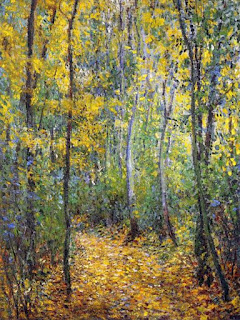
Wood Lane, Claude Monet, 1876


🌳 I loved also her observation on the simple life of farmers, when visiting a farmer house, she observed that they provide most of their domestic needs at home; doing all their spinning, weaving, dyeing by themselves.

🌳 Sometimes Cooper would talk about some unusual sights, like how, on one foggy dawn, a flock of wild pigeons alighted on the trees at the heart of the village (a rare sight!), and only after the fog has lifted, that the birds flown again. Some cows Cooper saw on her walk one evening, were returning home after pasturing along the road side or unfenced woods. They were left to forage by themselves, and usually came from different houses. They would leave home in the morning, and return home in the evening, one to this house, the other to that - all by themselves without anyone accompanying them.

🌳 Few more amusing things Cooper observed: Otters - these animals have one very strange habit: it is said that they actually slide down hill on the snow, merely for amusement. Then there is her amusing comment on singular leaf of a tree that dances merrily, moved by some light puff of air:

"A single leaf or two in rapid movement, all else still and calm; and one might fancy Puck, or some other mischievous elf, sitting astride the stem, shaking his sides with laughter at the expense of the bewildered spectator."
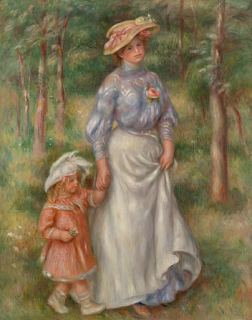
La Promenade, Pierre-Auguste Renoir, 1875


🌳 Cooper shared her father's sentiments regarding the Indians, which she showed in her note: "..a savage race is almost invariably corrupted rather than improved by its' earliest contact with a civilized people; they suffer from the vices of civilization before they learn justly to comprehend its merits. It is with nations as with individuals-amelioration is a slow process, corruption a rapid one."

🌳 I've just realized that the US named their rivers, mountains, or cities with Indian names: Michigan, Ontario, Mississippi, Potomac, and many more. Cooper beautifully put it into this reflection:

"A name is all we leave them, let us at least preserve that monument to their memory; as we travel through the country, and pass river after river, lake after lake, we may thus learn how many were the tribes who have melted away before us, whose very existence would have been utterly forgotten but for the word which recalls the name they once bore. And possibly, when we note how many have been swept from the earth by the vices borrowed from civilized man, we may become more earnest, more zealous, in the endeavor to aid those who yet linger among us."


🌳
Sometimes too, we get glimpses of some village stories or legends. One of my favorites is of a pet fawn, who, after being saved from haunting dog's chase by some people, was then shot by a hunter because it approached him without fear. Another reminder to us to let wild animals be wild!

🌳 I think from what I've written and quoted above, you can see how I loved this book! For a person who live in a tropical country with only two seasons: wet and dry, where the flowers keep blossoming, and the landscape never changes its hue, Cooper's journal provided me with invaluable glimpses of the four beautiful seasons I wouldn't have witnessed. I loved every little change of the lake color, the leaves, or the flower petals, from season to season. I'm a 'color' person, and this has been a wonderful "experience" of a lifetime, though only through Susan Fenimore Cooper's pen.

Rating: 4,5 / 5