Friday, May 3, 2024

Agatha Christie Short Stories 2024: MAY #AgathaChristieSS24


May is finally here, and I am looking forward to a milder weather here where I live, and a calmer month in general. Let's see what kind of stories we are going to read!


THE SIGN IN THE SKY

It's another Harley Quin's story, in which Mr. Satterthwaite attends the trial of a young man accused of murder. Shortly after the guilty verdict is returned, Satterthwaite runs into Harley Quin. Can they prove the man innocent? Or is he actually a murderer?

The story was first published in book form in the collection The Mysterious Mr Quin, published by Collins in 1930, which altered the title slightly from the original magazine publication's A Sign in the Sky. The collection was dedicated to its eponymous hero and is the only book of Agatha Christie's to be dedicated to a fictional character!


THE CRACKLER

Tommy and Tuppence are sleuthing again after a clever counterfeiter who has been flooding both sides of the Channel with phoney bank notes. This story sees the Beresfords as the Busies, in an Edgar Wallace-type adventure, which parodies Wallace’s slapdash, action-laden thrillers. "We need several hundreds of yards of extra book shelf if Edgar Wallace is to be properly represented" Tuppence says at one point, referring to Wallace’s vast output.

This story was published by Collins in the collection Partners in Crime, 1929, and the title was changed from The Affair of the Forged Notes to The Crackler. It was adapted for radio in 1953, starring Richard Attenborough and Sheila Sim. It also featured in the 1983 TV series Agatha Christie’s Partners in Crime, with Francesca Annis and James Warwick.

Both stories seem quite fun, don't they? Happy reading, and enjoy!

Wednesday, May 1, 2024

Zoladdiction 2024 Wrap-Up


May is here, and it means that Zoladdiction 2024 is coming to the end. I don’t know how the others had managed – April has been so crazily hectic for me, I couldn’t even check your blogs, let alone read all your Zola posts – so sorry! On my part, I have read and reviewed two short stories, and barely managed to finish the audiobook review of Germinal (a 3rd re-read) in time. All in all, I’m pretty relieved that I completed what I had planned to read, but it got me re-thinking about the future of Zoladdiction. I have hosted this event for eleven years now, but it begins to feel like a burden. My responsibility at work is increasing, following the company’s growth, and April happens to be the busiest month of the year with the annual tax report, and what not. That being said, I don’t know whether I’m going to host Zoladdiction next year or not. Let’s just see then!

I would like to thank all of you who had participated in Zoladdiction 2024, and wish you had a good time! Especially Brona, whose chronological read of Rougon-Macquart brings her to A Love Story (Une Page d'Amour); Nancy, who had read the same book (Une Page d'Amour); and Mallika, who had read the same short story I've reviewed earlier: Captain Burle - thanks to all your reviews! If you have reviewed or posted anything Zola but not mentioned here, please leave link to your post on the comment below, I’ll add them to this post, and will try to make time to read them!

Monday, April 29, 2024

The Mystery of the Burnt Cottage (1943) by Enid Blyton: The Five Find-Outers #1


๐Ÿ”ฅ Every now and then I always allow myself to a nostalgic reading. Enid Blyton's The Five Find-Outers is one of my earlier introduction to novels. Her Famous Five is probably the more well-known series, but I think I like The Five Find-Outers (and a Dog) a little better, as this series involves more mystery than adventure.

๐Ÿ”ฅ This one is the first in the series, where we are first introduced to Larry and Daisy, Pip and Bets - four teenager (age around eleven and thirteen, Bets is the younger - ten, perhaps?) live in Peterswood village. One night as they are watching their neighbor's cottage burnt down, they meet a rather smug boy who has just moved to the neighborhood with his parents. His name is Frederick Algernon Trotteville, but they nickname him Fatty - not body shaming the rotund boy, but it is derived from his initial (F-A-T). They don't really like the boy who's too much into himself, but they like his little dog Buster. So, they welcome Fatty into the group.

๐Ÿ”ฅ The burnt cottage belongs to a Mr. Hick, a kind of scientist, who claims that he lost his most precious papers during the fire. People begin to talk that someone burned that cottage on purpose. Fatty happened to notice a tramp hanging around Mr. Hick's garden the night of the fire. Was he the perpetrator? The children decide to play detective and investigate. They call their club the Five Find-Outers and Dog.

๐Ÿ”ฅ It's delightful to follow the five children's enviable lives; with freedom to spend their days outside school, doing chores, and meals. They usually gather at Pip and Bets' place to discuss any progress on the investigation and to decide their next steps. It's ranging from finding clues to interviewing suspects. But they must solve the mystery quickly before the local police (whom they nickname Clear Orf - his favorite phrase when seeing children around) beats them.

Rating: ⭐⭐⭐⭐

Friday, April 26, 2024

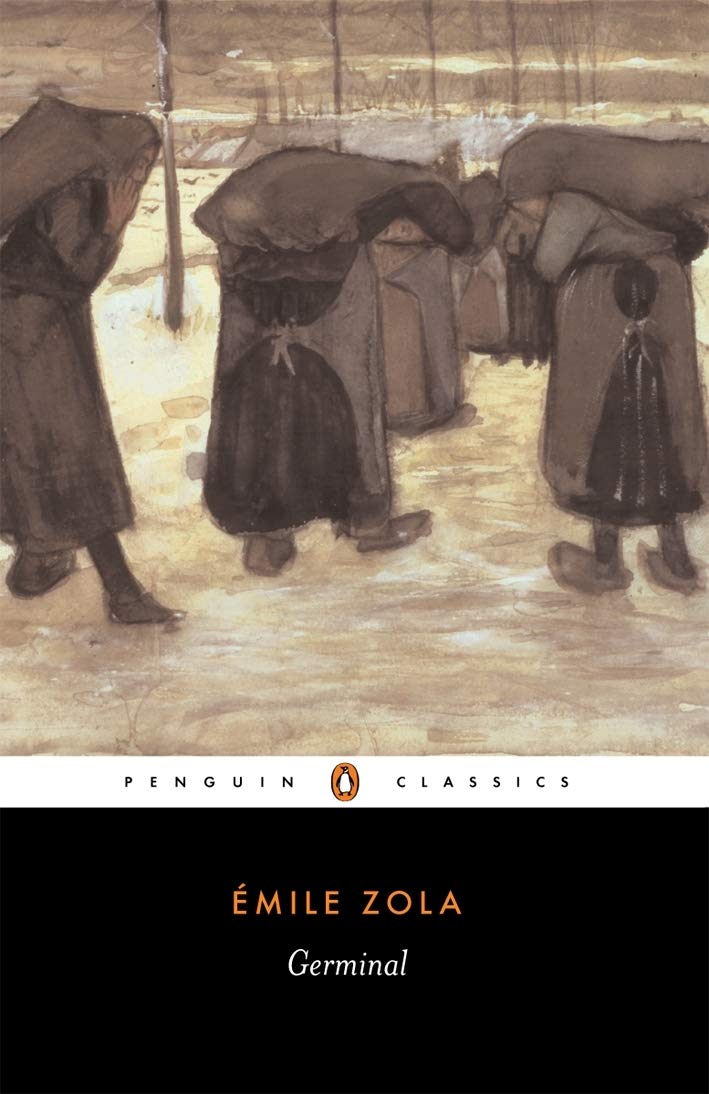
3rd Reading of Germinal by ร‰mile Zola #Zoladdiction2024


❤ Time and again I have mentioned that Germinal is my all time favorite book. I haven't yet found any other which is as compelling and eloquently written as this Zola's chef-d'ล“uvre - magnum opus. This was my third read (listen, actually) of it, and I still hold on to my conviction, that Germinal is the most magnificent work I've ever read.

❤ Germinal is about the life and struggles of mining workers in a small town of Montsou, where ร‰tienne Lantier (offspring of the Macquart line, with history of drunkards in the family), is looking for a job. He serves as the outsider's point of view of the local struggles (this is Zola's usual trope - a newcomer who changes or stirs the existing ground). Germinal has quite many facets of the story, the social injustice towards the working class; their hatred to the bourgeoisie; the struggles of the bourgeoisie - sandwiched between their inferior and superior of the "bosses" in Paris. It also touches on the socialism dream, and, of course, Zola's pet topic: naturalism.

❤ The strong point of Germinal lays in, as are with Zola's other books, his vivid narration of the landscape. You'd feel suffocated just by reading about the condition in the coal mine, hundred meters below the earth, which Zola brought to life through his magnificent research and detailed description. Another strong point is the eloquent prose with which he told this drama of human nature with its raw emotion. You'd feel the characters' anguish as if you are their kin.

❤ I think Germinal is one book that has to be read, not listened to. Either the audiobook I listened to uses edition with less qualified translation, or Zola's words are more eloquent read inside my head, rather than narrated. I don't blame the narrator, though, Leighton Pugh do a great job. I have listened to his narrating The Ladies Paradise, and really liked it. Germinal is just too eloquent to be narrated, that's what I think. Other than that, I think I wasn't supposed to read this book during my current mental condition. It conveys a huge amount of sorrows and helplessness (though with a little sparks of hope of brighter future in the end), and now just isn't a good time to read about these dark elements. Thus, I decided to give Germinal a rest for at least five or ten years before taking it again for the fourth time. Or maybe.... a great book is supposed to be read not more than twice, to preserve its magnificent quality? I don't know... 

Read this book for:


Monday, April 22, 2024

Have You Got Everything You Want? by Agatha Christie #AgathaChristieSS24


๐Ÿ’Ž A recently-married young wife is on board the Orient Express to Constantinople to join her husband, who had been there some days before. She recognizes a man whose name is familiar to her from The Times ad she often notices: 'Are you happy? If not, consult Mr. Parker Pyne.' Well, Elsie is unhappy right now, so she consults Parker Pyne.

๐Ÿ’Ž A week before her husband left for Constantinople, Elsie found on the blotting paper few lines of her husband's writing: 'wife', 'Simplon Express', and the most curious one: 'just before Venice would be the best time'. Elsie is naturally worried, and Parker Pyne takes the matter in his hand.

๐Ÿ’Ž Near Venice, a little incident happens, and during the confusion, Elsie's jewelries were stolen. A Slavic woman is their suspect, but they find nothing on her. Where the jewelry could have been? At one point Elsie can't trust Mr. Pyne any longer as he didn't deliver what he had promised. But Parker Pyne proofs he's a good detective besides his skill of making people happy.

๐Ÿ’Ž It is a light story, and the perpetrator isn't hard to guess. Nonetheless, it's an entertaining piece of story with a bit of cuteness. I guess that's what makes every Christie's a comfort read for me. It's not just about the mystery (and they are usually simple-clever), but Christie seems to always promote love as the greatest mystery of human being. And she delivers them with a humorous cheekiness. ❤

Rating: ⭐⭐⭐⭐

Friday, April 19, 2024

How Do You Live? by Genzaburo Yoshino #1937Club


๐Ÿ–ค Genzaburo Yoshino was graduated from college in the 1920s with a degree in philosophy, but his interest was soon shifted to politics. In 1925, Japan passed the Public Security Preservation Law, forbidding its people to say or write anything critical to the government. Yoshino was arrested and imprisoned for eighteen months after attending political meetings with socialists. After being released, a friend offered him a job of editing ethics textbook series for younger readers, to teach them the importance of free and rich culture to human progress. Yoshino thought such books would bored young readers, so they came up with the idea of writing it as a novel instead. How Do We Live? is the end result.

๐Ÿ–ค The story is about a fifteenth year-old boy called Honda Jun'ichi, but nicknamed Copper. It's an interesting story how Jun'ichi got this nickname. His father died two years before, and his last wish was that Copper would grow into a good human being. So, Copper's uncle begins to guide and advice him. They become very intimate and inseparable.

๐Ÿ–ค One day Copper and his Uncle are on top roof of Ginza, looking down on the busy street of Tokyo. At that moment Copper realized how tiny his existence was, just like a single molecule within the wide world. And that's when his Uncle starts writing a letter-like notes to Copper in a notebook. His topic ranges from science (Coppernicus - that's whom Copper got his nickname from), philosophy, ethics, to culture (Buddhism) and history (Napoleon).

๐Ÿ–ค Through out the story, we are presented alternately with Copper's struggles at school, as well his impressions of human beings; and with the Uncle's long notes on various topics accordingly to what Copper has faced or shared to him about. Inspiring and reflective though they are, I think these lectures could have been too long-winded, if they were addressed to young readers. My favorite part is when Copper befriends a poor boy, whose family own a tofu shop. Well, not so poor as they have few employers, but is considered poor compared to the wealthy families the boy is in school with. I just wondered why the poor family chose this school for the boy in the first place. Anyway, it provides a nice education for Copper. Another one is one of Copper's friends is bullied, and how Copper, when the moment come when he should've stood up for his friend, failed to do so, and it tormented poor Copper. What a huge learning he got from that experience, what with his understanding mother and intelligent uncle! 

๐Ÿ–ค All in all, it's a gem from bygones that I'm very glad to have found, thanks to the 1937 Club! Speaking of 1937, it's refreshing to be able to take a journey to Japan in that era. I would love to seeing newsreel film at the theater, like what Copper and his uncle do for leisure.

A few wonderful quotes:

"A heroic spirit that's not devoted to human progress may be empty and meaningless, but goodness that is lacking in the spirit of heroism is often empty as well."


" When you have made a mistake, to recognize it bravely and to suffer for it is something that in all if heaven and earth, only humans can do."


Rating: ⭐⭐⭐⭐

Read this book for:

hosted by Simon @ Stuck in a Book & Karen @ Kaggsy's Bookish Ramblings


Thursday, April 18, 2024

The Classics Club Spin #37


I am almost completing my annual task of tax reporting at work, and I think I deserve some excitement, that is…. The Classics Club Spin! I will allow the Spin to decide which book I will read for May. But first…

What is Classics Spin?
It’s easy. At your blog, before next Sunday 21st April, 2024 create a post that lists twenty books of your choice that remain “to be read” on your Classics Club list. This is your Spin List. You have to read one of these twenty books by the end of the spin period. On Sunday 21th, April we’ll post a number from 1 through 20. The challenge is to read whatever book falls under that number on your Spin List by the 2nd June, 2024.

My list:

--UPDATE: I'll be reading: Stormy, Misty's Foal-- 


  1. A Room with a View (E.M. Forster) – DNF several years ago, just because I was not 1n the right mood.
  2. Frenchman’s Creek (Daphne du Maurier) – planning to read for Daphne du Maurier Reading Week (if happening).
  3. Lucy Gayheart (Willa Cather) – I used to do a personal Willa Cather reading month, and been meaning to start again this year.
  4. The Cornish Coast Murder (John Bude) – planning to read for A Century of Books, year 1935.
  5. Queen Lucia (E.F. Benson)
  6. Cranford (Elizabeth Gaskell)
  7. The Duchess of Bloomsbury Street (Helene Hanff)
  8. Stormy, Misty's Foal (Marguerite Henry)
  9. Cold Comfort Farm (Stella Gibbon)
  10. The Enchanted Barn (Grace Livingston Hill)
  11. From the Mixed-Up Files of Mrs. Basil E. Frankweiler (E.L. Konigsburg)
  12. Cider with Rosie (Laurie Lee)
  13. Miss Marjoribanks (Mrs. Oliphant)
  14. Excellent Women (Barbara Pym)
  15. The Nine Tailors (Dorothy L. Sayer)
  16. Rhododendron Pie (Margery Sharp)
  17. The Black Arrow (Robert Louis Stevenson)
  18. The Reef (Edith Wharton)
  19. A Woman of No Importance (Oscar Wilde)
  20. Maltese Falcon (Dashiel Hammet)

Spot a favorite or two? Which ones do you hope the Spin pick for me? I’m hoping for no. 2 and 4, but any book will be nice!