Wednesday, July 10, 2024

Manx Gold by Agatha Christie #AgathaChristieSS24


๐Ÿ’ฐ Cousins, as well as lovers/fiancรฉes, Fenella and Juan, gets a surprise from their deceased uncle. He bequeathed his gold to his next of kin, but in competition. He had hidden the gold in four locations, and whoever of the four candidates (Fenella and Juan counted as one, and there are two others) can find them, the treasures will be theirs.

๐Ÿ’ฐ Fenella and Juan get 24 hours advanced start because their Uncle knew the others are cunning and unscrupulous. He was right. Just after first treasure was found, one of the two was murdered. So now, the treasure hunt turned to a dangerous game.

๐Ÿ’ฐ To be honest, this is a disappointment for me. Judging from the synopsis, I thought it would be a proper, albeit short, treasure hunt with a murder. In reality, there was a hunt, but the readers didn't know what's going on most of the time. After getting a clue in rhyme, for instance, it would run like this: "I think it's located at (...). Then they went to the spot, searching for a while, and then "I found it! Let's go to the next clue". Just like that, and the readers were not involved in the searching at all. It read like a news about a treasure hunt, not a story. 

Rating: ⭐⭐⭐

Monday, July 8, 2024

The Girl Who Reads on the Mรฉtro (2017) by Christine Fรฉret-Fleury #ParisInJuly2024 #20booksofsummer24


๐Ÿ’› Juliette doesn't love her 9-5 job at the real estate agent, but she loves her metro journey to the office every day. Juliette lives a melancholic life as an ordinary young woman, a life ruled by monotony, devoid of either purpose or passion. Her sole entertainment are two things: books and imagination.

๐Ÿ’› Besides her love for reading, she loves to imagine the lives of her fellow metro passengers, through books they read every day. There's a woman who always cries when she gets to page 247 of the same book she always read on the Metro. Then, an ornithologist who loves reading book about insects, and a lady with her cook book. Juliette's imagination brings colors to her otherwise bleak existence.

๐Ÿ’› Her life changes when Juliette passes a different road to office, and notices a curious little bookstore with a book wedged on its gate. Intuitively she enters the tranquil courtyard which feels like another world from the hustle bustle of Paris. There she becomes acquainted to Soliman, the bookshop owner, and his daughter Zaide, and without realizes what's happening, Juliette agrees to be a passeur.

๐Ÿ’› Soliman's bookshop isn't an ordinary one. He hired passeurs who match books with people they see - books that they would need or books that match their personalities. The kind of occupation that suits Juliette perfectly and correlated to what she's been doing lately on the Metro. But her biggest life change didn't happen until Soliman asked her to move into his house to take care of little Zaide while he's away.

๐Ÿ’› This is the kind of book without much of a plot. Its strength lays on the beautiful writing and its deep understanding of human struggles and the power of books to heal or guide human lives. I would love it better if it tells us more about the bookshop and the passeur concept. Are the secondhand books passed on to people freely, or should they pay for them? Because Juliette only passes them on to people, there are never any transaction. And if they are free, then how the bookshop keep itself running? If the books are sold from the shop, but some of it are passed on to readers, there are no hints of business along the story. These aspects made the story less relatable to me, though I love the bookshop itself - the tranquil hushed-up atmosphere which seemed to transport me to a secret alley in Paris which is hidden from tourists.

Rating: ⭐⭐⭐1/2

Read for:

hosted by Emma @ Words and Peace


20 Books of Summer 2024
hosted by Cathy @ 746 Books


Saturday, July 6, 2024

Six Degrees of Separation, from Kairos to The Unexpected Mrs. Pollifax


Six Degrees of Separation
is a monthly meme, now hosted by Kate @ books are my favorite and best.

On the first Saturday of every month, a book is chosen as a starting point and linked to six other books to form a chain. Readers and bloggers are invited to join in by creating their own ‘chain’ leading from the selected book.

This month we start from yet another book I haven't read:


0. Kairos by Jenny Erpenbeck


"An unforgettably compelling masterpiece—tells the story of the romance begun in East Berlin at the end of the 1980s when nineteen-year-old Katharina meets by chance a married writer in his fifties named Hans. Their passionate yet difficult long-running affair takes place against the background of the declining GDR, through the upheavals wrought by its dissolution in 1989 and then what comes after. In her unmistakable style and with enormous sweep, Erpenbeck describes the path of two lovers, as Katharina grows up and tries to come to terms with a not always ideal romance, even as a whole world with its own ideology disappears." ~ Goodreads

I feel a bit lazy today, so I'm going to do this in easiest possible way. My first chain would be a classic by another German author:


1. The Nutcracker and the Mouse King by E.T.A. Hoffman


A Christmas classic I've read for the first time last year. I have never seen the ballet, but suspect that it would be much more beautiful than the book.

Another book with boy and girl siblings secondary characters but with no less importance to the story is...


2. Scarlet Feather by Maeve Binchy


It was my first Binchy, but loved it very much, I'll definitely read more of her. I read this for the last Ireland Month.

I would link this to another book with the word "scarlet" in the title:


3. The Scarlet Letter by Nathaniel Hawthorne


It was called a classic for a reason. I found layer upon layer of depth beneath the story that I produced a lot of posts around it.

Still linking words in title, here's a book with "letter" in the title:


4. Dear Paris: The Paris Letters Collection by Janice MacLeod


I learned so much more about Paris from this collection of illustrated letters than from any other sources before. What a joyful book to read!

Another play with the same words in the title, my next chain shares the word Paris :


5. Mrs. Harris Goes to Paris by Paul Gallico


A British charwoman won a lottery to buy her dream Dior dress in Paris was the most delightful read you'd come across!

For the last chain, here's another book with "Mrs" in the title, which shares similar elderly women who still have some spirits left in them for another life-changing adventures:


6. The Unexpected Mrs. Pollifax by Dorothy Gilman


A charming, funny, and sweet story to enjoy, with spy-adventures - rather than thriller. It's also a good way of learning a little about the Cold War and Albanian culture in the 1950s.


Have you read those books? If you do #sixdegree, how it worked out for you this time?

Friday, July 5, 2024

Madam, Will You Talk? (1955) by Mary Stewart #ParisInJuly2024 #20booksofsummer24


๐Ÿš˜ Set in the 1950s (about ten years after WWII), a British widow named Charity Selborne is on holiday in Provence with her friend Louise. At the hotel she gets acquainted with a 13-year-old boy and his dog who introduced himself (the boy, not the dog) as David Shelley. Now, Mrs. Selborne was formerly a teacher and is very fond of poems. The boy's name Shelley naturally amused her, and the fact that the boy himself knows of the poet David Shelley. So casually she's jokingly mentioning David Byron, at which, surprisingly, she noticed David turned pale.

๐Ÿš˜ That incident later on became a significant clue to the forthcoming events that will completely change Charity's life. Another important clue related to poets or poems is that another guest of the hotel who was reading T.S. Eliot at breakfast. There's yet another poet-related fact to this story - Charity learned from other guest that David is actually the son of Richard Byron, an antique dealer who had been accused of murder. Mrs. Bristol, who's travelling with David, is Byron's second wife, and David stepmother.

๐Ÿš˜ David and Mrs. Bristol are clearly scared and worried, but of what it who? Charity got the answer when she took David to a local trip, where a man called Richard Coleridge chatted with her - yet another poet! His reaction when she let slip that she knew David, md his persistent question of David's whereabouts made her realize that the man was none other that Richard Byron - David's father, the murderer. Thanks to Charity's quick thinking, she and David had time to flee from Byron's clutch. But how long will it take for him to trace them?

๐Ÿš˜ From the queen of romantic mystery genre, this is more of a gripping thriller with high-speed car chase scenes from Provence to Marseilles, than a mystery. Charity turned out to be a terrific driver and quite a resourceful heroine with iron nerves, though not of the same quality as a sleuth. The romance is clichรฉ, and I think I prefer a proper mystery with a sprinkle of romance than an equal portion of romance and mystery. The romance here feels a bit rushed to be plausible, but too much for just a sprinkle to spice up the thriller. All in all, it's an entertaining page-turner book, where you could explore the roads of Provence and Marseilles in the 1950s.

Rating: ⭐⭐⭐1/2

Read for:

hosted by Emma @ Words and Peace


20 Books of Summer 2024
hosted by Cathy @ 746 Books


Wednesday, July 3, 2024

Perestroika in Paris (2020) by Jane Smiley #ParisInJuly2024 #20booksofsummer24


๐Ÿด Perestroika, or Paras for short, is a racehorse. But as much as she loves racing - the adrenaline rush when flying to the finish line - Paras is, by nature, a curious filly. One day her caretaker forgot to lock her stall door, and Paras found her first freedom. She didn't run away, just tasting the fresh grass outside, here and there (grass tastes differently in different place, you know). Further and further she wandered, until she's near Place du Trocadero, where she met Frida.

๐Ÿด Frida is not a stray dog. She used to belong to a street performer who loved to wander along Paris. But after he died, Frida has been living by herself, remembering that she must not act like a stray, or else the gendarmerie would take her to "prison". And Frida hates confinement. When she first met Paras, Frida was more interested in the thing that Paras brought - the caretaker's purse - than of the horse itself. From her living with her late owner, Frida knows the value of money. She goes shopping for them all every day, taking one bank note at a time. The kind grocer thinks Frida shops for her humans, and pretty amused with this canine customer.

๐Ÿด Soon Paras and Frida were joined by an old raven, and the three live quite harmoniously within the garden of Champ de Mars. A dog and a raven are common sights in Paris, but what about a horse? Well, people nowadays are more interested in their own businesses or smartphones, no one would have seen unusual things about the garden. Moreover, Paras takes her nap during the day and starts wandering around after dark.

๐Ÿด But is Paras really unnoticed by any human being? The gardener found horse manure around some corners, so he knew there's a horse, but never actually saw it. During one of Paras' evening excursion, she found a young woman called Anaรญs who works at night for a patisserie. She often feeds Paras, so Anaรญs too knows about a horse loitering in Paris.

๐Ÿด Finally there's an orphan little boy of about eight, who lives with his great grandmama. He "could" see Paras, and the two became inseparable best friends. I think moral of this story is that modern people have mostly lost the ability of being humane. They stick to their smartphones, tablets, social media, and forget what's more important of being human - love, friendship, and caring for others. The fact that none of these Parisians see a horse who share probably their daily jogging track is rather worrying. They most probably don't care either for their neighbors, friends, and so on. Some who do know about the three unlikely friends, and concern about them, are the happiest of all. They have a wholesome life as human being.

๐Ÿด This is a book about Paris, but also about freedom, choices, and friendship. Jane Smiley did a great job to make me transported to Paris and vibes I had experienced more than twenty years ago (but I still remember very clearly to this day). I loved especially the animals interaction, with other animals and also with humans. It's a heartwarming story and the perfect book to start Paris in July this year!

Rating: ⭐⭐⭐⭐1/2


Read for:

hosted by Emma @ Words and Peace


20 Books of Summer 2024
hosted by Cathy @ 746 Books


Monday, July 1, 2024

Agatha Christie Short Stories 2024 JULY #AgathaChristieSS24


Halfway through our #AgathaChristieSS24, we are going to have double fun: a treasure hunt and a party. Yeah baby, bring it on! ๐Ÿฅณ

MANX GOLD

Two cousins eagerly return to the Isle of Man for the reading of their uncle's will. Having grown up hearing tales of buried treasure on the island they are excited when the will reveals their uncle had found it. But where?

This story is probably the most exciting we've read so far. Not only about the story itself, its background is no less interesting. So, in 1930 Christie accepted the grand sum of £60 to write this story. It came as a request from the people responsible for boosting tourism on the Isle of Man. The clues were written in a ‘treasure hunt’ format and were published by Manchester’s Daily Dispatch, and distributed in pamphlet form to hotels throughout the island. Imagine what an exiting moment it was for the visitors! But no worry, we would be able to have a little taste of the excitement by reading and review this story!


THE GENTLEMAN DRESSED IN NEWSPAPER

From a treasure hunt to a party. And we're going to it with Tommy and Tuppence, who discovered a secret invitation to a ball in the newspaper.

Tuppence was in boredom. She wants to go dancing and is reading the paper in search of a party. That is until she discovers a secret message in one of the articles. Just what does it mean to “finesse the king”? This story, which was published by Collins in the collection Partners in Crime, 1929, does sound like a jolly one to read, does it?


Saturday, June 29, 2024

Six Books Saturday #10: Memorable Horses in Books


#SixBooksSaturday is my personal monthly bookish meme, inspired by Six Words Saturday, which I've stumbled upon @ Travel with Intent. It's basically to list six books of random category, which I'd decided on the spot. Anything is possible according to my whim. I post Six Books Saturday on last Saturday of each month. If you're interested, you are, of course, welcomed to join me. There's no rule, really. You can post six anything about books.

I just realized that I have been reading more than a few books about horse lately. I always love horses - in books or movies I mean. I tend to love every book with horse that I've read so far, so why don't I feature the creature in this month's Six Books Saturday? Here they are...


SIX MOST MEMORABLE HORSES IN BOOKS


Beauty in Black Beauty (Anna Sewell)


My love for the equine was probably started when I read Black Beauty. Anna Sewell did a fantastic job in bringing the horse to life. A beautiful book about a beautiful creature!


Joey in War Horse (Michael Morpurgo)


Joey the War Horse is probably the most sensitive horse I've read so far. His personality made the book shone, more than his handsome appearance, with chestnut color, four equally white socks and a white Cross on his forehead.


Gabilan in Red Pony (John Steinbeck)


I think Gabilan's memorable feature for me is his color - red (he must look quite striking!) and his name. Poor Gabilan the red pony!


Paras in Perestroika in Paris (Jane Smiley)


(I have just finished reading the book for Paris in July, but the review would be up next week.)

Paras, short of Perestroika (what a name for a horse!), is a horse with the most interesting character I've ever read. She's so cheerful and inquisitive that her life as a racehorse didn't dampen her spirit at all. She's also kindhearted and amiable that her presence is always uplifting for others. I love her!


Battaile in Germinal (Emile Zola)


Okay, Germinal isn't about horse at all. Battaile is a minor character too, and there's little of him that we know of, apart from his being brought down to the coalmine from his early life. But his plight is so touching that makes him very memorable. The miners are able to go up again after work, but Battaile never see the sun again for the rest of his life, and that broke my heart more than the miners' sorrows!


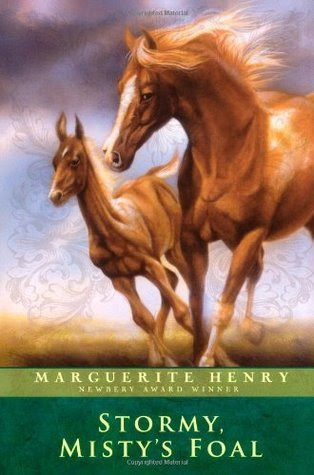
Misty in Stormy, Misty's Foal (Marguerite Henry)


What I love most about Misty is... her name! Misty is such a gentle soul, that the name Misty matches her perfectly. |


Honorable mention:

Potato Chip in Aunts aren't Gentlemen (P.G. Wodehouse)

I have to mention this one, even though his (or her? I think it's a he) role isn't that important. But how can you forget a racehorse called Potato Chip in a Wodehouseian universe who won't prance unless his BFF of a cat is present. Cute, isn't it? 


Have you read any of them? Which one is your favorite?


Next Six Books Saturday: 27th July 2024.