Tuesday, July 17, 2012

[Non-English Victorian Author] Émile Zola


If you ask me what I came to do in this world, I, an artist, will answer you: I am here to live out loud.” ~ Émile Zola

Still in the event of A Victorian Celebration, I have a plan to explore two non-English Victorian authors of my favourites. This particular post would be about one of them: Émile-Édouard-Charles-Antoine Zola, who is famously called Émile Zola. Born in Paris on April 2, 1840 from an Italian engineer, Zola is mostly recognized for his naturalism theory and his political move in the Dreyfus affair—a case of a falsely-accused man, besides his novels.

Naturalism

Naturalism is an extension of realism movement in literature. “In literature it extended the tradition of realism, aiming at an even more faithful, unselective representation of reality, a veritable “slice of life,” presented without moral judgment. Naturalism differed from realism in its assumption of scientific determinism, which led naturalistic authors to emphasize man’s accidental, physiological nature rather than his moral or rational qualities.” [Encyclopedia Britannica]. It is believed that Émile Zola was the first author to introduce the use of the term ‘naturalism’.

Life and early career

His father died when Zola was four years old, and left the family with a small pension. Actually his mother had wanted Zola to take a law career, but he failed in his examination. Since childhood Zola made friend with Paul Cézanne, a famous artist and a Post-Impressionist painter, who painted Zola together with his writer friend, Paul Alexis on 1869-1870. However, the friendship broke up after Zola fictionalized Cézanne and his Bohemian painter friends’ life in his novel: The Masterpiece (L'Œuvre).

Paul Cézanne, Paul Alexis reading to Emile Zola 
1869-1870

Before starting his writing career seriously, Zola worked as a clerk in shipping firm, then in a publishing company named Hachette. There he made many interesting contacts and learned the new rules of the literary market. He also became a politic journalist for the same publisher, where he never hid his dislike against Napoleon III. When his second novel—an autobiographical one—La Confession de Claude was being published on 1865 and got police attention, he was fired from the publishing company.

His writing

Therese Raquin could be assumed as Zola’s first major novel (his very first book was Contes à Ninon, published in 1864). And after that, in the age of 28, Zola began his plan for a series contained of 20 novels called Les Rougon Macquart, about two branches of a family under the Second Empire: the respectable (legitimate) one—Rougon and the illegitimate one—Macquart, which Zola described as:

"I want to portray, at the outset of a century of liberty and truth, a family that cannot restrain itself in its rush to possess all the good things that progress is making available and is derailed by its own momentum, the fatal convulsions that accompany the birth of a new world."

Zola has thought from the start the big layout of the stories theme. Being a Naturalist, and in order to make them cover only Truth, Zola had developed a systematic method to create the whole plan. First he collected news articles, investigation notes, and studies by informers, notes on settings or on language, and completed his historical, sociological, or lexical information. The preliminary files also contained plan, list of characters and their individual files. From those preliminary files, Zola then wrote the rough draft of each novel.

If you have read Therese Raquin and L’Assommoir, you would have noticed how thoroughly Zola described the scenes in both novels. It appeared that Zola had seen the particular passage du Pont Neuf (from Therese Raquin) and rue de la Goutte-d’Or (from L’Assommoir) from the eyes of his painter friend, then recreated them in his writings.

Illustration of the passage du Pont Neuf, 
appeared in the opening of chapter 1 of Therese Raquin 

Illustration of rue de la Goutte-d’Or, 
appeared in chapter XII of l’Assommoir

J’Accuse and The Dreyfus Affair


One of his famous attempts in politics—which brought a high risk for his career and life—was his open letter to President Félix Faure which was published on the front page of Paris daily newspaper L’Aurore, on 13 January 1898. J’Accuse..! was the title, in which Zola accused the highest level of French army has been conducting injustice and anti-semitism against Alfred Dreyfus, a Jewish artillery officer in French army. French intelligent had found out that someone had given their military secrets to German embassy, and Dreyfus was put under suspicion and convicted to life-imprisonment although there had not been any direct evidence against him. Zola's intention was that he be prosecuted for libel so that the new evidence in support of Dreyfus would be made public. The Dreyfus Affair became a huge issue at that time, dividing the nation into two sides—reactionary army and church on one side and the more liberal commercial society on the other side.

On 7 February 1898 Zola was brought to trial for criminal libel, as the reaction of his J’Accuse. He was convicted, but rather than going to jail, Zola fled to England, and only returned to Paris eight months later after charge against him was dismissed.

His Death

On the 29th of September 1902 Zola was found dead at his home in Paris because of carbon monoxide poisoning caused by a stopped chimney. It was assumed that his politics enemies were behind the poisoning, although there was no clear evidence against it. However, decades later, a Parisian roofer made a claim during his last minutes of life, to have closed the chimney of Zola’s house for political reasons. Is that true? Sadly—we will never know…

Zola was initially buried in the Cimetière de Montmartre in Paris but on 4 June 1908, almost six years after his death, his remains were moved to the Panthéon, where he shares a crypt with Victor Hugo and Alexandre Dumas.

His Legacies

The artist is nothing without the gift, but the gift is nothing without work.” ~Émile Zola

Every great man must have had people who criticized them. Unlike Charles Dickens, Zola has been criticized to be lack of the power of creating life-like and memorable characters, and to make his characters true to life. Zola himself insisted that he refused to make any of his characters ‘larger than life’, that it was either scientifically or artistically justifiable to create larger-than-life characters. This is what—I think—differ Zola from the most Victorian authors—especially Dickens.

I am little concerned with beauty or perfection. I don't care for the great centuries. All I care about is life, struggle, intensity.” ~Émile Zola

Bibliography:

Les Rougon-Macquart Series
The Fortune of the Rougons - book 1
La Curée - book 2
The Belly of Paris - book 3
La Concuête de Plassans - book 4
La Foute de l'Abbé Mouret - book 5
Son Excellence Eugène Rougon - book 6
L'Assommoir - book 7
Une Page d'Amour - book 8
Nana - book 9
Pot-Bouille (Restless House) - book 10
The Ladies' Paradise - book 11
The Joy of Life - book 12
Germinal - book 13
The Masterpiece - book 14
The Earth - book 15
The Dream - book 16
La Bête Humaine - book 17
L'Argent - book 18
La Débâcle - book 19
Le Docteur Pascal - book 20

Three Cities Trilogy
Lourdes
Paris
Rome

Les Quatre Evangiles Tetralogy
Fécondité (Fruitfullness)
Travail (Work)
Vérité (Truth)
Justice (Justice -- not end)

Other Novels
Thérèse Raquin
The Dreyfus' Affair: "J'Accuse" and Other Writings
Madeleine Férat
The Mysteries of Marseilles
Contes à Ninon
La Confession de Claude

Short Stories
The Attack on the Mill and Other Stories
For A Night of Love
La Mort d'Olivier Becaille

Novella
The Flood

Source:
Wikipedia
Goodreads

Do Me A Favour, Choose One From These Three…


Dear friends and followers,

I am right now reading Alexandre Dumas’ Twenty Years After, the sequel of The Three Musketeers. So, here I am again, meet those four famous gentlemen from France: Athos, Porthos, Aramis, and D’Artagnan. As usual, I will pick one or two characters from the book to be featured in my Character Thursday meme. I have planned to pick two characters from Twenty Years After, and will post the first one next Thursday (25/7). The question is, WHO MUST I PICK?

I am now on page 126, and have met all the four musketeers. The problem is, they are all wonderful characters with unique and interesting personality, that I still can’t make my mind of who must I pick for Character Thursday. So, here I offer a chance for all of you to help me.


Who would you like me to pick to be featured in Character Thursday?

I have featured D’Artagnan for The Man In The Iron Mask before and won’t write about him again, so the choice would be on the other (original) three musketeers.

Would you choose:


The calm and noble ATHOS?
The simple and naïve PORTHOS?
Or the elegant and full of intrigues of ARAMIS?

I would appreciate your ideas, you can just simply choose one of them by name only, or you can also give me reason why you chose him. I will pick whoever gets chosen by most of you, to be featured in the Character Thursday. 

Thanks guys… J

Monday, July 16, 2012

The Old Curiosity Shop


[Conclusion in English is at the bottom of this post]

Di sinilah semuanya berawal, di sebuah old curiosity shop di kota London—sebuah toko yang menjual barang-barang antik (di mana anda akan menemukan sesuatu yang mengundang keingintahuan=curiosity), karena di sinilah tokoh utama kita, seorang gadis yatim-piatu berusia empat belas tahun bernama Nell tinggal bersama kakeknya. Hanya berdua saja di dunia ini menjadikan Nell dan kakeknya memiliki ikatan cinta kasih yang amat kuat, sehingga meski hidup pas-pasan, mereka berdua merasa bahagia.

Sayangnya sang kakek, dalam harapannya untuk mengentaskan Nell dari kemiskinan, mencoba mencari uang lewat jalan pintas—perjudian. Ketika akhirnya harta mereka yang sedikit dan rumah mereka berpindah ke tangan lintah darat jahat bernama Quilp, mereka pun terpaksa pergi dari rumah, mencoba mencari kebahagiaan di alam bebas, rela hidup sederhana daripada berada di bawah kekuasaan Quilp. Dalam pengembaraan mereka, ada begitu banyak hal terjadi. Ada saat-saat mereka bertemu dengan orang-orang yang baik hati, yang memberi tumpangan dan uluran kasih, namun ada juga orang-orang jahat yang ingin memanfaatkan kerapuhan kakek Nell dalam perjudian.

Sepanjang pengembaraan mereka, Nell—di usianya yang teramat muda—harus menanggung beban yang terlalu berat baginya. Ia harus bertahan hidup sembari khawatir Quilp akan menemukan mereka, sekaligus memelihara kakeknya yang—setelah ‘kejatuhan’ mereka—mengalami kemunduran mental. Yang lebih hebat lagi, Nell menjadi semacam hati nurani bagi si kakek; pada saat si kakek nyaris jatuh dalam jerat jahat perjudian, Nell lah yang harus mengambil keputusan berat dan berani untuk melarikan diri.

Setelah semua pengalaman mereka—yang indah maupun yang kelam—akhirnya mereka tiba di sebuah desa nan tenang dan memulai hidup yang baru. Akankah mereka menemukan kembali kebahagiaan seperti yang sering mereka rasakan ketika masih di rumah lama mereka, old curiosity shop?

Sementara itu, ada juga seorang anak laki-laki yang biasa bekerja di curiosity shop kakek Nell, bernama Kit. Ia anak yang miskin, baik hati, jujur dan sangat mengagumi Nell. Ketika Nell dan kakeknya pergi mengembara, ia pun mengalami banyak petualangan, dari yang menakutkan hingga membahagiakan. Kisahnya boleh dibilang mengiringi kisah Nell. Dengan dua tokoh utama ini, banyak pula hadir para ‘penggembira’, baik dari kubu yang jahat maupun yang baik, menjadikan kisah ini semacam dongeng yang dituturkan dengan indah oleh Charles Dickens, kisah yang akan selalu melekat di benak siapa pun yang membacanya.

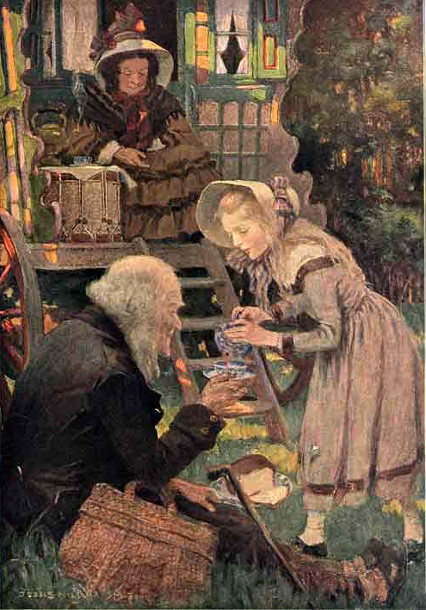
Nell & grandfather in Mrs. Jarley's caravan

Conclusion:

This is my fifth Dickens, and I can say that The Old Curiosity Shop has just become my new favorite. Usually I don’t quite like tales, where there were only black and white, the good ones must be perfect: handsome, kind-hearted, yet weak and poor; while the bad ones were always imperfect: ugly, wicked, heartless and powerful. Can you see Little Nell and Quilp in those two opposite frames? Like I said, if I don’t like tales, then I should have disliked The Old Curiosity Shop. However, it turned out that I really enjoyed reading this book. One of the reasons perhaps, because this book spoiled me with many adventures scenes during Nell and grandfather’s pilgrimage, which made the plot went quite fast. Other reason is the appearance of comical characters like the funny-eccentric Dick Swiveller or the street entertainers Nell met within her pilgrimage. Mrs. Javier’s waxwork company and Whisker the funny pony of Mr. Garland were also highly entertaining!

Besides the entertaining aspects, I also found satisfaction in Dickens’ concerns of injustice—especially to children—which became this book’s main theme. For your information, I always love to read novels that bring concerns for injustice as the main theme! Here we got two cases, one was Little Nell and the other was Kit. Both were innocent and kind-hearted children who must suffered from adult’s faults, crime and greediness. Dickens interestingly crafted these two cases in two separate frames of story with Quilp being one of the main red-thread that related them both to be concluded in the last chapters.

Speaking of the last chapters, they were very emotional, and this aspect is the one I like the most from this book. **spoiler** I can feel that Dickens had poured out his own emotion into these last chapters—the scene of Nell’s death, that he wrote them while remembering and memorizing the death of Mary Hogarth—her sister-in-law—in her seventeenth age, almost as youth as Nell was. You might have read on his biographies, that Dickens have an affection towards Mary, and was quite shocked when Mary died from heart failure in his arm. “Mary’s death affected him grievously and the shock never seemed completely to dissipate.” [from Dickens’ Bicentenary 1802-2012 by Lucinda Dickens Hawksley]. I can’t but share Dickens’ grief when he wrote about Nell’s burial, and how his grandfather and others felt about it, feel how Dickens must have felt on Mary’s sudden death, and the consolation he must have seek at that time, just as what he wrote here...

“Oh! It is hard to take to heart the lesson that such deaths will teach, but let no man reject it, for it is one that all must learn, and is a mighty universal Truth.”

And from the same book too—Dickens’ Bicentenary—I learned that writing about Nell’s death had re-opened Dickens’ old wound of Mary Hogarth: “I am ….nearly dead with work—and grief for the loss of my child.**spoiler ends**

And last but not least, I also like how Dickens concluded every piece of fragments nicely. I am a reader who judges a book from its ending, not about happy or sad ending, but more on whether it was cleanly closed or not. I don’t like it when there were still one or few things unfinished or unclear, it will make me keep asking questions like why that should happened, or what caused this or that, etc. In this book, one concern raised in my mind near the ending. I noticed that Kit—after his release from jail—had met and thanked everyone except the biggest heroes: Dick Swiveller and the Marchioness, whom Kit never mentioned nor made initiative to come to thank personally. You might think I’m being absurd to think of such small things like that, but as I said, I am a perfectionist when it comes to story ending, everything must be cleared up before I closed the book (most likely) forever. However, thanks to Dickens, I was rewarded by the final page where Kit and Barbara named one of their children as Dick “whom Mr. Swiveller did especially favour” (p. 544). And so…this story becomes one of my favorites of Dickens so far, and I rewarded him with five stars!

Title: The Old Curiosity Shop
Author: Charles Dickens
Publisher: Wordsworth Classics
Published: 1995
Pages: 544 + notes

Thursday, July 12, 2012

Nell’s Grandfather on The Old Curiosity Shop


Talking about Little Nell from The Old Curiosity Shop, is impossible without talking about her grandfather, for everything that happened to poor Nell throughout the book must have been related to her grandfather, the owner of an old curiosity shop in the suburb of London, with whom the orphan Nell lived and the only one Nell ever loved. After Nell’s parents died, her grandfather took over the responsibility to take care of her. I can see that he loved Nell very much.

“Do I love thee, Nell,” said he (the grandfather). “Say, I do love thee, Nell, or no?”The child only answered by her caresses, and laid her head upon his breast.“Why dost thou sob,” said the grandfather pressing her closer to him. “Is it because thou know’st I love thee, and dost not like that I should seem to doubt it by my question? Well, well—then let us say I love thee dearly.”“Indeed, indeed you do,” replied the child with great earnestness.


Basically Nell’s grandfather was a good man, he was just an old man who loved his grandchild, and tried to do something to give her a bright future. Unfortunately, he had chosen the wrong way to gain it. Couldn’t be patient to run his old curiosity shop business properly, he tried a faster way to earn money, by gambling. I don’t know which one comes first in Nell’s grandfather’s case, the gambling-addict or the greediness. However I can say one thing about him, that in spite of his kind heart, Nell’s grandfather has an obvious weakness, he could not resist the temptation of gambling though he knew deep in his heart that what he did was wrong and that it would make Nell sad.


I was torn between love and hate with the old grandfather at first, but reading along this book I’d rather think that he used Nell’s future to be his reason for gambling. Perhaps at first he was really a good grandfather who earnestly loved his grandchild, but having tried gambling as a desperate way to enrich himself—in his obsession to fight the poverty, and to make Nell become a lady or a woman who have a better place in society—he became addicted to gambling. It seems from the book that Nell’s grandfather has never won, but I think it’s hardly possible that a man should lose again and again. I think he sometimes won, but he used the money he won to raise his bet, until he lost all his money. And the same as a drunkard, an addicted gambling would do anything to get money, robbing if he must!


Although I felt pity to Nell’s grandfather—and all other men with same problem—I can’t sympathize with him. I do believe that men have their weaknesses, and must try to improve all their lives, but deceiving himself that he is doing it for the sake of the one he loves, well…it’s unacceptable for me. So, old and pitying Nell’s grandfather is, I can never love him, especially that he had been in many times disappointing Nell—and had been reminded by the little child—but kept doing it and deceiving himself and his grandchild. No, I can’t but blame him for all the sorrows that Little Nell must have endured.

The moral lesson from this character is obvious, that gambling could destroy—not only the gambler’s own life—but also his family and people he loves. And, the only way to stop is to stay away from the temptation. Nell has done the best thing for her grandfather by bringing her grandfather away from the temptation, no matter high the risk was.

Wednesday, July 11, 2012

[Short Story] The Half-Brothers by Elizabeth Gaskell


I read this story during few hours when my internet connection was very poor, that I can’t do anything else (browsing, tweeting, emailing), but copying the content of this short story from the bookmarked page of classicreader.com (I don’t know why I succeeded in doing this while having been failed with other sites). Anyway, I started to quick-browse the entire story right away, only to notice that Gaskell (or anyone who re-typed this story for ebook) has written this in long paragraphs, something I really dislike. I lost my reading appetite in an instant, but having nothing more interesting to do, I kept reading while here and there tidying up the paragraphs into moderate ones for more comfortable reading.

Very soon I began to be absorbed within the story, and after finishing it, began to cry….

The story was told in first person by a young man. He retold his story partly from his aunt Fanny and partly from his own experiences. It started when his mother had married her first husband in a very young age, only to be a widow after three years, when his husband left her a child and a farm with no money to support their household. Fortunately there was an old bachelor called Stenton—the owner of a big farm—who would like to marry her and took Gregory (his son) too into his care.

They were soon wed, but it didn’t take a long time for the old bachelor to realize that his wife’s love was never meant to be for him, but for Gregory, her son. This made him disliked and even hated Gregory, and began to ill-treat him at least with words. Then the baby was born, Stenton’s son, who would become the narrator of this story. The mother had not survived long, but before she died, she asked for Gregory to be put besides his half-brother, and for Gregory to take his brother’s hand in his. And from then on this son—the half-brother of Gregory—became everyone’s favorite, while Gregory often received hard words from other, for being awkward and ungainly.

It went on for sixteen years, when on one night the narrator was sent to a Fell (mountain) in an errand. That night turned out to be a stormy and snowy night, and the narrator soon got lost on the Fells. While he was in a desperate state, looking forward to his death, there came a help from—of course—his half brother Gregory, who was accompanied by his spaniel dog. Now, what will happen next—can the two brothers came home safely in the middle of that stormy night? I think—as other short stories—you could guess the ending. But for me, I shed my tears in the middle of my lunch hour—thanks to Elizabeth Gaskell… L

This is the first piece of Gaskell I’ve ever read, and I don’t know whether the short story can reflect her writing style in her more famous novels, but if it does, I can say that there is not something special from Gaskell that can make her stand out from other authors. Her narration flows naturally, but if not for words we have been familiar with 19th century works, I would have thought it was a work from one of modern authors.

The story is quite engaging and touching, and probably was made for shedding tears. What I can learn from it is—and I have read a similar story before—the highest quality of love, which is to keep loving others despite of their bad treatment to us. It also tells us not to ill-treat others, for ill-treatment on child could negatively affect it, which would make the child grow up as an unhappy person. The awkwardness, the indifference came not from stupidity, but from others treatment.

[I read the ebook version from classicreader.com]

This post is included in Short Storieson Wednesday.


[Short Story] A Terribly Strange Bed by Wilkie Collins


When I first found this short story, I was wondering whether I am going to like it. The title is not really promising—‘A Terribly Strange Bed’? What would that be about? However, being determined to read short stories from authors whom I have never read before for A Victorian Project, I decided to download the ebook, and then read it right away. After finishing it in two days—I read it at office ours, as it is in Words file—I have already fell in love with Wilkie Collins!

The story was set up in Paris. Two English men were travelling to the city of light, and in the search for a night amusement, they went to a small gambling house in a rather slum area of Paris. The narrator—Mr. Faulkner (Collins revealed the name only at the end of the story)—was not a genuine gambler, he did gambling occasionally just as a mean of amusement. However, that certain night appeared to be his lucky night, for he kept winning hugely at the ‘Rouge et Noir’ game. Left alone in the gambling house, an old soldier persuaded him to drink champagne, and got him drunk. Afraid of his security, the old soldier advised him to spend the night at the inn in the upstairs of the gambling house, which he fully agreed.

After securing the money bag under his pillow, locking and bolting the door and checking on piece of furniture to make sure everything was safe, Faulkner was trying to sleep, but failed. And suddenly—this was where the thriller began—something strange happened. The man in painting—which he had contemplated in his desperate effort to sleep—suddenly “lost” his hat. What has happened? And did he felt that the bed was moving?..... 

This is the first time I read Wilkie Collins, and although this is only a short story, I can get a feel of his writing style. The story theme itself reminds me of Poe’s thriller—although Poe’s are much more gripping. **spoiler** In particular, this reminds me a little of Poe’s The Pit and The Pendulum, both are about a murdering machine, but Pit is much darker and terrorizing, while Collins wrote it more as a mystery thriller or crime. **spoiler ends**

I like how Collins described the state of Faulkner’s mind wonderfully, especially because it is written from his own point of view. The scene on the bed where Faulkner could not get asleep, for example; inexperienced author might describe it in few words only to say that the man has tried but he can’t get to sleep. But Collins took us to be in Faulkner’s place, we can feel ourselves how desperately it might be for him.

…Every nerve in my body trembled—every one of my senses seemed to be preternaturally sharpened. I tossed and rolled, and tried every kind of position, and perseveringly sought out the cold corners of the bed, and all to no purpose. Now I thrust my arms over the clothes; now I poked them under the clothes; now I violently shot my legs straight out down to the bottom of the bed; now I convulsively coiled them up as near my chin as they would go; now I shook out my crumpled pillow, changed it to the cool side, patted it flat, and lay down quietly on my back; now I fiercely doubled it in two, set it up on end, thrust it against the board of the bed, and tried a sitting posture. Every effort was in vain; I groaned with vexation as I felt that I was in for a sleepless night.

The way Collins led his readers to the terror scene also deserves two thumbs up. The gloomy room, the dark old picture hung on the wall (of a Spanish desperado waited to be hanged), and the moonlight that was shining into the room through the window, they all brought us to a dark gothic scene, as if those are where the exact terror would come from, which in fact they're not. However, without those aspects, this story would certainly lose its grip. 

Five stars for Wilkie Collins! And after this I’d like to read more of his books.

[I read ebook version from world-english.org]

This post is included in Short Stories on Wednesday


Monday, July 9, 2012

Character Thursday: Rejuvenated


What is Character Thursday?…

Followers of this blog should have known by now that I have a feature called ClassicsCharacters, which you can find in my horizontal menu. The idea is to make analysis for characters from books I have read or am reading. And since 18 weeks ago, I have been hosting a weekly meme called Character Thursday. The goal is the same, to let everyone who wants to join me, to post about their chosen characters from books. My own post of Character Thursday would also appear in my Classics Characters.

The (new) purpose…

Lately I feel the urge to rejuvenate my Character Thursday feature. I want to make it not just as something fun to do or something to write when you don’t have any idea to post, but rather as a way to delve more into a book, to better understand a character, to enhance your knowledge and awareness of the psychological factors that make people "tick." This, in turn, can lead to an analysis of your own attitudes and behaviors in similar circumstances and help you to recognize who or what influences the future choices you will make in life, in school, at work or in relationships. [source].

So, here it is….

The rejuvenated Character Thursday…

Button

First of all, I have created a new button for this feature. The old one seems to me too childish and casual, so I have created this new button that looks more mature and focused to book and/or reading. Hope you like it too!

Format

Actually I don’t want to make Character Thursday as a serious task, however to help you to post yours, here are several guidance that you can follow (you don’t have to answer all questions, and if you do it, you don’t have to answer it in order)

  • Are they protagonist or antagonist?
  • Who are they? What was their role in the book?
  • What was your strongest impression on the character(s)? You can quote the dialogue or narration you got the impression from.
  • What are the strengths or weaknesses of your character(s)?
  • How do they develop throughout the book?
  • What makes you love/hate them?
  • What lessons or influences you got from them?

How do you join?...

It’s simple, just post on Thursdays, your character choice from the book you are reading or you have finished with. It can be the protagonist or the antagonist, characters that you love the most or hate the most. You can pick any book of any genre as you like. Please feel free to grab the button and paste it in your post and link here to let others know about this feature. Last but not least, please add URL of your post in the linky at the bottom of this post, and hop to other participants to learn about their characters and books. This way we can get to know what others think about a character we already knew, and get to know more books we haven’t read.

Can’t wait to read your next Character Thursday!... J