Saturday, December 8, 2012

Weekend Quote 13: Great Expectations


This is a passage of what Pip said to Estella, a reflection of his desperation in his everlasting love to Estella…


You are part of my existence, part of myself. You have been in every line I have ever read, since I first came here, the rough common boy whose poor heart you wounded even then.

What makes it more tragic is that it was so true, that Pip’s strong determination to be a gentleman was mostly to melt Estella’s cold iron heart. It can be said that Pip’s life changed after he had seen Estella for the first time. What a love! And when I thought at first it’s only a childish love, it lasted until Pip grown up to become a gentleman. Once again, what a love that someone you love can be part of your existence!

This Weekend Quote is hosted by Half-Filled Attic. Feel free to join. You can:
  • Give the context of the quote
  • Give your opinion whether you agree or disagree with it
  • Share your experience related to the quote
  • Share similar quotes you remember
  • Or anything else. Just have fun with the quote.


Friday, December 7, 2012

Great Expectations


I don’t think one would be worthy to be called a Dickensian before reading Charles Dickens’ masterpiece: Great Expectations. I have just done it, so I’m now proudly calling myself a Dickensian! :) I don’t know why it took me rather long before I come to Great Expectations; maybe because I had long time ago watched its modern-setting movie adaptations—1998 version with Ethan Hawke and Gwyneth Paltrow— which was rather weird to me and I didn’t like at all (bookish lesson #1: do not watch a movie before you read the book!). Anyway, I have read it at last, and I admit now that enjoyed Great Expectations very much from the first to the last page.

Great Expectations was written as an autobiography of a fictional character: Pip. It was started when Pip was very young (around seven years old)—an orphan boy who was brought ‘by hand’ by his sister, wife of a kind-hearted blacksmith named Joe. In the real life, Pip might have grown up as a simple and humble blacksmith in a small village, marrying a simple and smart girl like Biddy, have kids, and would have finally buried in the church’ cemetery, just like his father. However, faith brought him to another scenario of life. I don’t know which one between the runaway convict and the eccentric Miss Havisham who had the most effect in shaping Pip’s life into its new mold. I believe both of them had an equal share, just like our lives molded by so many circumstances.

Pip and the convict

If little Pip had never been to Satis House, he would never had realized that he was a coarse and common boy, he would have never wanted more than life had been providing him up to that moment. And with that realization, come the need to have more. I’ve been reflecting, if Pip had never been granted with the great expectations, would he be happier then—as a poor boy who longed to have more but didn’t have the power to reach it? I think Pip would always be tormented by his own dream, he would always feel unworthy to love Estella, yet he loved her still.

The great expectations molded Pip’s life even beyond his own dream, from a coarse poor boy, he became a gentleman. He could now live the life he has always wanted. Yet, happier was he? At first everything was so fantastic, but after that Pip went through a lot of hard times that in the end he missed his old time again, and wished he’d never have met either Miss Havisham or Magwitch the convict.

Pip met Miss Havisham & Estella

Back to my reflection again, which one would be better for Pip? I believe the later one. The hardship opened Pip’s realization of what were true and what were abstract in life. Through the prosperity, and through Estella’s cruel and cold respond towards his love, Pip learned so many things in his journey to be a grown up man, that he finally knew by himself what he really wanted and what was the most important and valuable in life for him. The great expectations have built Pip’s personality much greater than if he lived as a blacksmith all his life.

To me, Pip is representing our own lives. He was not perfect, he made a big mistake as a matter of fact by being snob at Joe and Biddy, but he endured all his hard times very well, and he could learn from his mistake. I am happy because Pip was forgiving and grateful to his benefactor, despite all the negative consequences they had brought him. I think Pip know that people could bring you their influences, but at the end, it’s you who must make the final decision. Pip had made his own decision, wrong it was, but he learned, he regretted, he asked for forgiveness, he learned for the good.

[might contain spoiler] The copy I read (Penguin English Library) contains George Bernard Shaw’s analysis of Great Expectations and other Dickens’ works, and from it I know what kind of ending Dickens had originally put for this book, but was asked to discard it by Bulwer-Lytton. What we read now was the second ending Dickens wrote, but I somehow felt that it was still not a perfect ending after all. I would have preferred Dickens to end Pip and Estella’s love story for good, than being hung with: “I saw the shadow of no parting from her”. I felt that Dickens was forced to put a happier ending, but somehow did not want to explicitly make it a ‘they-lived-happily ever-after” tale-kind of ending. [spoiler ends]

Anyhow, I grant five stars for Great Expectations, it was a great moral lesson in a great story telling with aspects you can hope from a Victorian novel: romances, mystery, action, the gothic atmosphere of Miss Havisham's Satis House, and criticism to hypocrite society who over-praised wealth and gentlemanship.


I read this for:


Thursday, December 6, 2012

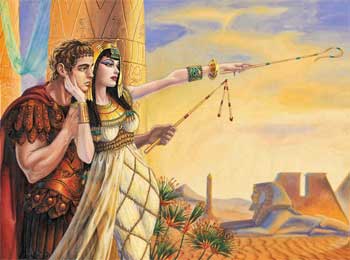
Mark Antony in Antony and Cleopatra


I have read successively two Shakespeare with Mark Antony as one of the main characters: Julius Caesar and Antony and Cleopatra. From both plays I gathered that Mark Antony was one of the greatest generals at that time. His leadership was obvious—at least before he neglected his tasks in his madness to Cleopatra—among his soldiers. He respected them, treated them fairly, and—most importantly—he fought with them. I think it’s really important that a general or captain fought with their soldiers, not only giving orders from the comfort of his camp; this way the soldiers’ respect grew larger to their master. And Antony did this very well.

However, in personality, I think Mark Antony was a nobleman with high taste; he appreciated luxury and elegance; and although he might be a bit harsh and straight forward in his manners, he had a tender heart and very skillful in words. I imagine Antony to be a pleasant man; he must have had many friends, and they all—as also his men—loved him as he too had loved them. He must be honest and honorable, for if not, Julius Caesar must not have had confidence in him to take him in his inner circle.


I don’t consider Antony as a very ambitious man, for he was quite comfortable in his position as Caesar’s number two. If only Caesar had never been murdered, Antony might be quite satisfied with his career in the Senate without ever pursuing to conquer the world alone; by serving Caesar at his best. But circumstances changed, Caesar’s dead, and to this time Antony had always been faithful to his master and friend. His speech during Caesar’s funeral was brilliant, maybe it can even be leveled with Cicero’s.

After that circumstances brought him to share the world with Octavius and Lepidus in the Second Triumvirate. His meeting with Cleopatra was the worst thing that happened to him and brought him to a humiliation and falling down. To have an affair with Cleopatra was not a great matter, if he did not then neglect his tasks in Rome for almost two years. Cleopatra had not only seduced him with his sensuality, but also with Egyptian vulgar exotics, luxury and elegance. Roman despised him for that, his men disgusted at him, and the ambitious young Octavius made the best he could to make the Senate grudge him.

At that point—and after his wife’s death—Antony came to his senses, and he struggled to free himself from Cleopatra’s bound. If only he was as ambitious and determined as Octavius, he might be able to resist Cleopatra’s charm. But Antony was Antony, he’s not the opportunist Caesar or the dubious Octavius; he’s just a man who praised beauty and romance.

The dying Mark Antony was carried
through window

Antony’s nobleness was obvious when he was defeated by Octavius; he granted a ship full of treasures for his men, and advised them to join Caesar, as he was already beaten. Nevertheless, Antony was still encircled by loyal captains and friends who would fight with him although they knew he would be beaten at the end. Antony was also forgiving, he forgave Enobarbus for his betrayal, and he forgave Cleopatra too—but not after he heard that Cleopatra’s dead! :)

At the end, how could I not like a man like him? He had a weakness—but who didn’t?—but otherwise he was a true gentleman, an honest and loyal friend and leader.

Tuesday, December 4, 2012

Celebrating Dickens Mini Readalongs


I’m so excited that there are already 16 of you (until today, November 30th) who have signed up for Celebrating Dickens next February! And though it’s only one week from the announcement, I am obliged to post our first update, which is about Mini Readalongs. This post will also be the master post for all our Mini Readalongs for Celebrating Dickens. If you have plan to read certain book(s) and want to know whether there are others to read it along with, you can simply comment here, I will update your entry in this post.

For this Mini Readalongs you are not obliged to post anything in your blog (except you’d want to), this post would act as master post, where you can see who are reading the same book with you. Let’s just read together and have discussions if you want either on blog, twitter, FB or any other media. As we have here Indonesian participants who read translation, I divide the Mini Readalong into two categories:

For International:

The Mystery of Edwin Drood
- Fanda @ Fanda Classiclit
- Astrid @ Books To Share
-  ??

Great Expectations
- Melisa @ Surgabukuku
- Sabrina @ Notes of The Dreamer
- ??

Dombey and Son
- Melissa @ Avid Reader's Musing
- ??

David Copperfield
- Alouette @ Reading For The Sky
- ??

For Indonesian only:

A Tale of Two Cities (translation)
- Desty @ Desty Baca Buku
- Maria @ HobbyBuku's Classic
- Rereong @ Wonderful Books
- ??

We will have something for Dickens’ 201st anniversary celebration (February 7th, 2013), so keep checking in here to see my next update! To join in Celebrating Dickens, please go directly to the sign up post.

Monday, December 3, 2012

December Readathon


I spent my weekend of December 1st and 2nd mostly for December Readathon hosted by o (Delaisee). I have picked Dickens’ The Great Expectations for this occasion, and I’m glad I did that, I enjoyed every pages of it.

I started on Saturday morning at page 189, and stopped at page 466 on Sunday night; 278 pages all. For me, it’s a good achievement because my usual speed on weekend or holiday is 50 to 100 pages. It was my first readathon ever, and I think I’ll do it again in the future if the time fits my schedule, and if I have a perfect book to read!

From this readathon, I learned that social media and blogging are two biggest enemies to my readings—especially social media, because blogging is part of my reading activities. To be able to join the readathon, I must close all internet connection so that I can focus mainly on my book. Sometimes I really miss the old times when I can read all day long without interruption…

Antony and Cleopatra – Final Review


This is my second Shakespearean tragedy after Julius Caesar, and while we are still entertained with wars—though not as flourish as Julius Caesar’s—we are also spoiled with stories of love and lust, loyalty and betrayal, nobleness and dirty politics; all bitters-and-sweets in human’s live.

I believe Antony was a great general, he fight with his soldiers; not just watched and gave orders from the camp (compare this with Octavius who pointed Agrippa to lead the army), and for that his soldiers loved and respected him—well at least before he was crazy. He was a gentleman of his time, always treated his soldiers fairly, and his friends loyally. However—as every man must have his weakness—Antony could not resist love charm; and in this case, the charm has a name: Cleopatra, the queen of Egypt.

From the beginning of the play we can see that Cleopatra was an obsessive woman, she kept asking Antony how much he loved her. If one does not know her reputation, one might think she was just like any other silly young girl who was in love. But I believe this was not the case of Cleopatra. I think she was an ambitious, self-possessed and even cunning woman—you could not become a queen at that time if you did not possess those qualifications—and for her, to keep her throne was more important than to win a man’s heart. I think, after Caesar’s death, Cleopatra needed an allegiance to protect her interests, and she had chosen Antony.

On the contrary, Mark Antony had really fallen in love and trapped into Cleopatra’s charm, that he neglected his duty as the ruler of one third of the world, leaving the young ambitious Octavius worked alone (with Lepidus) in Rome for his own interests. This was Antony’s biggest fault, to let his heart controlled his brain. However, with a woman so charming and determined like Cleopatra, it’s difficult for Antony to avoid his faith.

Cleopatra on the Terraces of Philae
by Frederick Arthur Bridgman, 1896


I loved this play a lot, it has all you can ask for an exciting reading; history, romances, politics, wars and witty dialogues now and then. I always love Roman history, so I don’t have any trouble of loving this one too, plus I think I’m a new fan of Mark Antony, although Cicero is still (for me) the best. One thing I don’t like from this play, is how Cleopatra was portrayed here by Shakespeare. I think, except for once or twice when she was really angry and in the last chapters, one will think Cleopatra was a spoiled teenager who was madly in love.

I am still wondering whether Cleopatra had betrayed Antony as Antony had accused her. If not, why had the Egyptian deserted their master twice, first in Actium battle, second near Alexandria? And Cleopatra never gave Antony any reason why she had instructed her army to abandon him in Actium, nor did she defend herself when Antony accused her after the last battle; she just left him and hid in the monument.

Assuming that Cleopatra was innocent and she hid herself merely afraid of Antony’s rage, why did she send her eunuch to tell Antony that she had died, but then sent another messenger to say that she was still actually alive? Did she send the first one because she knew how Antony would react if he heard about her death—thus keeping her promise to Caesar; then sent the second one because she was in fact still in love to him? Oh what a complicated woman!

The label of “hero of this play” I think must be granted to Eros, who—when was instructed by Antony to kill him—chose to end his own life because he could not kill his own master, but he did not want to disobey him either. Antony did not have the courage to kill himself and must ask his men’s help, but Eros stabbed himself without any doubt. Antony killed himself as a result of his own conducts, but Eros killed himself merely of his infinite loyalty to his master.

My dear master,
My captain, and my emperor, let me say,
Before I strike this bloody stroke, farewell.

(stabs himself) Thus I do escape the sorrow
Of Antony’s death.”

I have enjoyed this play until Mark Antony died. After that, it’s like an anticlimax for me. I did not really want to know how Cleopatra will end her life (for I had already know the facts), and what Octavius would do. Act V was the most boring part of this play, and for that—and for absurdity in Cleopatra’s manner—I granted four stars for Antony and Cleopatra. Although this play was slightly interesting than Julius Caesar, but all in all, I liked Julius Caesar more.

You can read my post for each act: Act I - Act II - Act III - Act IV - Act V


Saturday, December 1, 2012

Weekend Quote 12: Antony and Cleopatra


A not only beautiful but also meaningful quote from Mark Antony about how we must bear sorrows that come to our lives…

“Bid that welcome
Which comes to punish us, and we punish it,
Seeming to bear it lightly.”

Instead of taking sorrow as a severe punishment of what we had done wrong, we can opt to welcome the punishment and take it lightly. Rather that the sorrow punishes us, WE punish the sorrow (by taking it lightly). I think this is a great wisdom to be applied in our lives. We are not immune from making mistakes, all we must do is to accept the consequences, learn from it, and move on.


This Weekend Quote is hosted by Half-Filled Attic. Feel free to join. You can:
  • Give the context of the quote
  • Give your opinion whether you agree or disagree with it
  • Share your experience related to the quote
  • Share similar quotes you remember
  • Or anything else. Just have fun with the quote.