Thursday, December 13, 2012

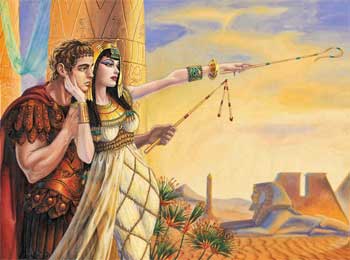
Cleopatra in Antony and Cleopatra


To be a queen at her time, Cleopatra must be a very strong and smart woman; were those enough? No, because she was a woman, and women at that time were in the lower class than men. Cleopatra must have one other qualification to reach the top; it’s her sensuality. Historian concluded that Cleopatra was not beautiful, she was believed to have long nose and rather masculine face structure, but I guess she knew how to attract men; and that had become one of her weapons.

Cleopatra was ambitious, and unlike common women at her time, she was smart and a good politician. I think as a princess, she used to get what she wanted; she must have been a spoilt and stubborn princess. It became more obvious when she was a queen. I never believe that Cleopatra had really fallen passionately in love with Mark Antony; I think Cleopatra was much stronger than that. Love and lust must not have been her weakness, no, she needed to make an alliance with Antony after losing Julius Caesar. If she was portrayed as an obsessive lover to Antony, it was because she wanted to make sure Antony was still in her side, as was reflected from this scene:

Cleopatra: “If it be love indeed, tell me how much.”
Antony: “There’s beggary in the love that can be reckon’d.”
Cleopatra: I’ll set a bourn how far to be belov’d.”


Cleopatra had won Antony, and she demanded that his intention and interests would always be for her. When she tried to hold him in Egypt, it looked like a silly jealousy of a young girl, but I believe it’s more than that.

Although it was not clear whether Cleopatra had betrayed Antony to gain Caesar’s favor for her and her children’s safety—I have searched about this in the internet without any success—I still believe it was indeed the case. Of a woman of self possessed and brave such as Cleopatra, I could not imagine that she had never defended herself from Antony’s accusation. It’s rather strange too how the Egyptian suddenly left their master to join Octavius (in the second war near Alexandria) when it seemed that they would have won the war. Moreover, didn’t Octavius say that he could not fight before Antony attacked first? (Scene XI Act IV). I believe Cleopatra had done something in this, Mark Antony was not a stupid general, he must have known better than anybody else.

After Antony had died, I think Cleopatra did felt a bit depressed. As a woman I think, she must have felt alone without Antony. I wonder whether she’d ever thought that she would have been happier if she’d never pursued her ambition? Ah…but for an unordinary woman like Cleopatra, living an ordinary life would be much torturing than having to commit suicide to die in honor as she have chosen. Maybe….

Wednesday, December 12, 2012

Back to the Classics Challenge 2013


Being one of my most fun and successful reading challenges in 2012, I’m very glad to know that Sarah will be hosting Back to the Classics Challenge 2013. It comes with some new categories, which make it more exciting! I am combining the books I will read for this challenge my 2013 TBR Pile Challenge, my WEM Self Project, and of course my long term the Classics Club project. Here they are…

The Required Categories:

A 19th Century Classic: Little Dorrit by Charles Dickens
A 20th Century Classic: The Old Man and The Sea by Ernest Hemingway
A Pre-18th or 18th Century Classic: Romeo and Juliet by William Shakespeare
A Classic that relates to the African-American Experience: Song of Solomon by Toni Morrison
A Classic Adventure: The Three Musketeers by Alexandre Dumas
A Classic that prominently features an Animal: Moby Dick by Herman Melville

Optional Categories:

Re-read a Classic: The Great Gatsby by F. Scott Fitzgerald
A Russian Classic: War and Peace by Leo Tolstoy
A Classic Non-Fiction title: The Life of Saint Teresa of Ávila by Teresa of Avila
A Classic Children's/Young Adult title: Kidnapped by Robert Louis Stevenson
Classic Short Stories: Cinta Sejati (an Indonesian translation of short stories collection) by Guy de Maupassant

Tuesday, December 11, 2012

Me and Dickens: Celebrating Dickens Meme and Giveaway


To celebrate Dickens’ 201st birthday on February 7th 2013, I think it would be great if we all create something as a beautiful gift for Dickens. So, here’s the idea…

Post something about ‘you and Dickens’!

Tell us (or Dickens!) how you love his books, how Dickens has been affecting your life, how your relationship has been with him, how you feel about his works, how you want to give Dickens a try (if you haven’t read his book), or how you want to give him another try (if you have once bad experience with Dickens). In short…..just write about how you are getting along with Dickens. I really think that if Dickens was alive, it would mean something for him to know our feelings, and that we’d like to read his books. That would be a beautiful gift we could give to an author, don’t you think? Just create something that would have made Dickens proud and happy

Here are how you should do it…

Post in any way you like: text, images, video or a mix of them, be creative!
Examples: you can write a story about your first encounter with Dickens, you can show off your Dickens collections (books, movies or anything about him). Or if your strength is in poetry, you can write a poem about you and Dickens. Or you would like to write a Victorian style letter to Dickens? It’s okay too—I believe you are much more creative than me.. :)

The post title is free, however it must contain ‘Me’ (‘I’ and ‘My’ are also allowed) and ‘Dickens’ in it—anyway it’s about you and Dickens, right?
Examples: ‘Me & Dickens’ – ‘How Dickens Has Affected My Life’ – ‘Oh, I Just Love Dickens!’—I know, I’m suck at creating titles, LOL! In short, just be creative!

As we create it as a gift for Dickens, it should be presented right on his birthday; so we will publish our post simultaneously on February 7th 2013.

I will open a linky below this post on that date which will be closed on February 8th at 23:59 (GMT +7 or Indonesian time). So, make sure you add your post in the linky before it’s closed, otherwise you can still add your post via comment box.

Oh, have I said that you can post as many as you want? Well, as long as you make sure that they are all published on the same day.

And here is to reward all your efforts to make Celebrating Dickens as merry as possible (and because I will celebrate my own birthday on February).....


Giveaway!


  1. I will be giving away 1 (one) classics book from Penguin English Library from The Book Depository.
  2. I will pick 1 (one) winner with the most creative post that I think Dickens will like :)
  3. The winner can choose any book from Penguin English Library collection (as long as TBD can ship to your address).
  4. The winner should reply with their data within 48 hours after my email, otherwise I would choose another winner. Make sure you fill in your email address in the linky for this (it won’t be published).
  5. Only participants who are listed in the Participant List are eligible to enter this giveaway. Sign up is opened until February 5th 2013.

You have more than a month to prepare the post, so…have fun!

Monday, December 10, 2012

A Classics Challenge December Prompt: Wrap Up


This is the last prompt of 2012 A Classics Challenge hosted by Katherine (November’s Autumn), that act as well as a wrap up post for the whole year, and I am proudly say that I have participated in every prompt since January.

Link to your favorite Classic Literature post you've written this year, it doesn't have to be related to this challenge. Just something you'd enjoy sharing.

Or make a list of what you read for the challenge, you could compare it to your original list drawn up late 2011 when you were planning what to read, link to the posts you've written for the challenge, how many authors you've read or any little stat or detail you'd like to share.

I have posted so many classics literature, that it’s difficult to pick any favorite posts, so I’ll just pick my five favorite classics literature reviews that I mostly wrote in freshly emotional state right after reading the book:


And these are all the prompt from January to November:


Last but not least, I’d like to thank Katherine for hosted such an interesting literary challenge that have brought certain sensation into my classics readings during 2012. I don’t know whether this challenge would be up again next year, but I had much fun this year!

Saturday, December 8, 2012

Weekend Quote 13: Great Expectations


This is a passage of what Pip said to Estella, a reflection of his desperation in his everlasting love to Estella…


You are part of my existence, part of myself. You have been in every line I have ever read, since I first came here, the rough common boy whose poor heart you wounded even then.

What makes it more tragic is that it was so true, that Pip’s strong determination to be a gentleman was mostly to melt Estella’s cold iron heart. It can be said that Pip’s life changed after he had seen Estella for the first time. What a love! And when I thought at first it’s only a childish love, it lasted until Pip grown up to become a gentleman. Once again, what a love that someone you love can be part of your existence!

This Weekend Quote is hosted by Half-Filled Attic. Feel free to join. You can:
  • Give the context of the quote
  • Give your opinion whether you agree or disagree with it
  • Share your experience related to the quote
  • Share similar quotes you remember
  • Or anything else. Just have fun with the quote.


Friday, December 7, 2012

Great Expectations


I don’t think one would be worthy to be called a Dickensian before reading Charles Dickens’ masterpiece: Great Expectations. I have just done it, so I’m now proudly calling myself a Dickensian! :) I don’t know why it took me rather long before I come to Great Expectations; maybe because I had long time ago watched its modern-setting movie adaptations—1998 version with Ethan Hawke and Gwyneth Paltrow— which was rather weird to me and I didn’t like at all (bookish lesson #1: do not watch a movie before you read the book!). Anyway, I have read it at last, and I admit now that enjoyed Great Expectations very much from the first to the last page.

Great Expectations was written as an autobiography of a fictional character: Pip. It was started when Pip was very young (around seven years old)—an orphan boy who was brought ‘by hand’ by his sister, wife of a kind-hearted blacksmith named Joe. In the real life, Pip might have grown up as a simple and humble blacksmith in a small village, marrying a simple and smart girl like Biddy, have kids, and would have finally buried in the church’ cemetery, just like his father. However, faith brought him to another scenario of life. I don’t know which one between the runaway convict and the eccentric Miss Havisham who had the most effect in shaping Pip’s life into its new mold. I believe both of them had an equal share, just like our lives molded by so many circumstances.

Pip and the convict

If little Pip had never been to Satis House, he would never had realized that he was a coarse and common boy, he would have never wanted more than life had been providing him up to that moment. And with that realization, come the need to have more. I’ve been reflecting, if Pip had never been granted with the great expectations, would he be happier then—as a poor boy who longed to have more but didn’t have the power to reach it? I think Pip would always be tormented by his own dream, he would always feel unworthy to love Estella, yet he loved her still.

The great expectations molded Pip’s life even beyond his own dream, from a coarse poor boy, he became a gentleman. He could now live the life he has always wanted. Yet, happier was he? At first everything was so fantastic, but after that Pip went through a lot of hard times that in the end he missed his old time again, and wished he’d never have met either Miss Havisham or Magwitch the convict.

Pip met Miss Havisham & Estella

Back to my reflection again, which one would be better for Pip? I believe the later one. The hardship opened Pip’s realization of what were true and what were abstract in life. Through the prosperity, and through Estella’s cruel and cold respond towards his love, Pip learned so many things in his journey to be a grown up man, that he finally knew by himself what he really wanted and what was the most important and valuable in life for him. The great expectations have built Pip’s personality much greater than if he lived as a blacksmith all his life.

To me, Pip is representing our own lives. He was not perfect, he made a big mistake as a matter of fact by being snob at Joe and Biddy, but he endured all his hard times very well, and he could learn from his mistake. I am happy because Pip was forgiving and grateful to his benefactor, despite all the negative consequences they had brought him. I think Pip know that people could bring you their influences, but at the end, it’s you who must make the final decision. Pip had made his own decision, wrong it was, but he learned, he regretted, he asked for forgiveness, he learned for the good.

[might contain spoiler] The copy I read (Penguin English Library) contains George Bernard Shaw’s analysis of Great Expectations and other Dickens’ works, and from it I know what kind of ending Dickens had originally put for this book, but was asked to discard it by Bulwer-Lytton. What we read now was the second ending Dickens wrote, but I somehow felt that it was still not a perfect ending after all. I would have preferred Dickens to end Pip and Estella’s love story for good, than being hung with: “I saw the shadow of no parting from her”. I felt that Dickens was forced to put a happier ending, but somehow did not want to explicitly make it a ‘they-lived-happily ever-after” tale-kind of ending. [spoiler ends]

Anyhow, I grant five stars for Great Expectations, it was a great moral lesson in a great story telling with aspects you can hope from a Victorian novel: romances, mystery, action, the gothic atmosphere of Miss Havisham's Satis House, and criticism to hypocrite society who over-praised wealth and gentlemanship.


I read this for:


Thursday, December 6, 2012

Mark Antony in Antony and Cleopatra


I have read successively two Shakespeare with Mark Antony as one of the main characters: Julius Caesar and Antony and Cleopatra. From both plays I gathered that Mark Antony was one of the greatest generals at that time. His leadership was obvious—at least before he neglected his tasks in his madness to Cleopatra—among his soldiers. He respected them, treated them fairly, and—most importantly—he fought with them. I think it’s really important that a general or captain fought with their soldiers, not only giving orders from the comfort of his camp; this way the soldiers’ respect grew larger to their master. And Antony did this very well.

However, in personality, I think Mark Antony was a nobleman with high taste; he appreciated luxury and elegance; and although he might be a bit harsh and straight forward in his manners, he had a tender heart and very skillful in words. I imagine Antony to be a pleasant man; he must have had many friends, and they all—as also his men—loved him as he too had loved them. He must be honest and honorable, for if not, Julius Caesar must not have had confidence in him to take him in his inner circle.


I don’t consider Antony as a very ambitious man, for he was quite comfortable in his position as Caesar’s number two. If only Caesar had never been murdered, Antony might be quite satisfied with his career in the Senate without ever pursuing to conquer the world alone; by serving Caesar at his best. But circumstances changed, Caesar’s dead, and to this time Antony had always been faithful to his master and friend. His speech during Caesar’s funeral was brilliant, maybe it can even be leveled with Cicero’s.

After that circumstances brought him to share the world with Octavius and Lepidus in the Second Triumvirate. His meeting with Cleopatra was the worst thing that happened to him and brought him to a humiliation and falling down. To have an affair with Cleopatra was not a great matter, if he did not then neglect his tasks in Rome for almost two years. Cleopatra had not only seduced him with his sensuality, but also with Egyptian vulgar exotics, luxury and elegance. Roman despised him for that, his men disgusted at him, and the ambitious young Octavius made the best he could to make the Senate grudge him.

At that point—and after his wife’s death—Antony came to his senses, and he struggled to free himself from Cleopatra’s bound. If only he was as ambitious and determined as Octavius, he might be able to resist Cleopatra’s charm. But Antony was Antony, he’s not the opportunist Caesar or the dubious Octavius; he’s just a man who praised beauty and romance.

The dying Mark Antony was carried
through window

Antony’s nobleness was obvious when he was defeated by Octavius; he granted a ship full of treasures for his men, and advised them to join Caesar, as he was already beaten. Nevertheless, Antony was still encircled by loyal captains and friends who would fight with him although they knew he would be beaten at the end. Antony was also forgiving, he forgave Enobarbus for his betrayal, and he forgave Cleopatra too—but not after he heard that Cleopatra’s dead! :)

At the end, how could I not like a man like him? He had a weakness—but who didn’t?—but otherwise he was a true gentleman, an honest and loyal friend and leader.