Thursday, May 2, 2019

Understanding Émile Zola’s “La Joie de Vivre” in Van Gogh’s “Still Life with Bible” Painting


Have you ever had any idea that Vincent Van Gogh – the famous Dutch post-impressionist painter – was a Zola’s fan? In his letters to his brother Theo, Van Gogh often quoted some excerpts from Zola’s books, and he was thoroughly influenced by Zola’s ideas. Van Gogh was born into a religious family; his father was a minister of the Dutch Reformed Church. Before plunging headlong into painting, Van Gogh was a fervent evangelist in one of coal-minings in Belgium. In fact, his two years stay with the coal miners left deep impression in the village, that Émile Zola later depicted his Abbé Ranvier character in Germinal from Van Gogh’s image, when Zola stayed there in doing researches for his masterpiece-to-be.

One of Van Gogh’s “Still Life” paintings (a work of art depicting mostly inanimate subject matter, typically commonplace objects which are either natural or man-made - wikipedia) is: Still Life with Bible, which he painted in 1885.


It is a gloomy painting of an open bible on the table against dark background, with a candlestick beside it. In front of the bible, with a faint yellow light, sit a battered copy of Zola’s La Joie de Vivre. The painting’s caption on Van Gogh museum’s website read: “This hefty Bible had belonged to Van Gogh's father, a Protestant minister. Van Gogh painted it just after his father's death. He placed his own copy of Émile Zola's La joie de vivre next to it. That book was a kind of 'bible' for modern life. The books symbolize the different worldviews of Van Gogh and his father.” While in his letter to his brother Theo – with whom he often had a lengthy discussions of his painting progress – Van Gogh described this painting as 'a still life of an open, hence an off-white Bible, bound in leather, against a black background with a yellow-brown foreground, with an additional note of lemon yellow.'

Normally I won’t be interested in this painting – it’s too gloomy, and poor of color – but for Zola’s book in it. Now, I have just read The Bright Side of Life (English title for La Joie de Vivre published by Oxford World Classics), and while searching for some background texts, I accidentally stumbled upon an article about this interesting fact. And so, I began to scan the painting thoroughly, and tried to unfold its meaning.

What struck me immediately while scrutinizing it for the first time, is the lighting. You can see that the background is totally dark. Yet, there is the yellow light on the foreground; and from the way the shadow projecting from the book, the light could not come from the foreground. Then, where does it come from? There is a candlestick beside the bible; it even has a candle on it, but unlighted. I’m not a painter, and perhaps I’m not quite qualified to discuss paintings, but in my opinion, normally Van Gogh won’t have seen the objects in that way of lighting. So, was it intentionally, then – to emphasize an idea, perhaps?

Before trying to solve the “mystery of the lighting”, let’s discuss first about the bible and the book. We know that the bible belonged to Van Gogh’s father, the Protestant minister, who, I imagined, had planted Christian doctrines into his son’s head eversince Van Gogh's childhood. The bible is open, and we can see the blur prints on it – out of curiosity, I zoomed in the painting several times, trying to catch the title or a word or two to define to which part of the book it opened – I failed. Either my file is in low pixel (but I couldn’t find a better one), or it’s my eyes that are too weak! Anyway, I googled through, and finally found a text that says that the bible actually open to a certain passage from Isaiah 53:

“He is despised and rejected of men; a man of sorrows, and acquainted with grief: and we hid as it were our faces from him; he was despised, and we esteemed him not.
Surely he hath borne our griefs, and carried our sorrows: yet we did esteem him stricken, smitten of God, and afflicted.
But he was wounded for our transgressions, he was bruised for our iniquities: the chastisement of our peace was upon him; and with his stripes we are healed.” (King James edition)

Most coincidentally, I am a Lector at my local church, and for these months I have been reading this particular passage so many times I almost remember them, as I was preparing to read it on Holy Friday mass. So, technically, I have read Zola’s La Joie de Vivre along with Isaiah 53 – both pictured in this painting – during April, amazing, eh? That’s why I could relate very much to this subject.

Texts from Google which I have consulted were mostly convinced that Van Gogh saw La Joie de Vivre as a “new bible”, as Van Gogh was in a process to synthesize (if not replaced – as believed by a Cliff Edwards) religion with modernity. But, in that case, why is the bible opened, while the book shut? If he had wanted to replace religion with modernity, will it not make more sense to do the opposite? Some also argues about the different sizes of bible vs book – the book is way too small in comparison with the bible. But I don’t buy it; it’s mentioned in the museum website that the bible was “leather bound - hefty”, so it is only possible that it’s measured four times of the book (mass-market size?) Anyway, I’m more inclined to analyze the context, than the sizes of the object.

Isaiah 53 speaks about God’s man – a selfless man – who, though purely innocent, was chastised and must endure pain, solely for the salvation of others. Isn’t that directly correlated with La Joie de Vivre’s heroine, Pauline Quenu, who chose to endure the betrayal and robbery of the family only for their sake/happiness? Thus, in my opinion, the bible needed to be opened to show its precise passage, to be studied in parallel with the main theme of La Joie de Vivre. Do you think it’s possible?

Then how to explain the curious lighting angle (which many regard as symbolically shutting off his father’s rigid religion and shifting to a new-modern one)? In my opinion, still in conjunction with Isaiah 53, the dark background and unlighted candle reflected death (of God’s man or Christ, as well as his father’s perhaps), while the yellow light reflected the joy of life. Because, isn't it true that both Isaiah 53 and La Joie de Vivre speak of death and pain which in the end bring glory and joy? We could interprete the "wrong" angle of the lighting as symbolically alluding that the dark of death has been replaced with a simmering light of life. Does it mean modernity has become Van Gogh's "new religion", as he left his father’s religion? It is more likely that La Joie de Vivre has let Van Gogh adjusted his old view (influenced by his father and his almost puritan mother) on death and sorrow, to be brighter and more optimistic than before.

What do you think?

Zola's influence proved to be quite deep in Van Gogh, as besides this painting, Van Gogh also painted La Joie de Vivre in his "Still Life with Oleanders". The poor miner family in Germinal was also depicted in Van Gogh's "The Potato Eaters".

Still Life with Oleanders - 1888
The Potato Eaters, 1885


Tuesday, April 30, 2019

His Excellency Eugène Rougon by Émile Zola


Reading a political novel right after election (in Indonesia, where I live) is really not a good choice! But it's Zola, and I thought if there's any writer who could make politics - the most boring subject for me - slightly interesting, it should be Zola (he wrote about miners poetically in Germinal, after all!) I'm not entirely wrong, this sixth book of Rougon-Macquart cycle provides some enjoyable intrigues; but the rest are dry and boring. It is by far my least favorite of Zola's.

Eugène Rougon is the eldest son of Pierre and Félicité Rougon, who, in The Fortune of the Rougons has used his influence as Minister of the Republic to provide his parents with information on crucial political situations before the coup d'état in 1851. The novel opens when Eugène has just handed his resignation as Minister of the Second Empire regime, after having a conflict with the Emperor. This situation worried his political cronies, as they had hoped that Rougon could do their personal favors, using his influence. One of them was Clorinde Balbi, an Italian woman with dubious background. Clorinde knew that Eugéne was obsessed with power to control others. She shared this obsession, but unlike Eugène, as a woman, she could only work in the background. She seduced Eugène with a hope of marriage, but Eugène rejected her. Insulted, Clorinde decided to take revenge. She took side with Eugène's successor Cound de Marcy. Meanwhile, his cronies started to do lobbying to raise Eugène's popularity, encouraged by Clorinde.

The Senate in session

About this time, Eugène got an inside information about an assassination plan to the Emperor, but decided to do nothing. The plan failed, but it encouraged the Emperor to appoint Eugène to be Minister of Interior. Using his new power, Eugène rewarded his friends, and punished his enemies. But the ungrateful and greedy friends (of whom Eugène has made efforts to grant every favor) began to think he had done nothing for them, and even did harm to them. Clorinde did her best to ripen her schemes to throw Eugène down from the power, now that she has become one of the most powerful persons in the Empire, by becoming the Emperor's mistress.

This novel emphasizes how fragile and subtle the foundation of one's political entity is. To be on top, one depends absolutely on others' support and loyalty; and to buy these, one must obligingly do endless favors for them. There is no friend in politics, only supporter or enemy. Politicians are like wild animals, who, in any gathering must always keep an eye on each other; every gesture, every word, every eye contact can mean anything. People, who today support you to be on top, can dethrone you tomorrow. They can instill you with power, but can also rob you of it the minute you fail to satisfy them.


"These were the death throes of his power. Strong as he was, he was bound these idiots by all the work they had done together for their mutual benefit. As they withdrew, each of them robbed him of part of himself."

This is a novel about the hypocrisy and dynamics of political life, manipulation and cronyism during the Second Empire of France. Zola based many of his characters and events from historical facts. One of the most interesting is the baptism of the Prince Imperial. Zola captured the atmosphere perfectly as a journalist would when reporting a grand event live from the center of it. And indeed, wasn't he a journalist before he became a novelist?

While the topic might be uninteresting, Zola's style of allegorizing the protagonist's agony with the nature, as usual, spices up the story.

Here is Zola's portrayal of how the cronies have treated Rougon:

"They were all around him. They clambered on to his lap, they reached up to his chest, to his throat, till they were strangling him. They had taken possession of every part of him, using his feet to climb, his hands to steal, his jaws to tear and devour. They lived on his flesh, deriving all their pleasure and health from it, feasting on it without thought of the future. And now, having sucked him dry, and beginning to hear the very foundations cracking, they were scurrying away, like rats who know when a building is about to collapse, after they have gnaw great holes in the walls."

And here is how the weather fluctuates following Rougon's mental struggle following his last fall, and his subsequent resurrection.

[Right after the Emperor really accepted his "feigned" resignation – he must really resigned in the end – Rougon walked back to his Minister-quarter - from which he soon must move out]
"On the skyline, a storm was brewing. Below him was the Seine, an oily, dirty green coloured, flowing sluggishly between the embankments with their clouds of dust. In the garden, guts of hot wind shook the trees, whose branches then drooped again, their lifeless leaves hanging limp. He followed the path between the huge chestnuts. It was almost pitch dark. A damp heat was rising from a cellar."

"Paris, The Seine & Alexander Ili's Bridge" - 1896, Frank Myers Boogs


[At home, moved by the calmness of his wife after receiving the news]
"The storm was refusing to break. Reddish clouds filled the horizon. Huge thunderclap resounded down the Champs-Élysées. The Avenue was deserted. The thunder was like a series of cannons going off."
"By now the storm had broken. It was incredibly violent. The downpour was accompanied by heavy thunder. [..] The Champs-Élysées were now a lake of mud, yellow, liquid mud, stretching from the Arc de Triomphe to the Place de la Concorde as if the bed of a river had suddenly been drained of water. [..] In the sky, the storm had left behind a trail of tattered, coppery clouds, a low hanging, dirty mass covering the remains of the day, a cut-throat, sinister gloom."

"Les Champs-Elysees Lido Paris" - unknown


[Daydreaming about the future]
“In the miserable light of the copper-coloured sky, a procession was approaching through the slush of the roadway, on its way back from the Bois, the bright uniforms glinting in the darkness of the avenue. In the front and at the rear cantered a squad of dragoons. In the middle was a closed landau, drawn by four horses. At the doors were grooms in full gold-embroidered livery, impassive as the mud spattered them with each turn of the wheels. They were already caked in it, from their turndown boots to the tips of their helmets. And in the darkness of the closed landau Rougon could make out a child. It was the Prince Imperial looking out, his pink nose pressed to the plate-glass window, his ten little fingers spread out on the pane.”

"Bois de Boulogne" by jean Beraud


From these train of scenes, I could feel some hope in Rougon’s mind – and in whole France – of the better future of their beloved nation. And I can’t help but admiring how Zola could portrayed the Prince Imperial scene so vividly – it’s as if he has taken a photo when the landau passed the street, and he explained to a blind man, every tiny detail of the picture!

Overall, like I said before, it’s not an enjoyable novel for me, but I can’t help acknowledging how relatable it is to every nation’s political lives – and that’s why politics often disgusts me!

Score: 3,5 / 5


Tuesday, April 23, 2019

The Bright Side of Life by Émile Zola


The twelfth novel of the Rougon-Macquart cycle turned out to be the most autobiographical of Zola's. He wrote The Bright Side of Life when he was 44 years old, and was in one of his much mental instability cases caused by the death of his two friends – one of them was his mentor: Gustave Flaubert – then followed by his mother's. From age 30, Zola too has been suffering from necrophobia (irrational fear of death) and obsessive-compulsive disorder. From these few facts, you know what's to expect from this novel. Despite of the original title: La Joie de Vivre, there's also a balanced dose of pain and sorrow. In fact, The Bright Side of Life is all about paradox: life force vs death, health vs pain, optimism vs pessimism. But Zola's true aim is that optimism must counterbalance pessimism, which was spreading in France when he wrote it.

Our heroine this time is Pauline Quenu, the daughter of Lisa Macquart and Quenu (from The Belly of Paris). She is, perhaps, the most mentally-stable member of the Rougon-Macquart clan. From the first, Pauline is a cheerful, hopeful, loving, and persevering young girl. Whatever her condition is, she always brightens her surroundings, spreading positive vibes around her. Pauline was orphaned after Lisa's and Quenu's death. She was adopted and lived with Chanteaus family on the seaside village called Bonneville. She tended her uncle Chanteau, who suffered from gout, with extra tenderness. And with Lazare, her cousin, Pauline often played outdoor near the seaside. Now Lazare was Pauline's opposite. He was gloomy and pessimistic, and gradually it became clear that he suffered from obsessive-compulsive disorder. He had an obsessive fear of death (necrophobia) – yeah, he is Zola’s embodiment in this novel – and he could never settle his mind on anything. Despite of their huge age difference and character difference, Pauline and Lazare were attracted to each other.

Pauline inherited a large sum of money from her parents, and from the first Madame Chanteau insisted that she would keep the money intact in the drawer at her desk until Pauline come of age to manage it herself. However, with Lazare's incapability to earn money, Madame Chanteau began to borrow Pauline's money for daily household, which the girl was always too pleased to lend. Then Lazare would come up with an idea which he believed will make the family rich, but had no money to fund it. Pauline would lend her money for capital, of which the Chanteaus made sure of returning after Lazare's success. He failed eventually, the money evaporated, and the pattern repeated over and over again! Madame Chanteau, out of her shame and indignation of "begging" from her niece, eventually just took the money without consulting Pauline. Moreover, she shut down her conscience by turning the blame to Pauline. She made herself believed that Pauline has brought bad influence to the family, and began to treat Pauline with hostility. On the face of all this, Pauline felt sad, but persevered and maintained her loving and cheerful manner. Pauline and Lazare were about to be married (Madame Lazare's genius idea of legally robbing Pauline's money), but one day in came a sophisticated town girl called Louise, whose femininity attracted Lazare. So now, it's not only her money, they robbed her of love too. She has sacrificed everything for the happiness of others, yet she was treated badly.

"Le Joie de Vivre" copy in Van Gogh's "Oleanders" - 1888


I have been wondering through the story, why Zola titled this book the joy of life, while it is filled with sorrow and pain – Pauline's heartbreaking is nothing compared to Louise's suffering in her greatly painful labor (Zola pictured it too vividly, that I felt my stomach ached only to imagine it!) So, where is the "joy"? I think this is the most philosophical novel from Zola which I have read so far. It takes us to reflect upon life and its meaning. Why must we continue living and persevering if at the end death is inevitable? Is life all sorrow and hopeless, then? Through Pauline, Zola wanted to raise France from its pessimistic slumber. Life might not be full of joy, but the joy of life is in life itself – being alive, having survived through perseverance in one's daily routines, sharing, loving and sacrificing for others' happiness, that is the joy of life! That is humanity. I loved how Zola symbolized Pauline’s emotional struggles with another “living character” of this book: the sea! When Pauline is happy, the sea is calm and beautiful, but when jealousy outburst (the only family-inherited “flaw” found in Pauline) violently shook her, the sea, too, became dark, raging, and turbulent.

In a way this novel is very Zola, but at the same time, it's very un-Zola – in term of the writing style. You won't see any of his usual exaggerated (or as I prefer to call it: intense) narrative. It was actually Zola's intention from the beginning to create a "simple" story. "This is the novel I want to write. Good, honest people placed in a drama that will develop the ideas of goodness and pain. Then, it will all be down to how it is written. Not my usual symphony. A simple, straightforward story. Environment still playing its necessary role, but less to the fore; description reduced to minimum. The style direct, correct, forceful, without romantic flourishes. The kind of classical language I dream of writing. In a word, honesty in everything, nothing dressed up." ~Zola's preliminary sketches of this novel. To be honest, I rather miss his “dressed up”, powerful, intense style – a quality I rarely found combined with beautiful prose in any other writers. Nonetheless, it’s one of the most honest books I’ve ever read; it’s OUR lives, OUR journeys, and OUR struggles.

My score: 4 / 5

Thursday, April 18, 2019

The Classics Club Spin #20


Alright, I’m not supposed to squeeze any book into my tight schedule at present. Yet, who can ever resist The Classics Club Spin, although I have said earlier that I’d skip this round? Following Brona’s example of picking only “slim volumes” from her list, I tried to do the same. So here’s my list, consisting of books under or equal to 300s pages.

  1. The Red Badge of Courage (Stephen Crane)
  2. Othello (William Shakespeare)
  3. Things Fall Apart (Chinua Achebe)
  4. Their Eyes Were Watching God (Zora Neele Hurston)
  5. The Warden (Anthony Trollope)
  6. The Crucible (Arthur Miller)
  7. All the Pretty Horses (Cormack McCarthy)
  8. The Glass Menagerie (Tennessee Williams)
  9. Persuasion (Jane Austen)
  10. Hard Times (Charles Dickens)
  11. The Man Who Was Thursday (G.K. Chesterton)
  12. This Side of Paradise (F. Scott Fitzgerald)
  13. Agnes Grey (Anne Brönte)
  14. We Have Always Lived in the Castle (Shirley Jackson)
  15. Silas Marner (George Eliot)
  16. Murder in the Cathedral (T.S. Eliot)
  17. My Antonia (Willa Cather)
  18. Frankenstein (Mary Shelley)
  19. The Cannery Row (John Steinbeck)
  20. Under The Net (Iris Murdoch)

Not all of the books are on my shelf at the present, I might have to buy the e-book from Playbooks if my copy has not arrived in time; but that’s OK. My bigger concern is whether I can make it by 31st May, as I’d be reading Gaskell too next month…. Anyway, it’s just for fun, isn’t? And for that, I’m in!


Friday, April 12, 2019

Zola: Photographer


Near the end of his life, Émile Zola became a passionate photographer. He learned the subject from his journalist friends, and along the way he even perfected a shutter release system that allowed him to take a selfie – sorry, the word hasn't even been invented that time :P – I mean to photograph himself. Like his writing, Zola always worked wholeheartedly. This book is a compilation of 208 photos, diary entries, and letters collection, selected and compiled by François Émile Zola (Zola's grandson) and Massin (French art director and book designer). It contains photos taken by Zola, as well as family photos taken by others, divided into seven categories:

Life in Médan
Point of interest: photos of Zola's house. You might be interested to learn that Zola named the left tower "Nana", while the right (square) one was "Germinal" - do you think it's each book's revenue that paid for the tower building?

Zola'h house in Medan
View from Zola's house - no wonder he pictured the trains so vividly in La Bete Humaine, eh?
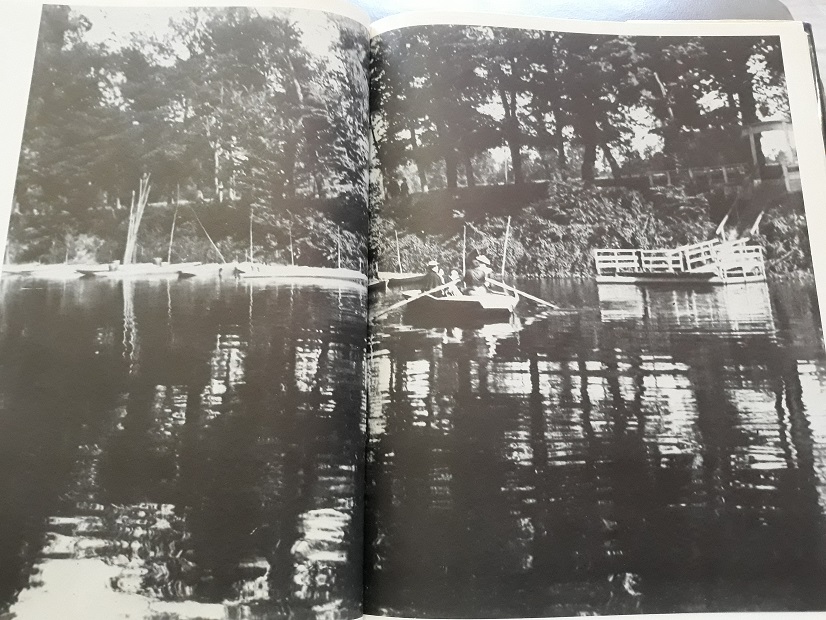
The little island near Zola's house - Loved the play of lights on the water! Zola would have had a long paragraph describing it in a novel, I bet!


A Second Family
Point of interest: ALL of Jeanne Rozerot's (Zola's mistress) and the children’s. It provides many detailed aspects of Zola's triangle marriage with Alexandrine (first wife) and Jeanne Rozerot (ex Madame Zola's seamstress). I have always wondered, at what stage of their household lives it was, when Jeanne "entered the scene". This book provides the answer: it was a couple of months after the family's holiday in Royan, of which Jeanne was taken along by Alexandrine (Madame Zola). Alexandrine's health (she was often “indisposed”) prevented her to accompany Zola on his outgoing walks, and so she arranged Jeanne to walk with him. That was, I think, how it all began.

From the photographs, I assumed that Jeanne was tender and caring, the exact opposite of the strong, businesslike Alexandrine. But maybe, most importantly, Jeanne has given Zola the children, of which Alexandrine has failed, despite her great household management. Zola adored children, and I guess family gave Zola the peaceful mind he needed to produce his masterpieces.

Tea Time a Verneuil house

I loved especially these three "Teatime" photographs; you can feel the peaceful and calm atmosphere when the family gathered around a small table out in the garden, under the shades of a tree, enjoying a cup of hot tea and biscuits. These were taken from the Zolas' garden in Verneuil, to where Zola would walk from his house in Médan (where he stayed with Alexandrine) every afternoon to have tea with his second family.

Another tea time - I love Jeanne's natural pose!

By the way, they were three different photos of different occasions – do you notice the piles of biscuits on two plates in the second photo, which was different in the first (it looks like cakes?), and they wore different clothes too. I loved Denise's dress and hat in #2. And the Zolas have a cat too! Is it the real inspiration of Minouche-the cat in The Bright Side of Life? :) What I love most of all of these photos, is their natural pose. I believe 19th century people didn't use to capture their daily lives with camera; it only showed that Jeanne and the children were so used to it that they could act that normal – thanks to Zola's passion in photography.

See the abandoned teacup with teaspoon in it in Tea Time #1? It must have been Jeanne's. As if, after serving tea, maybe after one or two sips, Jeanne would get up and say: "Wait, a couple of photos first!", just like what we do nowadays, the difference is only that we would instantly post it in Instagram, while theirs would have stayed in the film, to be professed later by Zola in his darkroom.

Tea time under the trees

I can look at these photos forever, devouring every little details, such as the teapot (I liked its 'twirling' shape), the floral tablecloth with fringes, and the way the little family sipped the hot tea from their teaspoons; exactly my habit of drinking tea. By the way, what's your habit – do you sip directly from your cup, sip it from teaspoon, or from the saucer? (My dad used to do the later to drink his coffee.) Do you see the chair cushion lying on the stool on the left in photo #3? Who do you think have abandoned it - Zola, perhaps? And who took this photo? Could it possibly be Jacques (Zola's youngest boy)? Do you think Zola has taught him to use the camera at very young age? Well... I can go on and on with my imagination, but these photos really made me feel like I was there too with the Zolas! One more thing, I loved how, maybe after tea, the Zolas stayed there to relax; Denise would be reading, Jacques doing homework under guidance of Zola? – loved Zola's chequered bowtie, by the way! ;), while Jeanne was crocheting. So peaceful...It's indeed a family goal!

Relaxing after tea?


The Trip to Italy
Zola made a trip to Italy on 1894, staying for six weeks. As you might have guessed, he was preparing materials for his second installment of Three Cities: Rome. It was during this visit that Alfred Dreyfus was arrested as a German spy.
Point of interest: none, as there's only several random photos.

Exile in England
Point of interest: almost everything, especially views from his hotel rooms, and a street scene near Crystal Palace. He took tons of wonderful pictures here, perhaps because he was alone, boring, distressed; and needed some action to focus his energy upon.

View outside Zola's hotel in London


A street in London


Zola's Paris
You could feel Zola's love for Paris from pictures he took, which are all gorgeous, every single one of them. I loved especially some of the place Clichy, and the swan lake in Bois the Boulogne (with Denise and Jacques feeding the swans).

Place Clichy after rain


Denise & Jacques feeding swans, supervised by Jeanne


The World's Fair of 1900
Point of interest: although perhaps not the best pictures he had taken, I admired Zola’s night shots, especially on Eiffel. People didn’t risk taking night photos at that time due to bad results, but Zola, of course, took no heed on it, and did his best to capture these:

A night photo in the turn of the century

Eiffel during 1900 World's Fair


Portraits and Still Lives
The last part consisted personal, as well as group, photos of the Zolas. Most of them were Jeanne’s (she’s quite photogenic for a 19th century woman!) One of it shows Jeanne smiled and tilted her head, which I think is quite unusual pose one took at that time for photograph. The point of interest of this collection is perhaps Zola’s portraits sans glasses – which is a rare sight. He looks a little different, don’t you think? I think his vigorous look comes from his glasses… :) And from this collection, you can also get a rare clear picture of Alexandrine.


Like I said, I have enjoyed very much reading through this book. If you want to get to know Zola as the man behind his pen, this book is a treasure! On the other hand, I think we readers would always be indebted to both Alexandrine and Jeanne, for without them, we might never read masterpieces from Zola. Alexandrine, particularly, has suffered the most from the triangular love; making peace with Zola and Jeanne and putting up with their peculiar relationships, and even going as far as ensuring Zola’s children got what they deserved after their mother’s death. It only proved her to be a great woman of strong courage and generous heart. And I was a bit relieved that Zola at least has never left or abndoned Alexandrine. 

Score: 5 / 5


Monday, April 1, 2019

Zoladdiction 2019 Master Post


We are here at last! Zoladdiction . BEGINS . today.

Grab your book, read, and experience nature and life, which are always celebrated in Zola’s books.

The linky will appear below this post, started on the 15th, where you can add your reviews or other Zola posts. Do not forget to share them on Twitter or Instagram too with hashtag #Zoladdiction2019! I will retweet/repost them on my accounts.

Everytime you catch interesting snippets (you’ll find many from Zola’s!), do not forget to capture them and share on Twitter or Instagram! Use these prompts to help you:


For further explanation on the prompts, you can check my pinned tweet (just click “show the thread”), or my “Zoladdiction” highlight stories on my IG.

As Zoladdiction originally started as celebration of Zola’s birthday, let us make effort on April 2nd (or before, if you need to prepare something!) and spreading a lot of attention to Zola, by sharing our personal “Zoladdiction” on blog, Twitter or IG. It can be just a photo of your Zola collections, or sharing how you have first found Zola, or maybe you’d like to post a personal challenge to read all his books? – anything to show our love/appreciation to Zola. He really deserved that!

And now, let’s have fun!


Wednesday, March 20, 2019

Twenty-Four (Bookish) Things

I first saw this meme from Brona's; who has adapted an existing meme into this bookish one to highlight some of her forgotten TBR piles. It's fun, and really helpful, so I work one too.

Our family bookcase


*4 Books on My Desk*

The Bright Side of Life by Émile Zola
Because I just can’t wait till #Zoladdiction2019 in April! In my defense, I’m reading it very slowly, devouring everything while taking notes, that I think I will finish it on April anyway. 😁

Take Courage: Anne Brontë and the Art of Life by Samantha Ellis
I have actually started this two weeks ago, but I was in no mood for another biography, after getting quite bored with The Black Count. I might take it back after Zoladdiction.


The Pen and the Brush by Anka Muhlstein
Another non-fiction; but I read this one to prepare for a post I plan to publish during Zoladdiction (if I have enough time to do it!)

The Man in the Brown Suit by Agatha Christie
Have started this a few weeks ago too, but neither a biogrpahy nor a detective story could keep me from reading Zola (I’m a chronic Zoladdict!)


*4 Books on the Bottom of the Pile*

Casino Royale by Ian Fleming
I can’t even remember how or where did I find this book. It must have been when I often shopped at the local second-hand book market, like a century ago. Should read this soon, maybe this year.

Nicholas Nickleby by Charles Dickens
This is actually the second copy I owned. I bought the first one (with movie-cover) from second-hand book market. Few years later someone sold her collections, and the Wordsworth Classic edition of this book was included. I bought it, and sold my own. However, until now I still can’t manage to read it, shame on me!

Martin Chuzzlewit by Charles Dickens
Similar to Nicholas Nickleby. In fact, this was perhaps one of the first books I bought when I seriously thought of investing in classic books. So sorry, Martin... I mean Dickens!

The Bones of Paris by Laurie R. King
Talking about TBR Pile, I also have a digital pile in my phone! This book is among the first I acquired last year. Now that I’m in for Agatha Christie Perpetual Reading Challenge, this one might have to wait a little much longer!


*4 Books New to the TBR*

The Divine Comedy by Dante (John Ciardy’s translation)
Preparing this for Adam’s coming readalong of Dante’s Divine Comedy. After years of indecisive quest of THE translation I should read, I finally made up my mind on John Ciardi’s. Hopefully I made the right decision!


Into Thin Air by Jon Krakauer
Have read a lot of good reviews on this, I’m excited to read it... hopefully very soon!

Under the Net by Irish Murdoch
This book has been on my wishlist for years, but I was still unsure about Irish Murdoch. Until Brona’s review convinced me to try.

The Rooster Bar by John Grisham
John Grisham is always one of my “autobuy” authors. Bad news is he produces books MORE regularly than my reading of his books (and it’s certainly not healthy for my cedit card!) Thus, I was deligthed when my secret santa gave me this last Christmas! Now... I must find time to read this before Grisham publishes another book. (Oh! He has!! {-_-})


*4 Books that Won Awards*

Rebecca by Daphne du Maurier
I plan to read this for next Halloween. And this is one of the books I buy for its beautiful cover!

All the King’s Men by Robert Penn Warren
A winner of Pulitzer prize... must read this soon!

The Martian by Andy Weir
It’s actually an impulse buying, because I’m a fan of Matt Damon (whose face is on the cover!). But there are good reviews about the book (I quite loved the movie). It also won the Goodreads Choice Awards: Best Science Fiction in 2014 (and I rather trust Goodreads readers than a bunch of literary cristics anyway), so, why not?

Angela’s Ashes: A Memoir of a Childhood by Frank McCourt
I bought this from a friend, having heard praises about it for years. And only today did I realized it has actually won a Pulitzer Prize for Biography or Autobiography in 1997. Well, another biography to read!


*4 Books I’m Keen to Read ASAP*

His Excellency Eugene Rougon by Émile Zola
Only four books from the Rougon-Macquart series which I haven’t read yet. This is one of them, along with The Bright Side of Life. I have ordered a copy of The Dream (it’s still on the way to Indonesia), which left only Doctor Pascal (of which OUP has not yet published its latest translation) to complete my collection.

North and South by Elizabeth Gaskell
This will be my first Gaskell, which makes me excited, but also intimidated by its length. But, to be honest, I’m rather craving for Victorian reads right now! Helena from @reading.the.classics is hosting #elizabethgaskell2019 readalongs in Instagram, and I will join in for North and South on May.

The Warden by Anthony Trollope
Besides two Christmas short stories which I read (and loved) last year, I haven’t yet read any Trollope. This year, Sir, I promise!

Rebecca by Daphne du Maurier
As I wrote above, I WILL read this on Halloween!


*4 Books I’m Thinking of Discarding Unread*

Now this is, by far, the most useful segment! I live in an apartement, thus do not have much space for keeping my books; ‘only’ one family book case (my mom and dad’s is a quarter of it, and the rest is mine – I’m a bad child, I know!) which is now almost full. I need to discard books which do not ‘spark joy’ anymore, to get space for the new ones. I will definitley discard more than 4, but these ones are for sure:

Antony and Cleopatra by Colleen McCullough
It was a longtime-ago-birthday-gift from my bookish bestfriend: Melisa, who is familiar with my obsesion with Ancient Roman things. I would have been thrilled about this one, but after having browsed some pages, I found it uninteresting (I have failed McCullough’s The Thorn Birds long ago, and I’m not sure I want to read anymore from her for the time being). So.... sorry Mel!

The Sound and the Fury by William Faulkner
It’s an on-and-off book for me, meaning that one time I’m keen on reading it, but next I’d be intimidated, then really braved myself to read it, but put it down again in the end. I WILL read it at any rate, but for now I’ll just discard my copy (Indonesian translation which is meh!), and will buy an e-book when I’m ready to take it!

The Turk and My Mother by Mary Helen Stefaniak
I kept wondering why I have (bought?) this one in the first place. Anyway, I must have thrown it away long ago....

Perempuan Bernama Arjuna by Remy Sylado
Remy Sylado is an Indonesian writer, and this book is supposed to be the Indonesian version of Jostein Gaarder’s Sophie’s World – a novel from which you can learn about history of philosophy in a fun way. I was curious at that time, but it just does not spark joy anymore....! :)


How about your TBR pile? Are they under control? ;)