Tuesday, February 19, 2013

Taking Notes – While Working on WEM Project


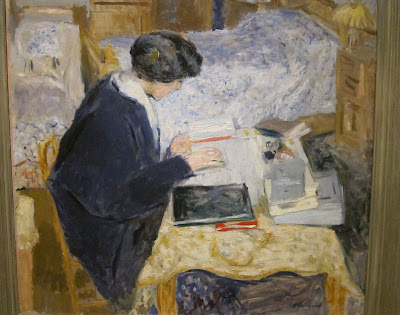
painting by Edouard Vuillard
While working on my WEM (The Well-Educated Mind) self project, I just realized that taking notes is one important aspect of reading—especially—classics. Susan Wise Bauer recommends us to always jot down our thoughts, questions, summaries, and quotes along the reading, that I must created a method to make everything easy for me.

Between work and other activities, I can read anytime, anywhere, during the day—on the way to and fro the work, at work (thank God I stay behind my desk the whole day), at home, and anywhere else possible to read. So, wherever I am, a book plus a light-small notebook always accompany me (when I am reading for WEM project). I choose light and small notebook because it’s quite handy and practical for me to carry.  But what kind of notes, and how often I need to take notes to require such effort for creating a method?

Character Lists

When I read a book with many characters, and read it from e-book, I would need to make a list of characters before I start reading. I don’t like to have to move to the earlier page and come back again to the page I’m reading everytime I need to refresh of some characters. With paperback I have no such problem, as I can open the character page easily—provided that the book has it, or otherwise, I’ll add in any characters I encounter during the reading in my notebook. Here is just an example of my character list I wrote for Shakespeare’s Julius Caesar.


Chapter summaries 

As WEM required us to make short summary for each chapter, I usually jot down…
1. The most important event(s) in that chapter.
2. Any important ideas/questions, or just my thoughts on that chapter
…everytime I finished with a chapter. And this requires much of notes taking (and plenty of pages in the notebook) for each book I tackle for WEM! My notes for chapter summaries look like this….


Vocabularies

The first book I read for WEM project was The Scarlet Letter. At that time I was still searching the most applicable method to take my notes. I tried to do it in the book; my copy of The Scarlet Letter is now full of summaries notes and vocabularies (words I’m not familiar with), just like these….


But after finishing the book, I felt guilty for having been scribbling on its pages, that I decided to not using that method anymore, and applied the light and small notebook system instead, which works and satisfies me so far.


Quotes

When I came to beautiful quotes or important passages I'd like to copy for my posts, I usually dog-ear the page (just a small part of the page which I would straight again after I've done copying—it won't destroy the book after it is placed on the shelf), and leave a check-mark near the passage I want to quote (so I don't have to look for it later). Why must I do that instead of copying it directly? Because I don't know whether I, in the end, will use that certain quote or not.


Do you have any particular notes-taking method for classics reading?

Check these WEM-ers methods too, you might find a particular method of taking notes that suits you well! (I will link to the posts after they have been published).

Jeannette, Christine, and Christina Joy of Classic Case of Madness


Monday, February 18, 2013

My Zoladdiction List


I think I owe Zola an apology…. Having been proclaiming myself as Zola’s fan, I have only read three of his books and collecting five—compared to ten Dickens I have, it’s not impressing at all! But I’m going to repair that during Zoladdiction event! So, here are my plans…

Reading at least two books – Gervaise level

I challenge myself to read at least two books, but if time permits, I will add one more, from this list:
- The Masterpiece
- La Bete Humaine
- The Debacle
Those are the only three remaining Zola books in my pile which I haven’t read yet. But it might soon change, as I have another plan during Zoladdiction…

Buying more book(s)

I have intended to expand my Zola collections, but there are so many temptations lately that it has been neglected. This year I must add at least 2-3 of these books:
- The Kill
- The Belly of Paris
- The Fortune of the Rougons
- The Earth
- The Ladies’ Paradise
- Pot Luck (Pot-Bouille)
- Nana

Are you eager to make your acquaintance with Monsieur Zola? You can do it by participating at Zoladdiction, a Zola Reading Event in April. Signing up is already opened! And for you who had participated or are thinking of participating, what would you read for Zoladdiction?

Friday, February 15, 2013

Zoladdiction – Zola Reading Event Announcement


Since last year, Émile Zola has been my most favorite classics author. I admire him for writing honestly and beautifully, that, even when the story is depressing, I can’t stop reading it enthusiastically. On the forthcoming of his birthday (April 2nd), I would like to celebrate it by hosting a Zola reading event during the month. O (delaisse)—who is a big fan of Zola too—was very enthusiastic when I asked her to host the event together. So….here is our…

Zoladdiction
April 1st – 30th, 2013


…because o and me have been addicted to Zola, now we want to spread the Zoladdiction to you all!

Zoladdiction is a reading event dedicated to Émile Zola—the most prominent contributor of Naturalism in 19th century. From April 1st to 30th we invite you to delve into Zola’s works. We have arranged some levels you can use to challenge your own addiction…

1st level: Maheude (reading 1 book)
2nd level: Gervaise (reading 2-3 books)
3rd level: Nana (reading 4 books or more)

Notes: The levels were named after three of most popular female characters in Zola books. Maheude is from Germinal, Gervaise is from L’Assommoir, Nana is from Nana.

All you have to do is… 
  • Posting about your intention to participate in this event, including the level you choose (you can upgrade it later if you want), and books you are going to pick, if you already have the idea.
  • Put links of that post in the linky below.
  • Help us to spread the Zoladdiction, either by putting the Zoladdiction button on your sidebar, or by discussing the event on Twitter using hashtag #Zoladdiction.
  • Start reading Zola’s works when your calendar turns to April 1st, of course :)
  • The master post would be up on April 1st with a linky where you can put your posts about Zola’s books.
  • At the end of the event, o and I might prepare some questions to give you ideas to post your wrap-up (we still have to discuss about this).

For questions, you can mention me at Twitter @Fanda_A or simply comment here. Are you ready to be exposed to the Zoladdiction? :)

Thursday, February 14, 2013

Cordelia in King Lear


Cordelia is the youngest daughter of King Lear, and the kindest princess of the King’s three daughters. She is a tender-hearted young woman, honest and easily touched by injustice. Cordelia has no pretense in her. When King Lear asked his three daughters, how much they loved their father, Cordelia could not make up words to explain how deeply she loved her father, although she knew that her father would get angry to hear her plain expression. For Cordelia, it’s enough that she loved him deep in her heart; that her love could only be expressed through her care for him.

Even if her answer would cost her everything—her inheritance and her suitors (she would have nothing as her dowry)—Cordelia kept her principle, that true love could not be expressed plainly through words. I think she could have invented some lovely words just to save her status in the Kingdom, but she did not do that. I admire Cordelia’s strong hold of her principle and honesty. And to those qualities, she was rewarded by the King of France—one of her suitors—by marrying her despite of the lack of dowry.

Years after that, although having been unfairly banished by her father, Cordelia kept thinking of him, she never hated her father, there’s no vengeance in her heart. She persuaded her husband, the King of France to come to England to save her father from her two wicked sisters.


When Cordelia finally met King Lear, he was not the powerful King any longer, he has been a poor and weak old man who was banished from his own Kingdom. In his condition, Cordelia still loved him, because she has been loved him from the beginning not as a King, but as a father. And now, when seeing the poor condition of King Lear, Cordelia could finally express her deep love for him. That’s the purest kind of love a father could expect from his children. And from Cordelia, we can learn that love doesn’t need proof; love can only be felt with our hearts.

Wednesday, February 13, 2013

The Classics Spin


This is why I am proud as well as happy to be a member of The Classics Club; we are always provided fun events to read classics—which were often considered as serious readings. This time the club invited us in a challenge called The Classics Spin; the idea is to list 20 books from our The Classics Club list. Then on Monday (Feb 18th) the moderator will “spin” those twenty numbers, and pick one number. Our next task is to read one book from the list which corresponds to the picked number. Isn’t that a good idea?

This is my list…. And now let’s hope for the best!—but whichever it would be, one thing is sure, I’d be able to scrap one book from the list by April 1st … :)

Books from new Authors:
1. Inferno – Dante Aleghiery
2. Candide - Voltaire
3. Mrs. Dalloway – Virginia Woolf
4. Medea - Euripides
5. The Mill on the Floss – George Elliot
6. The Stranger – Albert Camus
7. The Trial – Franz Kafka

Books from my most favorite author (Zola):
8. The Masterpiece
9. La Bete Humaine
10. La Debacle

Randomly picked from my list:
11. Richard III – William Shakespeare
12. The Three Musketeers – Alexandre Dumas
13. A Farewell To Arms – Ernest Hemingway
14. Just So StoriesRudyard Kippling
15. The Jungle Book – Rudyard Kippling
16. Kidnapped – Robert Louis Stevenson
17. Cinta Sejati (translated short stories collection) – Guy de Maupassant
18. A Tree Grows in Brooklyn – Betty Smith
19. Greyfriars Bobby – Eleanor Atkinson
20. Notes from Underground – Fyodor Dostoyevsky

Tuesday, February 12, 2013

Winner Announcement – Me And Dickens Meme & Giveaway


First of all, I’d like to thank all of you who had been participating in #MeAndDickens meme by posting your “present” for Dickens on his birthday. Actually, I did not expect too much from this meme, as I know that some efforts would be needed to produce something unique—and there not many of us who have time and interest for it. It turned out, however, that this meme have interested not less than nine of Celebrating Dickens participants, and they all have produced equally unique and creative posts, that made me think hard before choosing a winner!

You can check their posts here, and let me know which one is your favorite. Of those nine, these certain posts have been my favorites (based on the linky order):

Astrid – with her confession-poem

It’s so hard for me to pick one of them, because I love them all, each in different way. But, I must pick only one winner, so….trying to ‘borrow’ Dickens’ way of thinking (if that is ever possible!), I announce here the winner of Me and Dickens meme IS….

……drum roll……


MELISA


While Dickens would have been very pleased to read all the ten posts—mine included.. :)—I believe he would particularly be intrigued by Melisa’s message to him, in addition to her word-crafting, of course. What made Dickens’ books famous until now is—one of them—his unique characters; not only unique in personalities, but also unique in names (Plornish, Micawber, Dorrit, Havisham, ….you name it!). And Melisa expressed her admiration to that quality of Dickens in her message, which I believe, would be agreeable to the author! Not mentioning Melisa’s rather witty style in writing it, just as how Dickens is always famous of.

Congratulations to Melisa, you can choose any book from Penguin English Library as your reward. Don’t forget to let me know which book you’d choose. And for the rest of you, thanks again for your efforts, it might not be your lucky day yet, but don’t worry, there will be another giveaway at the end of Celebrating Dickens!

Visiting Great St. Bernard Hospice With Little Dorrit


Starting the second part of Little Dorrit, Dickens brought us mountain-biking to the Alps of Switzerland. The “Fellow-Travelers”—as the first chapter title—stopped by the famous Great St. Bernard Monastery and Hospice. And to help myself following the vivid descriptions presented by Dickens (he actually visited the place on September 1846), I have gathered these…. enjoy!

"In the autumn of the year Darkness and Night were creeping up to the highest ridges of the Alps. It was vintage-time in the valleys on the Swiss side of the Pass of the Great Saint Bernard, and along the banks of the Lake Geneva." ~p. 409

[source]


"The air had been warm and transparent through the whole of the bright day. Shining metal spires and church roofs, distant and rarely seen, had sparkled in the view; and the snowy mountain-tops had been so clear... (...) Mountain peaks of great celebrity on the valleys, whence no trace of their existence was visible sometimes for months together, had been since morning plain and near in the blue sky." ~p.409

[souce]


"Up here in the clouds, everything was seen through cloud, and seemed dissolving into cloud. The breath of the men was cloud, the breath of the mules was cloud, the lights were encircled by cloud, speakers close at hand were not seen for cloud, though their voices and all other sounds were surprisingly clear." ~p. 411

[source]


"There were gloomy vaulted sleeping-rooms within, intensely cold, but clean and hospitably prepared for guests." ~p.411

[source]


"Finally there was a parlour for guests to sit in and to sup in, where a table was already laid, and where a blazing fire shone red and high." ~p. 11

[source]


"Prey, has your convent many of its famous dogs now? ...I saw three in the gallery below.... And I think I have seen one of them before. | He was a dog sufficiently well known. Monsieur might have easily seen him in the valley, or somewhere on the lake, when the dog had gone down with one of the order to solicit aid for the convent." ~p. 417


[source]

Of course it would be slightly or much different on the 19th century when Dickens visited the monastery, but at least I could imagine a bit of it. Thanks you Mr. Dickens for slipping little entertainment here in the middle of this (quite) tedious reading...