Monday, February 25, 2013

Let’s Discuss On The Mystery of Edwin Drood!


When a mystery tale failed to reveal its mystery, it will open an unlimited room for discussion. The Mystery of Edwin Drood qualifies this. I have just finished it yesterday for Celebrating Dickens, and now have a lot of unanswered questions, and have been playing ‘detective’ to try to answer it. I think it would be fun too to hear other’s theories and ideas on it too. So, if you have read this last and unfinished novel of Dickens, let’s have a discussion on The Mystery of Edwin Drood through this post. For you who haven’t read it, you better skip this post, as it will give you many spoilers! You can still join us later when you have read the book though...

The rules:

  • Everyone is invited here, whether or not you are participating in Celebrating Dickens.
  • We will have the discussion via comment box.
  • I will start one or two topics, then you can post your own idea, response or theory upon it by replying the comment.
  • If you want to discuss something apart from my topic, you can start it by posting a new comment.
  • It will be better if you give title to your comments to help others get to the subject easier.
  • To follow the discussions, you can “subscribe by mail” all comments in this post (just click the link below the comment box).
  • There have been a lot of theories on this from Dickens’ critics, but I invite you to have your own imagery of the story.


So….let’s imagine and discuss!

Friday, February 22, 2013

Little Dorrit


Until now, Little Dorrit might have been the most struggling Dickens I have ever read. If you think it’s the thickness, no, it’s not a problem at all. It’s not the story either—although I did have several complaints I would have made to Dickens on it if he’s still alive. The most annoying aspect in this book for me is Dickens’ lengthy depiction around Circumlocution Office and the economics system, which reminds us of the infamous Ponzi scheme. I know, it’s mainly on those two subjects that Dickens wanted to criticize through Little Dorrit, but again, his tedious description and emphasize on those subjects really bored me to death.

Little Dorrit followed the story of the Dorrits in their two extreme conditions. In the first stint, they lived poorly in Marshalsea debt prison—Dickens wrote it from his own childhood experience. Amy Dorrit born and grew in this prison, and after her mother died, she must endure not only poverty, but most of all—especially for Mr. Dorrit the father—family’s humility. In this prison also, Amy befriended a young man, Arthur Clennam, whose kindness and attentive manner has stolen her heart. In the second stint, the Dorrits unexpectedly inherited a large sum of money, which altered their faith. Leaving the prison behind, they hastily entered the high society of London.

Beyond that, Dickens also took us to the chronicles of the Clennams, the Merdles, the Meagleses, the Gowans, Rigaud and Cavalletto, and of course the mysterious Miss Wade. Their stories intertwined with each others, and through them Dickens presented us with the dark themes of social injustice, hypocrisy, greedy, hatred and revenge; and showed us how love and kindness were the only way to happiness.

My first impression after finishing this book was how Mrs. Clennam reminded me of Miss Havisham, both with their eternal passion of vengeance against love infidelity, and both rotted in their darkness houses and hearts. And then I was thinking how vividly Dickens wrote about their hatreds, did he experience the same feeling himself? In the same likeness, Little Dorrit also reminds me of Little Nell in The Old Curiosity Shop. Both were tender, shy, grew in poverty—which forced them to bear a bigger responsibility than what girls at their age must bear. Both were full of love, and must take care of the elders, and both were called ‘Little’. I think this was much influenced by Dickens’ fondness of young, delicate and innocent girls.

From the plot I felt that, here and there, Dickens seemed to force things to suit each other. At first the story was quite boring, again, with long description of the Circumlocution Office—the satiric way Dickens criticized the unbearable bureaucracy; that even they seemed to always be busy, they in fact did not do anything but circling one task all over the office without ever gone out from it. Fortunately nearly the end, we were entertained with the mysteries surrounded the Clennams, which boost the plot a bit faster, although I felt it too faster this time. There were still few things I still didn’t get after finishing it.

First of all, what did really happen with the money Little Dorrit should inherit? Was the money still existed when Mrs. Clennam revealed the secret? Was it kept in Mrs. Clennam’s possession all the time? Or whether Mrs. Clennam had spent the money? But on what? Considering on how wretched her old house was, the fact that she could not afford to buy back the codicil from Rigaud/Blandois, and her high pride, it’s very unlikely that she did as low as using the money herself. And speaking about the house, don’t you think its ruining or blazing was a bit exaggerating? And, who was the “the poor thing that kept here secretly”, whose ghost haunted the house and whose “sounds” Affery used to hear?

And what about the oddness of how Mr. Gilbert Clennam—uncle of Mrs. Clennam’s husband—had made his will. After the woman with whom Arthur’s father had had adultery died, the money must be granted to her patron’s youngest daughter or the youngest daughter of the patron’s brother if the patron didn’t have any. Wasn’t the plot a bit forced, do you think? Why her patron? And most of all, why the youngest daughter? Well, it is supposed to be a tale anyway, but still….

I keep also wondering why Little Dorrit insisted upon burning the codicil. I think Arthur had the right to know who his mother was. Mrs. Clennam has died anyway, so Little Dorrit won’t hurt anyone—but Arthur—if she just let Arthur read the document. And I don’t think Arthur would have been much hurt by the secret, he might have been angry to Mrs. Clennam for deceiving him, but still...I would never agree on one’s hiding a truth from someone he/she loves. Or perhaps Little Dorrit was afraid that the legacy will make her rich and unhappy? But the one she burned was only the codicil, not the original legacy, isn’t it? Oh well….whatever, I’m confused.

Apart from those confusions, Little Dorrit brings us the true portrait of social and economics of London in 19th century. From this book we came to know how the combination of careless investment and the corrupt government would do injustice to innocent people. Mr. Dorrit was imprisoned in Marshalsea after failing to pay his debt. He should have not stayed there for such a long time if the Circumlocution had done their works. Moreover, families of the prisoner suffered much from humility and banished from the society. Even after being released from it, the imprisonment itself left a dark trace in one’s life, as had happened to Mr. Dorrit.

In term of moral value, Little Dorrit taught us also that the real happiness does not come from wealth and status, but from love. Little Dorrit never looked at her poverty as a handicap; she always rich in love, and because of that, people loved her.

Three and a half stars for Little Dorrit, it’s not one of my favorites, but still….how can you don’t love Dickens’ witty and sweet story telling?


~~~~~~~


*I read the 1996 Wordsworth Classics paperback edition*

*This book is counted for*


Thursday, February 21, 2013

Miss Wade in Little Dorrit


Although not the most influencing characters, Miss Wade is one of the most intriguing characters I found in Little Dorrit. She could not be included in the protagonists or antagonist group, as she was just an unhappy and indifferent young woman who added ‘colors’ to this book’s main story and theme.

From her first appearance on board the ship that brought Arthur Clennam to England, I have noticed something special in Miss Wade. She was described as ‘a handsome young Englishwoman, travelling, quite alone, who had a proud observant face, and had either withdrawn herself from the rest or been avoided by the rest.’ She was a stern woman, anti-social and liked to spend times in her solitary; she seemed to be having a severe hatred in herself, and always regarded the world with bitterness.

It was later on revealed that Miss Wade was an unfortunate human being. From her confession letter to Arthur Clennam, we began to understand why she appeared to be mysterious; and despite of her haughty manner, no one knew who she really was, and what social status or level she possessed. Miss Wade turned out to be born as an orphan. Since childhood she was treated differently; girls of her age with whom she lived with began to patronize her; and people conciliated her in insolent pity and superiority—just because she was an orphan.

Maxine Peake in the BBC mini series


Miss Wade has a deep love towards another girl whom she lived with; but she treated her just like others. Sometimes she seemed to be sweet to her, but other times she often deliberately hurt her too by making her jealous. In a little coincident, Miss Wade heard her friend told someone that Miss Wade was a child with an ‘unhappy temper’.

Further more when she was a young woman, she fell in love with a young man. They have been engaged and were certain to get married, when Miss Wade felt that the guy’s family wanted her to be submissive to the family. Once again Miss Wade felt she was being dominated by others, and this enraged her. The marriage was cancelled, and Miss Wade had a bitter hatred towards her lover.


I think her strong will and determination came first from the lack of love she experienced in her childhood. Not having parental affection, she searched for it in her friends—and that’s why when she liked one of the girls, she loved her immensely. However she was disappointed by others’ superiority towards her, including her dear friend. It was the disappointment from her best friend which terribly hurt her. And unfortunately she lived among the society who highly praised social status at that time, that she was assumed and treated as a woman of lower class, despite of her educated and cultured manner.

From her story, I learned that before we judge others, we ought to find out their background first, it’s more often than not, one’s character or moral was cultivated from his/her childhood social culture and education.

Wednesday, February 20, 2013

The Classics Club Check-In #2: February 2013


Time has been running very quickly, really! And it turns out to have been five month since the first check-in of The Classics Club (September 2012). Since then, these are what I have accomplished for The Classics Cub project:


Books I have read


My progress

If to reach my target in 2017 I should read at least two classics each month, then the above twelve I finished in five month was a fairly good achievement so far.

From those twelve, I read three books for my The Well-Educated Mind self-project (The Scarlet Letter, Heart of Darkness, The Portrait of A Lady), which I’m enjoying so far. Working on this project has been extending my knowledge of each classics piece I read, and how I supposed to read it. Especially with tough pieces like those three I read, you’d need to delve deeper into it to get what the author wanted to say through the books.

To add the excitement, I have joined several reading challenges and events for 2013, one of the most exciting is Turn of the Century Salon. And speaking about excitement....


More fun!

Beginning of 2013, The Classics Club has invented more exciting events to add colors to our classics reading, and to make us feel like—not only a community but also—a big happy family! On January we have had a 24 hours readathon, which I have enjoyed by reading The Portrait of A Lady. Then in February we are having The Classics Spin, reading a random book from our spin lists. They were awesome, and now I can’t wait for our next readathon (still on July, unfortunately…)


Struggles and Favorites

My biggest struggle was perhaps with Gone With the Wind. Heart of Darkness was also a struggle, that I must consult sparknotes and doing tasks from WEM first to finally grab the meaning. Another one I still failed to finish was Notes from Underground, which I would try to re-read from the beginning sometime this year.

My most favorite was Great Expectations. Beloved was a great book too, but it was more striking than enjoyable. It’s a kind of book you would read once in your life, but the effect goes with you eternally.

How about you, how’s your progress so far?

Tuesday, February 19, 2013

Taking Notes – While Working on WEM Project


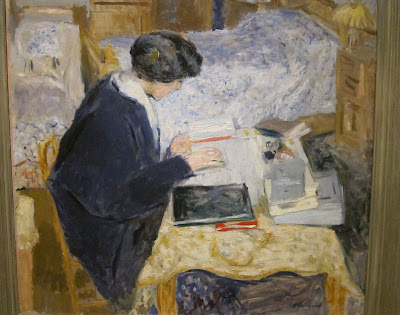
painting by Edouard Vuillard
While working on my WEM (The Well-Educated Mind) self project, I just realized that taking notes is one important aspect of reading—especially—classics. Susan Wise Bauer recommends us to always jot down our thoughts, questions, summaries, and quotes along the reading, that I must created a method to make everything easy for me.

Between work and other activities, I can read anytime, anywhere, during the day—on the way to and fro the work, at work (thank God I stay behind my desk the whole day), at home, and anywhere else possible to read. So, wherever I am, a book plus a light-small notebook always accompany me (when I am reading for WEM project). I choose light and small notebook because it’s quite handy and practical for me to carry.  But what kind of notes, and how often I need to take notes to require such effort for creating a method?

Character Lists

When I read a book with many characters, and read it from e-book, I would need to make a list of characters before I start reading. I don’t like to have to move to the earlier page and come back again to the page I’m reading everytime I need to refresh of some characters. With paperback I have no such problem, as I can open the character page easily—provided that the book has it, or otherwise, I’ll add in any characters I encounter during the reading in my notebook. Here is just an example of my character list I wrote for Shakespeare’s Julius Caesar.


Chapter summaries 

As WEM required us to make short summary for each chapter, I usually jot down…
1. The most important event(s) in that chapter.
2. Any important ideas/questions, or just my thoughts on that chapter
…everytime I finished with a chapter. And this requires much of notes taking (and plenty of pages in the notebook) for each book I tackle for WEM! My notes for chapter summaries look like this….


Vocabularies

The first book I read for WEM project was The Scarlet Letter. At that time I was still searching the most applicable method to take my notes. I tried to do it in the book; my copy of The Scarlet Letter is now full of summaries notes and vocabularies (words I’m not familiar with), just like these….


But after finishing the book, I felt guilty for having been scribbling on its pages, that I decided to not using that method anymore, and applied the light and small notebook system instead, which works and satisfies me so far.


Quotes

When I came to beautiful quotes or important passages I'd like to copy for my posts, I usually dog-ear the page (just a small part of the page which I would straight again after I've done copying—it won't destroy the book after it is placed on the shelf), and leave a check-mark near the passage I want to quote (so I don't have to look for it later). Why must I do that instead of copying it directly? Because I don't know whether I, in the end, will use that certain quote or not.


Do you have any particular notes-taking method for classics reading?

Check these WEM-ers methods too, you might find a particular method of taking notes that suits you well! (I will link to the posts after they have been published).

Jeannette, Christine, and Christina Joy of Classic Case of Madness


Monday, February 18, 2013

My Zoladdiction List


I think I owe Zola an apology…. Having been proclaiming myself as Zola’s fan, I have only read three of his books and collecting five—compared to ten Dickens I have, it’s not impressing at all! But I’m going to repair that during Zoladdiction event! So, here are my plans…

Reading at least two books – Gervaise level

I challenge myself to read at least two books, but if time permits, I will add one more, from this list:
- The Masterpiece
- La Bete Humaine
- The Debacle
Those are the only three remaining Zola books in my pile which I haven’t read yet. But it might soon change, as I have another plan during Zoladdiction…

Buying more book(s)

I have intended to expand my Zola collections, but there are so many temptations lately that it has been neglected. This year I must add at least 2-3 of these books:
- The Kill
- The Belly of Paris
- The Fortune of the Rougons
- The Earth
- The Ladies’ Paradise
- Pot Luck (Pot-Bouille)
- Nana

Are you eager to make your acquaintance with Monsieur Zola? You can do it by participating at Zoladdiction, a Zola Reading Event in April. Signing up is already opened! And for you who had participated or are thinking of participating, what would you read for Zoladdiction?

Friday, February 15, 2013

Zoladdiction – Zola Reading Event Announcement


Since last year, Émile Zola has been my most favorite classics author. I admire him for writing honestly and beautifully, that, even when the story is depressing, I can’t stop reading it enthusiastically. On the forthcoming of his birthday (April 2nd), I would like to celebrate it by hosting a Zola reading event during the month. O (delaisse)—who is a big fan of Zola too—was very enthusiastic when I asked her to host the event together. So….here is our…

Zoladdiction
April 1st – 30th, 2013


…because o and me have been addicted to Zola, now we want to spread the Zoladdiction to you all!

Zoladdiction is a reading event dedicated to Émile Zola—the most prominent contributor of Naturalism in 19th century. From April 1st to 30th we invite you to delve into Zola’s works. We have arranged some levels you can use to challenge your own addiction…

1st level: Maheude (reading 1 book)
2nd level: Gervaise (reading 2-3 books)
3rd level: Nana (reading 4 books or more)

Notes: The levels were named after three of most popular female characters in Zola books. Maheude is from Germinal, Gervaise is from L’Assommoir, Nana is from Nana.

All you have to do is… 
  • Posting about your intention to participate in this event, including the level you choose (you can upgrade it later if you want), and books you are going to pick, if you already have the idea.
  • Put links of that post in the linky below.
  • Help us to spread the Zoladdiction, either by putting the Zoladdiction button on your sidebar, or by discussing the event on Twitter using hashtag #Zoladdiction.
  • Start reading Zola’s works when your calendar turns to April 1st, of course :)
  • The master post would be up on April 1st with a linky where you can put your posts about Zola’s books.
  • At the end of the event, o and I might prepare some questions to give you ideas to post your wrap-up (we still have to discuss about this).

For questions, you can mention me at Twitter @Fanda_A or simply comment here. Are you ready to be exposed to the Zoladdiction? :)