Monday, November 11, 2019

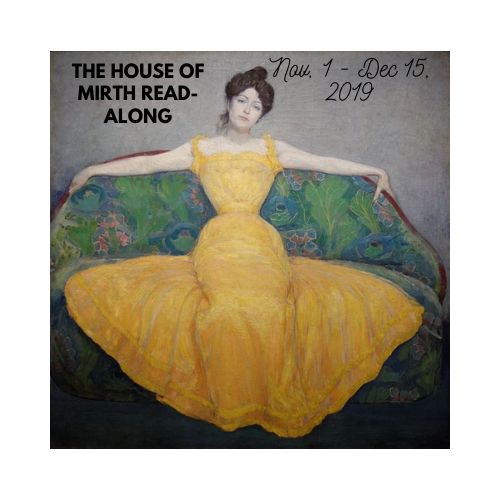
The House Mirth Readalong Week #1: Chapter 1-4


"It's all coming back to me now!" - was how I felt when first plunging into this one of all-time-favorites of mine, on my third read. And with it, I also saw things I haven't noticed previously. Here's my train of thoughts on the first four chapters.

Chapter 1

=Lily stood apart

From the train station scene, where Selden saw Lily Bart standing uncertainly on the platform: Lily Bart always "stood apart from the crowd", and "always roused speculation". I questioned myself: is it her exceptional beauty? The next sentence answered it: "that her simplest acts seemed the result of far-reaching intentions". And I instantly felt sorry for Lily. For the upper classes it's like a fun show, where they sit comfortably on the top, watching her climbing up the society slippery stairs to reach them. They might cheer her along the way, or might even bet on her, just to see whether she'd make it or not, and if not, aah... it's been a fun show; then go home thinking nothing of it. Even Selden, who isn't really their set, also found Lily Bart 'interesting'. Indeed, you could find in ch. 1 only, the word "amused" quite often attached to Selden, concerning Lily.

Chapter 2

=Naturalism

And so it reminded me that Edith Wharton was one of the prominent Naturalims authors in 19th-20th century. And this treatment to Lily Bart is typical Natutalism literature, where we are brought to analyze how a character would react under influence of heredity and social environment. As is Doctor Pascal in Zola's Rougon-Maqcuart cycle, so is Lawrence Selden in The House of Mirth - though I admit that Selden is more deeply involved into the story than Pascal (I guess, because I haven't read the last novel in the cycle, LOL).

Wharton also used animal-on-hunt analogy for Lily's approach towards Percy Gryce: "She began to cut the pages of a novel, tranquilly studying her prey through downcast lashes while she organized a method of attack". Animals hunt to survive, and so does Miss Bart!

Chapter 3

=Inheritance

Still on the naturalism theme - Lily inherited her mother's "extravagant aptitude" and crude passion for luxury, while from her father, a refined mind and taste. And so Lily is always torn between these two poles. It will be much easier (and happier) for Lily if she was just like her mother - and marry Percy Gryce; or more like her father - and marry Selden (for I am convinced that Selden would marry her if she has given him the chance).

Lily knew that in order to survive, she must get Gryce, but at the same time, part of her revolted at the idea of being a mere trophy to a man. I think what she truly wants is marriage for happiness (an equal marriage), but Lily has been brought up in the environment of upper classes; it has became her habitat, that she couldn't do more than marrying money. And that's why Lily forbade Judy Trenor of inviting Selden to Bellomont, for she instinctively knew that her conquest would be faltering when Selden is present.

Chapter 4

=Choices and Guidance

Lily's situation reminded me of my mother's advice years ago. No, I have never hunted for husband... LOL. But, as Wharton classified husband hunting as career, I then compared it with my own. Mom told me that one cannot always get the best of everything in life. So you must set your own priorities in your career - do you seek money or comfort? If you're lucky, you can find a job which pays well, and with nice atmosphere. But mostly you can only choose one of the two. I have left my first job with high salary, to move to my present (with lower salary) because my first job was full of intrigue, and they did not trust me. And now I'm so grateful I have listened to my mom in the first place; I have made the right decision. But not everyone is fortunate enough to have a good mother or family who could guide one through life. Poor Lily is one of these.

=Laziness and Procrastination

Chapter four was the turning point of Lily. Just when everything went smooth, and the target was within her reach, entered Lawrence Selden, bringing with him everything that Lily has been praising deep in her heart. Why do you think she stayed single at 29 years of age, with her beauty and "skill"? I think it's because Lily never felt sure she would be happy by marrying money, but she did not have enough strength to do otherwise. And so she kept delaying her decision to marry. I think she inherited too, from her father, the laziness to face uncomfortable truth. We don’t know for sure how Mr. Bart came to his ruin (the process, I mean, not the cause – for that we knew that the Barts spent more than what they could afford – and was he not a gambler? I vaguely remember… maybe Lily inherited that too?) But I imagined that Mr. Bart felt powerless while seeing his fortunes drained day by day, with the luxury they were enjoying, until the inevitable fact hit hard on him. I noticed that Lily did the same in chapter one after the Rosedale “accident”. Along the chapters we’d see that she had the habit of procrastinating important and “ugly” things, and let the thought passed “for the time being”.

Have you finished the first four chapters too? How is it so far?


Thursday, October 31, 2019

CC Spin #21: Tarzan of the Apes by Edgar Rice Burroughs


Previous Classics Club Spin has introduced me to an interesting book – One Flew over the Cuckoo’s Nest - which I have dreaded, but glad (more relieved, actually) that I have read it at last. This time the spin brought me another surprise - a book I regarded as a romantic adventure of an ape man (I remember watching Tarzan on TV when I was a kid), but rather different than last year's, this book appeared to be more serious than just a teenage lit. Here is why…

Heredity theme

Regular readers of my blog must have been familiar with my 'obsession' with Émile Zola, and the heredity and evolution theme in his monumental works: the Rougon-Macquart cycle. Thus you can imagine how excited I was when realizing that Tarzan of the Apes is more than an entertaining adventure/love story, it is also an interesting (more interesting even, perhaps, than Zola's) analysis on the theory of heredity and evolution. A gentleman by birth, but an ape by education, Tarzan is. It is thoroughly exciting to see how he begins to realize by instinct his superiority compared to his peers, how he learns cunning tricks, how he starts making calculations and strategies, and of course, how he teaches himself to read and write, by help of books in the cabin - John Clayton's library.

Self learning

Tarzan taught himself to read and write from a shelf-full of books, which John Clayton has, thankfully, brought with him, when he and Lady Alice decided to sail to his new post in British West Africa. I can imagine, how little Tarzan spent hours in the little cabin, diligently memorizing words and syllables from picture books, until he could fluently structure sentences, though he have never heard the pronunciation. The first proof of his study was the note he stuck on the door of the cabin which was found by the group of Professor and Jane Porter, signed by "Tarzan".

Frankly speaking, this signature was where I have detected the first flaw in Burroughs' heretofore genius scientific facts in the story. Immediately I thought: if Tarzan was the name Kala and the other apes called him in their 'tongues', and he has never heard before English words pronounced, then how could he write his name as T.a.r.z.a.n ? You know what I mean? But, if it is a flaw, it is of no significance, compared to how much Burroughs has influenced and impressed us with a touching, humorous, and adventurous stories.

Man vs animal

"Being a man, he [Tarzan] sometimes killed for pleasure, a thing which no other animal does; for it has remained for man alone among all other creatures to kill senselessly and wantonly for the mere pleasure of inflicting suffering and death." How much truth there is in this sentence! How often do we boast of human's superiority from animal, that we might forget that we, human, often behave even worse than animal - above quote is the proof.

People are often picking animal for an insult or verbal abuse, or even for bullying others. So, next time someone does that to me or my friends, I'll remind him/her using above argument. Man could be worse than animal, when he chose to do so. Tarzan, as a man-beast, highlighted the good sides and bad sides of human beings. The conflict in Tarzan, between wanting to self-develop himself and being disgusted at moral corruption of his kind, is what eventually shape him to a noble character. So, real nobility is not what man is born into, but what man decides to be, when he has choices to be other than that.

John Clayton, the Lord Greystoke, and his wife Lady Alice, were the embodiment of the true nobility, and Tarzan, while being educated as and to be an ape, he also inherited this nobility from his parents. On the other hand, though he inherited human's cunning way of views from his biological parents, yet he grown up in the nature, and so, by combining these two aspects in him, he evolved to be an almost perfect human being.

Back to Nature

Tarzan is one reminder, thus, to the world, that man should have intimate relationship with the Nature to better himself. I believe that spending much time in the nature enables us to reflect on the simplicity of God's creation, and to remind us of what we were created to be, in the first place.

This book has been an easy and entertaining read, but at the same time, an unexpected one.

4 to 5


Wednesday, October 23, 2019

Rebecca by Daphne du Maurier

Rebecca is often considered Daphne du Maurier's masterpiece. It's a perfect Halloween read - beautiful yet haunting. I have read it for R.I.P. XIV, and loved it. As most likely you all have read it, I’m not going to take the pain of summarizing it (and it’s difficult to do so without throwing spoilers – if you haven’t read it – anyway), so, here are my thoughts:

It begins with the end

If you hate spoilers, you might dislike this kind of writing style, in which the characters told you what have happened in the past that they ended up in their situation today. For me, it provides sort of certainty of how the story might end, which I prefer, rather than always worrying whether this will end tragically or happily. By knowing how it would end (except for mysteries, of course), I can read slowly and calmly, savoring every moment of it. In the end I found it much more satisfying. And so it was with this book. The heroine told us that she and her husband have survived from a tragedy - something which has happened to their lovely mansion: Manderley, and which they both desperately tried to forget.

It's about a woman without name, and a name without the woman

I was rather annoyed, in the early chapters, as it seemed nobody ever mentioned the name of the narrator! But in the end I think du Maurier did it purposely to highlight the contrast between her and Rebecca - whom everyone talked about, found everywhere, heard everywhere, though she was dead years ago.

Yvonne (let's give the narrator a name, at least in this post, as I hate a nameless character!) is timid, introverted and insecure young woman, working as companion to a wealthy woman. Rebecca is her opposite in everything! She married the owner of an estate, rich, bold, beautiful, sociable, powerful. Those were the outside qualities any outsider would have perceived. But as a husband, Maximilian de Winter knows better. Inside, the two women are also the David and the Goliath in their hearts and souls. Rebecca is also wicked, selfish, cruel, and without love. She reminds me of Cathy in East of Eden

[credit: Gardenvista]

Yvonne is sweet, loving, innocent, kind, and tender, if only you know how to love her, because she is, again, insecure. I can totally relate to her, because I understand how to manage insecure people. My dear mom is one. What they need, on top of everything, is love - they need to be sure that they are loved. When you love them, and protect their privacy (because that's what we, introverts, need most of all!), we'd see a brave woman underneath the fragile appearance. Unfortunately the world still love outside appearances better than inner qualities. And that's why introverts and insecure people tend to be disliked and misunderstood, just because they aren't sociable. They forget that these people, if you are willing to understand and respect their silence and timidity, you'll see that their capability to love is much bigger than the extroverts.

In this story, only Maxim and Frank, the agent, it seems, who could really see Yvonne's qualities, and understand her. From the very beginning I have had certainty that Maxim married Yvonne purely for love. That he, alone, could see underneath the plain appearance of this girl - while others would never, or with difficulty, understand.

[credit: Gardenvista]

Intelligence vs innocence

What struck me is, that the so called 'dim-witted' Ben could see the cruelness beneath Rebecca's superficial charm, while others who were more intelligent, failed. Apparently, being intelligent does not always prevent one from being shallow and vain. On the other hand, I think innocent people use their feeling more than their mind, in judging others' character. That's why Rebecca's charms never deceived poor Ben.

And I loved how du Maurier put Maxim's faith in Ben's hand. But, isn't murder still a murder, be it done to good people or villains? Well, sometimes, evil can only be stopped by violence. It's still wrong, of course, but I'd probably do the same if I have had a soulless person like Rebecca - or Cathy - as a spouse.

The wicked housekeeper

No, I'm not going to analyze Mrs. Danvers' character here. She's purely as wicked (and more sick, perhaps) as her mistress. It's only that every time I read about her, it was Downton Abbey's Mrs. Hughes face that popped up in my head. I know that Mrs. Hughes is kind and wise, so different from Mrs. Danvers, but do you remember her face when she looked at Mr. Green (the valet how 'attacked' Anna Bates)? It's full of cold hatred and disgust; and it's that face which I imagined was on Mrs. Danvers' every time she saw Yvonne. Yeah, a Gothic castle which is haunted by it's evil mistress, and kept by a wicked housekeeper... there's enough of Gothic element there to make it a favorite Halloween read!

It has been a delicious read for me, and I think I would love to return to it in the future!

4,5 of 5 - because I still hate any writer who doesn't name his/her narrator! :)


Monday, September 23, 2019

All the Pretty Horses by Cormac McCarthy


This was my first Cormac McCarthy. Years ago I have meant to try The Road, but after reading about his poor-punctuation style, I cancelled it. All the Pretty Horses is the first of his Border Trilogy, and since I'm always interested in similar theme, I thought this would be my entrance - and who knows, I might enjoy it!

I was wrong. The theme is great, but it's far from what I've expected. The story is dark, and at times it's even quite bloody, despite of "all the pretty horses".

John Grady Cole is a 17 y.o. boy grew up in a ranch. The ranch has become his life, so when his mother decided to sell it after all the family died, Grady decided to leave the ranch altogether. Together with his friend, Lacey Rawlins, he travelled to Mexico to become a cowboy - a romantic dream of boys their age.

Before crossing Mexican border, they met a skinny and shaggy young boy called Jimmy Blevins, who insisted that he was 16 y.o., and that the (too fine) horse he is riding is really his. Out of compassion, the two boys (Grady in particular; Rawlins distrusted Blevins from the first) let the skinny boy rode with them along the way. Blevins' horse run away one night after a terrible thunderstorm, bringing with it Blevins' vintage pistol (again, they doubted it really belongs to the boy). Blevins convinced Grady and Rawlins to steal the horse back after they found it in a nearby village. It turned into a chaos; Blevins was caught, and the boys ran away.

Eventually they found a big ranch, and were hired as workers. Impressed with Grady's great skill with horses, the owner brought him to stay near the big house. Grady fell in love with the boss' daughter Alejandra. At around this time a group of rangers came to the ranch, caught Grady and Rawlins, and put them into jail, where they had hard times, and almost got killed.

Enough with the summary, now let me bring out my scale to weigh the whole story:

Positive things:
* the cowboy things, both during the journey, but especially at the ranch (the horse trainings are fabulous!)
* bildungsroman - it's marvelous to witness how their journey matured Grady and Rawlins. When you are close with the nature, you'll think a lot about life, God, and all spiritual and philosophical stuffs.

Negative things:
* lack of punctuation - how annoying it is to follow a long dialog without proper punctuation; you'll get lost of who's talking right now, and it lacks the emotion too.
* polysyndetic syntax - okay, I confess I have had no idea that Hemingway's style has a name! Yep, it feels like reading Hemingway, you know... with a lot of "and" serves as the only conjunction on a passage. I guess it's half the reason I'd stopped reading Hemingway! So polysyndetic is something about "conveying a flow and continuity of experience in a passage" using certain conjunctions.

So, what's the final verdict? I guess 3 / 5 is the max. Another writer to be deleted from my list.


Thursday, September 19, 2019

Classics Club Spin #21, and a Tough Decision!


The next Classics Club Spin has come at the perfect time when I really needed it! The second semester of the year has been very hectic for me - and it will be until the end of the year; it might even stretch to early next year. I am very exhausted right now - more emotionally than physically, and my reading mood has kept altering between calm-and-soothing ones and light-fast ones. It means I always need to have two books to read simultaneously; and I can shift between books two or three times in a day. Really crazy, I know! And that's why, I was very excited to have the 21st Classics Club Spin!

Here's my list:

5 Random Classics

01. Their Eyes Were Watching God - Zora Neale Hurston
02. The Glass Menagerie - Tennessee Williams
03. The Crucible - Arthur Miller
04. The Deerslayer - James Fennimore Cooper
05. Tarzan of the Apes - Edgar Rice Burroughs

5 Victorian Classics

06. Agnes Grey - Anne Bronte
07. Hard Times - Charles Dickens
08. Return of the Native - Thomas Hardy
09. Silas Marner - George Eliot
10. The Red Badge of Courage - Stephen Crane

5 Gothic Classics

11. The Man Who Was Thursday - G.K. Chesterton
12. The Moonstone - Wilkie Collins
13. We Have Lived in the Castle - Shirley Jackson
14. The Mysteries of Udolpho - Ann Radcliffe
15. Othello - William Shakespeare

5 Modern Classics

16. Under the Net - Iris Murdoch
17. The Pearl - John Steinbeck
18. The Beautiful and Damned - F. Scott Fitzgerald
19. This Side of Paradise - F. Scott Fitzgerald
20. Things Fall Apart - Chinua Achebe

Which one I look forward the most? I don't know - I say, I'm quite excited to read any number the spin would get me. Maybe, I'd rather having something gothic to read for #RIPXIV. But, I will read from no. 11-15 anyway, so.... anything is welcomed.

Now it comes to the hard decision I have mentioned in the title.

I have made the toughest decision in my reading life, to sign out from Moby Dick Readalong. The thing is, I don't have the right mood for deep reading right now - what with my hectic life, and also with menopausal-depressions I have to cope with. It's not a regular thing - thank God! - but still, it comes now and then.

Actually I have been doing quite well with the readalong so far - I have even managed to post weekly updates, and was generally having fun with the other participants. But entering chapter 26 or 27, I began to lose interest - I don't know why; I believe it has nothing to do with the book - it's just me. And I was thinking that we are approaching the end of year, which is usually the busiest days at work. Then I realized that I wouldn't have the energy to cope with it. I have choices, of course, I can just have a light reading through it. But I have done that years ago (this was my second read). If it doesn't give me joy anymore, why should I continue? 

I feel sorry to Brona - I have been waiting for this for a long time, and even half encouraged her to do it, perhaps, but now I must put it down. I am disappointed too, but... yeah, I have no choice. Another thing, I have mentioned earlier that I'm planning to have an ambitious project of reading Zola's Rougon-Macquart cycle in 4-5 years, starting next year. Right now I'm very excited! I have prepared the materials, and can hardly wait till January. I might begin earlier with my Cambridge Companion to Zola, just to get the outline of what I must focus on next year!

Meanwhile, I'm going to enjoy my readings as much as I can - no ambitious task for the moment. Good luck with your readalongs, events, or spins! :)

Monday, September 2, 2019

Moby Dick Ch. 20-22: Aboard at Last!


Ch. 20: All Astir

= Aunt Charity, Bildad's sister, is the very opposite of her beloved brother. She is the embodiment of pure Christianity! - attended to all crews' needs with loving care. You gotta love her!

= I have just realised on this chapter, why Captain Bildad's name was quite familiar. Why, it's one of Job's friends from the Bible (Book of Job)! Bildad is the one who accuses Job of having done something bad to deserve God's wrath. An appropriate name for Bildad the Captain, whose main job description seems to be christening the savages, or his own crews.


Ch. 21: Going Aboard

= The mysterious Elijah: prophetic or lunatic?

= What was it that he'd wanted to warn Ishmael & Queequeg? Captain Ahab, or the dangerous voyage ahead?

= Were the shadows of some sailors, which Ishmael saw but not Queequeg, real or hallucinatory?

= Elijah, as is the Bible's Prophet Elijah, prophesied doom. Is his function in the story merely to portray the dangerous voyage of whaling (in the 19th century's superstitious style), or something else?

= Colonial mentality. I might have gone too far here, from the book's theme, but the comical scene where Queequeg innocently sat on a sleeping sailor on board Pequod has nevertheless prompted me to think about inferior mentality caused by colonialism. [From Wikipedia] "A colonial mentality is the internalized attitude of ethnic or cultural inferiority felt by people as a result of colonization, i.e. them being colonized by another group. It corresponds with the belief that the cultural values of the colonizer are inherently superior to one's own." Remember how Queequeg told Ishmael that "in his land, owing to the absence of settees and sofas of all sorts, the king, chiefs, and great people generally, were in custom of fattening some of the lower orders for ottomans." They'd buy "eight or ten lazy fellows" for that purpose. How, do you think, can these lower orders give themselves to be degraded like this? I think it's because they believe they were inferior to their kings or chiefs. Yes, it's not colonialism in this case, but the idea popped up in my head, because Indonesia have inherited the same mentality from our centuries of colonialism, and it affects us, sadly, even today.

= Another train of thoughts of mine on this subject: Queequeg, whose mind is noble in almost every other subjects, felt nothing is wrong with the degraded practice of his natives. It proves that one cannot fairly judge other's behavior as ethically or morally right or wrong, without first perceiving his or her background. In John Grisham's The Chamber, for example, the main character is a prominent KKK member who bombed a building and killed some innocent Jewish kids. He insisted he was not guilty at first, because it was what his family always taught him from childhood. Later on, after contemplating his action while in jail, he realized that what he's done was wrong. I won't open argument of whether it's possible or not here; my point is that, quoting the valuable advice of Nick Carraway's father (The Great Gatsby): "Whenever you feel like criticizing anyone, just remember that all the people in this world haven't had the advantages that you've had." In that light, Queequeg’s queer humor is quite acceptable.


Ch. 22: Merry Christmas

We were introduced to Pequod's chief mate, one of my favorite characters: Starbuck. You know, it never struck me, on my first reading, that his name was similar to that of the worldwide coffee chain: Starbucks! Later on I searched its history, and found that it's actually half-named after Starbuck the chief mate. Pequod has also been suggested, but they finally picked Starbuck, but ending it with an 's'. Interesting, right? The more you dig, the more Moby-Dickish bits you'd find!

I will end this weekend's update with another interesting finding: a superb 34 minutes video of whaling around the world:

The Grand Panorama of a Whaling Voyage 'Round the World by New Bedford Whaling Museum


It also mentions the one whaling voyage which a decade later has inspired Melville to write Moby Dick. In 1820, a whaling boat from Nantucket called Essex was rammed by a huge whale, and sank in Pacific oceans. From 20 crews, 8 survived, after resorted to cannibalism. The story was later told, in 1821, by its first mate, Owen Chases.

I have wanted to write three more chapters for this post, but I have wasted the last valuable 34 minutes I could spare yesterday by watching above video... so... it's all I could squeeze at the moment. Next weekend I'll be travelling, so no update is possible till the week after. See ye again, shipmates!


Wednesday, August 28, 2019

Moby Dick Ch. 12-19: On Religions and Some Cultural Backgrounds


Ch. 12: Biographical

How relatable is this passage about Queequeg's origin to our present world. Son of a High Priest on his native island, he was rejected, bullied, and distrusted when entering the "so-called-Christians" land. Christians, who regard themselves as superior towards other races, but often behave lower and more savage than they whom they called "savages". Only Queequeg, so far (yes, not even Ishmael - see ch. 17!), who regards fellow human being as brothers/sisters - all race and nation is just the same - that's what I call humanity at its best. "It's a wicked world in all meridians; I'll die a pagan."


Ch. 13: Wheelbarrow

= A hint of cultural diversity, the hilarious story from Queequeg. And it's good that Queequeg throws the shade over Ishmael's laughing at him about the wheelbarrow incident. And actually it's not the first time - Ishmael will do similar thing at ch. 17. Those arrogant "boobies and bumpkins" also had their fair shares by bullying Queegueg!

= Another hint of sin and slavery (related to ch. 1 - the passage about "the two orchard thieves [Adam and Eve]) in "the intorelableness of all earthly effort" and "how I spurned that turnpike earth- that common highway all over dented with the marks of slavish heals and hoofs."

= Again, another hint of water as deliverance against dust/land (as in ch. 1), and as key to freedom.

= I admired Queequeg's humbleness; he was unconscious of his heroic action, which was exemplary to all (particularly to Christians) - "It's a mutual, joinstock world, in all meridians. We cannibals must help these Christian's." Bravo, Queequeg!


Ch. 14: Nantucket

I have found an interesting fact while researching about Nantucket. Remember Peter Coffin, the owner of Spouter Inn, whose name has thrown dark gloom over Ishmael? Did you know that the real Peter Coffin was one of the owners of Nantucket back in 17th-18th century? A Hussey – as in the Husseys, owner of Try Pots inn [ch. 15] was also the name of one of the owners.

[From Wikipedia] :
“In October 1641, William, Earl of Stirling, deeded the island to Thomas Mayhew of Watertown, Massachusetts Bay. In 1659 Mayhew sold an interest in the island to nine other purchasers, reserving 1/10th of an interest for himself, "for the sum of thirty pounds ... and also two beaver hats, one for myself, and one for my wife." [In] 1659, when Thomas Mayhew sold his interest to a group of investors, led by Tristram Coffin. The "nine original purchasers" were Tristram Coffin, Peter Coffin, Thomas Macy, Christopher Hussey, Richard Swain, Thomas Barnard, Stephen Greenleaf, John Swain and William Pike. These men are considered the founding fathers of Nantucket, and many islanders are related to these families.”

Interesting, eh? I imagined how Melville might have been amused while finding this name (Coffin), which really fitted the dark gloom he wanted to cast around chapter 3!

By the way, I loved the poetic description of Nantucketer: "....with the landless gull, that at sunset folds her wings and is rocked to sleep between billows; so at nightfall, the Nantucketer, out of sight of land, furls his sails, and lays him to his rest, while under his very pillow rush herds of walruses and whales."


Ch. 15: Chowder

Another interesting fact: the chowder (but tell me first, can you read this chapter without salivating all over? LOL). Anyway, I always assume that chowder is a creamy soup. Is it the same in your place? But, again, researching about 19th century chowder, I realized that then, chowder was a layered casserole. I found this information in a post by a food blogger called The American Table.

“Traditionally, chowders are more like soupy casseroles, and that ‘chowdering’ referred to the process of layering ingredients. One of the first recipes for a chowder, for example, was published as a poem in the Boston Evening Post on September 23, 1751”:

First lay some Onions to keep the Pork from burning
Because in Chouder there can be not turning;
Then lay some Pork in slices very thing,
Thus you in Chouder always must begin.
Next lay some Fish cut crossways very nice
Then season well with Pepper, Salt, and Spice;
Parsley, Sweet-Marjoram, Savory, and Thyme,
Then Biscuit next which must be soak’d some Time.
Thus your Foundation laid, you will be able
To raise a Chouder, high as Tower of Babel;
For by repeating o’er the Same again,
You may make a Chouder for a thousand men.
Last a Bottle of Claret, with Water eno; to smother ’em,
You’ll have a Mess which some call Omnium gather ’em.

The original chowder, I guess, would have looked similar to this:
  
[credit: Book Phantom]


Ch. 16: The Ship

First meeting with the owners of Pequod: Captain Peleg and Captain Bildad. I noticed first of two inconsistencies regarding religion and its practices.

= On Bildad: despite of "Ye have been studying those Scriptures, now, for the last thirty years...", Bildad treated his crews cruelly. And I loved how Melville picked the verse of Matthew 6:19-21 ["lay not up for yourselves treasure upon earth...] to be particularly cited by Bildad when he decided to "swindle this young man" by giving him "long lay". Tipping my hat to you, Mr. Melville, that's just brilliant!


Ch. 17: The Ramadan

Inconsistency #2 was shown by Ishmael, when he criticized Queequeg's extreme practice of Ramadan. While keep saying that he (Ishmael) "cherish the greatest respect towards everybody's religious obligations, never mind how comical...", he was obliged, nevertheless, to scold Queequeg "rather digressively" by bullying or making fool of his beliefs, or faith, or whatever you call it: "Hell is an idea first born on an undigested apple-dumpling; and since then perpetuated through the hereditary dyspepsia nurtured by Ramadans." I personally was quite surprised by this speech - I thought Melville (through Ishmael - or is he not entirely Melville's voice?) made a point of condemning Christian's superiority towards other religions/beliefs. Not believing in other religions (or religions in general) is one thing (and tolerable), but making fool of them publicly is disrespectful. By doing that, Ishmael acted just like the Christians he criticized. We might regard other religious practices are ridiculous, but we must pay respect to them all the same - each to his own belief!


Ch. 18: His Mark

Captain Bildad and Captain Peleg, each has his opposite view of religion.
- Bildad: studied diligently the Scriptures, but practiced none.
- Peleg: ignored the Scriptures, but practiced it.

Browsing Brona's post, I have found out that Melville was assumed to be Agnostic. I shrugged off this idea at that time (last week), since so far, Melville has diligently quoted Bible verses, telling stories from Bible, and named his characters from Old Testament - not mentioning the powerful my-so-far-favorite chapter: The Sermon. But then, I began to notice few inconsistencies in the previous chapter; and now, this Peleg's argument with Bildad. So, maybe the Agnostic idea was not entirely ungrounded, after all. I begin to feel that Melville, perhaps disappointed with his fellows Christians, began to dream of (or "converted" to) a religion beyond existing religions, which was based on humanity and nature (which explains Ishmael's feeling of freedom, related to sea). Well, let's see!


Chapter 19: The Prophet

For an Agnostic (if Melville was really one), he really borrowed Biblical aspect so abundantly for his book! :) Now he brings us the Book of Kings - Elijah the prophet and King Ahab. I'm excited to see where he'd bring us to with this line.

And so, it’s all for now. ‘Till next week!