Monday, February 13, 2023

Re-reading Sad Cypress by Agatha Christie: A Review


🌹 This was the first time I've ever read a whole book by listening to audiobook (while occasionally reading the printed copy). And I'm glad with my decision; Sad Cypress is the perfect book to listen to. It's Christie's first time to incorporate law court scenes in her novel, and I think the scenes become more lively with a perfect dramatization from a great narrator, who is no less than Sir David Suchet!

🌹 What I admired from Suchet, is that he gives each important character their unique personalities; he can voice them in different inflection, power, and accent. Particularly whenever he voices Elinor Carlisle's reflection during court session - the soft, dreamy, and weary voice of a young woman after a tragedy.

🌹 Elinor Carlisle is accused of committing murder to Mary Gerard, daughter of lodge keeper of Elinor's wealthy aunt. It seemed to be a straightforward case - the motive (Roddy, a young man she loved and promised to marry, is smitten by Mary Gerard); the weapon (Mary died of poisoning after eating a sandwich that Elinor has prepared for an impromptu picnic) - all seemed to point out to Elinor as the murderer. Is she?


🌹 Luckily for Elinor, there's young Doctor Peter Lord, who's falling in love with Elinor, and believes in her innocent. It was him that contacted and persuaded Hercule Poirot to seek the truth. What kind of truth be revealed by Poirot? Is Elinor the real murderer? If not, who, and why?

🌹 Sad Cypress was written rather differently in structure, compared with Christie's usual method. The court scenes allowed her to break down the narrative into four phases. First, the court scene where Elinor as the accused pleaded "not guilty"; then the scene shifted to where it had begun, until Mary Gerard was found dead, and entered Poirot doing his routine interviews, interspersed with him discussing the progress with Peter Lord. Following that, the scene moved back again to the court, where the real murderer is finally revealed (not by Poirot as usual). My favorite part is the ending, where Christie tied up all the loose ends, satisfyingly.

🌹 The atmosphere of the whole story is more melancholy. There is not the usual red herring or plot twist; it's pretty straightforward, which gave Christie more space to delve into the characters' psychological struggles. Listening to audiobook only enhanced my understanding on this aspect, and made this reading a new and fulfilling experience (I still sometimes consulted the book when I didn't understand a word or two, especially when Poirot talked with his foreign accent.)

🌹 One more thing... I loved the cover art of my paperback edition, with a blur bluish image of a woman. It seems to portrait Elinor quite suitably. The artwork of Harper Collins edition with roses and thorns, seems suitable too. But you can understand its connection with the story only after reading it.

Rating: 4 / 5 

Friday, February 10, 2023

1st Impression on Ronggeng Dukuh Paruk (The Dancer) by Ahmad Tohari


Ronggeng Dukuh Paruk is an Indonesian classic historical fiction written by Ahmad Tohari. It was first published in 1982 in trilogy, but in 2003 Gramedia Pustaka Utama published it as a whole novel. It had then been translated into Japanese, Dutch, German, as well as English. The English version is titled The Dancer, translated by Rene T.A. Lysloff, and published by Lontar Foundation in January 2013. 


Cover of the English translation


Synopsis
Set in the tumultuous days of the mid 1960s, "The Dancer" describes a village community struggling to adapt to a rapidly changing world. It also provides readers with a ground-level view of the political turmoil and human tragedy leading up to and following the abortive Communist coup. This trilogy of novels traces the lives of two characters: Srintil, a dancer whose unwitting involvement with the region's leftist propaganda machine sets her at odds with Rasus, the love of her life who embraces Islam and finds a career in the army. Through their separate experiences, both learn the concepts of shame and sin: Rasus after he leaves their home village and journeys into the wider world and Srintil when the outside world finally comes crashing into her remote and isolated village.
 

I am reading the Indonesian novel edition, though, with its bright orange cover. Though the story isn't really as bright as the cover!


Two most important themes of the story are ronggeng itself and the historical political turmoil in Indonesia in mid 1960s, which would become one of the darkest tragedies of this nation.

About Ronggeng
Quoting from wikipedia: "Ronggeng is a type of Javanese dance in which couples exchange poetic verses as they dance to the music of a rebab or violin and a gong. The term "ronggeng" also applied for this female dancers. During a ronggeng performance, the female professional dancers are expected to invite some male audiences or clients to dance with them as a couple with the exchange of some tips money for the female dancer, given during or after the dance. The couple dances intimately and the female dancer might perform some movements that might be considered too erotic by standard of modesty in Javanese court etiquette. In the past, the erotic and sexual nuance of the dance gave ronggeng a shady reputation as prostitution disguised in the art of dance."

Ronggeng Dance by P. A. van der Lith (1893-1894)


So, 'Ronggeng' in the title alludes to the dancer, Srintil, our protagonist. Dukuh is a small village; so Ronggeng Dukuh Paruk can be freely translated as Ronggeng Dancer from Paruk Village.


Ronggeng and Geisha
From what I've been reading so far, I gathered that ronggeng is the "lower" version of geisha. While geisha is usually multi-talented, ronggeng's skill is mainly dancing and a little singing. They both entertained men - geisha, those of the upper classes; ronggeng, the lower working classes. One more striking similarity: to become eligible, there's a special rite they must perform, where their virginity would be sold to the highest bidder (I've at least gathered that about geisha from Memoirs of a Geisha by Arthur Golden). To become either geisha or ronggeng is regarded as an honor, and little girls dreamed to have such career. Geisha is perhaps more of honorable and intelligent entertainer, but ronggeng is plain prostitute disguised as dancer!


The 1960s Political Turmoil
The Indonesian genocide or Indonesian politicide was a mass killings primarily targeting members of the Communist Party of Indonesia (PKI), but also people or organizations suspected to be sympathizers of the ideology. It is estimated that between 500,000 to 1,000,000 people were killed during the main period of violence from October 1965 to March 1966.


Two rather unappealing historical facts in a novel - though the political turmoil, I suspect, will only appear rather later on the novel. But I decided to read through, because Tohari wrote this novel quite beautifully. I loved especially the first chapter, where he described the rustic beauty of Indonesian life in a small village - tranquil in its nature and simplicity - before modern life touched it.

I’m curious how the story and its characters would develop from that. I'm not really excited about this book – it might be a bit of a struggle for me - but let's just see!

Wednesday, February 8, 2023

Blogger-Inspired Wishlist Ep. 2: A Short Story Collection and Three New Authors


Blogger-Inspired Wishlist is a feature where I post recent additions to my wish list, which had been inspired by reviews from my fellow bloggers. It includes some synopsis, as well as some excerpts of the review which have intrigued me, complete with a link to the blogger's original post.

In this second episode you'll find me adding four more books into my wish list, three of which are from authors new to me.


Wessex Tales by Thomas Hardy
Inspired by: Reese @ Typings


Synopsis:
In addition to his great "Wessex Novels," Thomas Hardy wrote Wessex Tales (1888), a collection of six stories that, for the most part, are as bleakly ironic and unforgiving as the darkest of his great novels -- Jude the Obscure.

Readers will experience Hardy's uncompromising, unsentimental realism in Wessex Tales, and for those seeking a taste of the Dorset poet and novelist, they represent an ideal start.

From Reese's review:
"Those two stories, while perhaps not Tess of the D'Urbervilles tragic, are more what one thinks of as typically Hardy... Anyway quite entertaining, and much more varied than I was expecting."

Reese and I agree, to read (and enjoy) Hardy's you need to be in the right mood. What if you want to but are not in the right mood? I think this short story collection would be the best choice!


Madam, Will You Talk? by Mary Stewart


Synopsis:
Widowed Charity Selborne had been greatly looking forward to her driving holiday through France with her old friend Louise - long, leisurely days under the hot sun, enjoying the beauty of the parched Provencal landscape. But when Charity arrived at their hotel in the picturesque French town of Avignon, she had no way of knowing that she was to become the principal player in the last act of a strange and brutal tragedy. Most of it had already been played. There had been love--and lust--and revenge and fear and murder.

From Jane's review:
"I absolutely loved the setting, starting out in Avignon and ending up in Marseille, with terrific car chases, visits to ancient Roman and medieval French sites and landmarks, cafe lunches, moonlit strolls, kidnapping, and lots of derring-do along the way.

The romance is pretty sappy, but palatable. The suspense is marvelous--definitely couldn't put it down as I neared the end of the story."

A cozy mystery set in Southern France is enough to hook me up! πŸ˜‰


The Foolish Gentlewoman by Margery Sharp


Synopsis:
Light, humorous novel in the usual Sharp style, Isabel Brocken, a sentimental English widow, extends her hospitality to a rather mixed group of friends and relatives who have been left without living quarters by the war.

From Mallika's review:
"A charming piece of fiction. The story is gentle and told with humour and yet also realistic all through. I loved reading this book and how Margery Sharp told this unusual little tale. She gives us a good feel of post war England, with the changing face of the neighbourhood—some people having lost their lives, others moved away, old houses lost or badly damaged; the different views and problems."

Seems like a charming, delightful book!


Near Neighbours by Molly Clavering
Inspired by Heavenali @ heavenali 


Synopsis:
At number 6 Kirkcaldy Crescent lives Mrs. Lennox and her five children (all in their late teens or early twenties). Number 4, the house next door, Miss Balfour, a gentle and unassuming spinster who was constantly surprised to find "how astonishingly nice and good people were when you knew them..."
What she did not know and would not have believed was that the people who knew her could not help living up to her belief in their good qualities.

From Heavanali's review:
"An unashamedly delightful read – without being in way sugary or silly. Molly Clavering has created a cast of characters her readers can become immediately invested in. Her central character Dorothea Balfour in particular is a wonderful character – her back story is somewhat sad, and the reader can delight in her late blossoming and happiness. Near Neighbours is a very cheerful and hopeful novel. Certainly, an author I shall read more of in the future."

Another delightful book from Dean Street Press that is hard to resist!


Have you read any of these? 


Previous Blogger-Inspired Wishlist posts:
- Ep. 1 (Christmas edition)


Monday, February 6, 2023

Dandelion Wine by Ray Bradbury: A Review


πŸ’š Dandelion Wine is Ray Bradbury's remembrance of his childhood in Waukegan, Illinois, which he changed to Green Town in this book. It was originally developed from a short story of the same title.

πŸ’š Douglas Spaulding, the twelve years old boy, main character of this story, is Ray Bradbury himself. The story takes place in one summer in 1928. Summer is Douglas' favorite season. During summer holidays Douglas and Tom, his little brother, used to stay at their grandfather's house, and help him preparing bottles of Dandelion wines. In Douglas' view, each bottle contains the essence of every event that had happened during that summer holiday, that he wishes not to forget.

πŸ’š Douglas (or Bradbury) is an imaginative boy, while Tom is the opposite; he's the sensible one. They both take notes of day to day small but memorable events during that summer; happy and sad, terrifying and exciting. Douglas' new tennis shoes, for instance, is an important event in Douglas' summer.

πŸ’š Then there are things which excited their summer, but also made them contemplating about life. The Happy Machine, Colonel Freeley's 'time machine', and their last ride on the green trolley, are some of these. There are also Misses Fern and Roberta's Green Machine, the Buffalo dust and Ching Ling Soo, the Tarot Witch at the amusement park, and of course, the Lonely One! But maybe, the one that touched Douglas most during that summer, is when his best friend John Huff moved out from the town.

πŸ’š
Though this story has been modeled as a novel, I think it would be more fun to read it as short story collection. It still lacks a little cohesiveness to become a whole novel, because there is no plot. Nevertheless, all stories made us reflect about happiness in the past, and what matters most. There are those who tries hard to preserve and live in the past, such as Mrs. Bentley, who keeps bric-a-brac from her past. But there are also people like Douglas' grandfather who believes:

"Once a time was over, it was done. You were always in the present."

πŸ’š Maybe the best way is to keep happy memories, like Douglas' summers in bottles of Dandelion wine; then moved on, and to continue on living in the present - savoring all the little things we can, to be preserved then, in the next batch of Dandelion wines. Just like Douglas' grandfather's wisdom:

"When you’re my age, you’ll find out it’s the little savors and little things that count more than big ones. A walk on a spring morning is better than an eighty-mile ride in a hopped-up car, you know why? Because it’s full of flavors, full of a lot of things growing."

πŸ’š Dandelion Wine is a happy and delightful reading, with its sweet simplicity, its summer vibes, packed with fun adventures, written in a poetic and beautiful style by Ray Bradbury. I loved most of the stories, but two of my favorites are perhaps Douglas' half blind grandma's splendid food only while the kitchen is in topsy-turvy condition; and the kindhearted Mr. Jonas the not-ordinary-junkman who always know what one needs most. I know what I need most... more books that makes one smile like this one, please!

Rating: 4,5 / 5


Saturday, February 4, 2023

Six Degrees of Separation, from Trust to David Copperfield


Six Degrees of Separation is a meme, now hosted by Kate @ booksaremyfavoriteandbest.

On the first Saturday of every month, a book is chosen as a starting point and linked to six other books to form a chain. Readers and bloggers are invited to join in by creating their own ‘chain’ leading from the selected book.

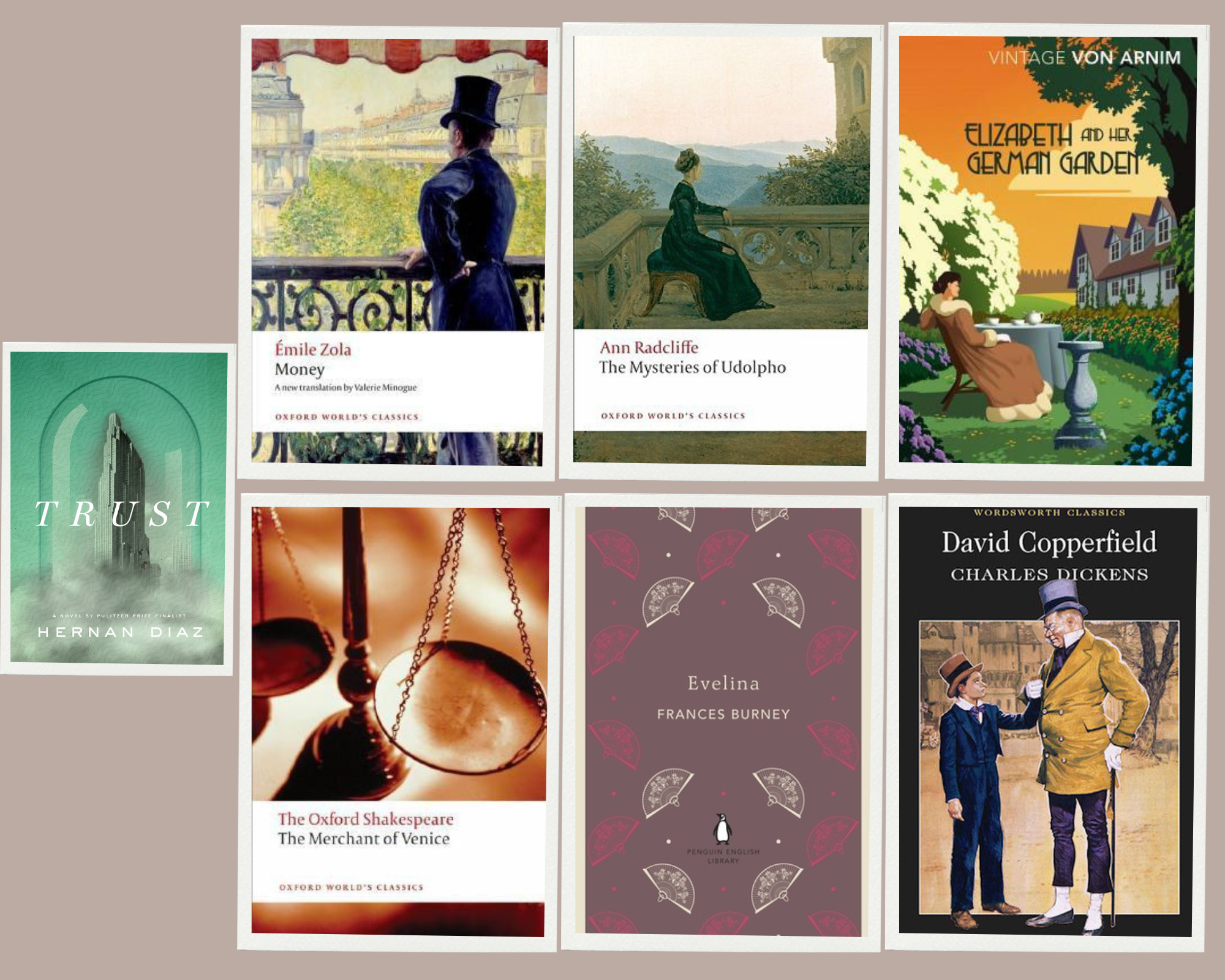
This month we start from:

Note:
- I have read all book except the starter.
- Each title is linked to, either my review, or to Goodreads page if I didn't review it.


I haven't read the book, but the theme is money/financial scheme. One book popped up instantly in my head:


1. Money by Γ‰mile Zola

It's about speculation and fraudulent financial scheme on Paris Bourse in 19th century. Aristide Saccard - main character of this novel - is anti-semitic. His principal rival is a Jewish banker. Another book where its character is also an anti-Semite who deals with a Jewish is:


2. Merchant of Venice by William Shakespeare

There might be quite many books set in Venice, but one book that instantly came to my mind:


3. The Mysteries of Udolpho by Ann Radcliffe

While the story isn't entirely set in Venice, it is in Venice that poor and innocent Emily meets Count Morano for the first time. Emily isn't the only orphaned girl with aggressive suitor in literature. I've read last year a book where the heroine suffered similar predicament:


4. Evelina by Frances Burney

Evelina, or A Young Lady's Entrance into the World is an epistolary novel, and so is...


5. Elizabeth and Her German Garden by Elizabeth von Arnim

It is a semi autobiographical novel of Elizabeth von Arnim, which reminds me of another book that share the same genre, but from different century:


6. David Copperfield by Charles Dickens

Another semi autobiographical novel, which is also one of my all-time favorite books.


And that’s how the chain ended. It’s been fun… I should do this more often!


Wednesday, February 1, 2023

January Wrap Up & Exciting Things on February!


Woman Reading, Portrait of Sofia Kramskaya, Ivan Kramskoy (1886)


The first month had come and then gone so quickly, but it has changed my reading life quite considerably.


πŸ“š Books Read in January

The Woodlanders by Thomas Hardy
- for CC Spin #32
A thorough and satisfying read; wrote four posts about it.
Read from: printed book

Dandelion Wine by Ray Bradbury (reviewed, unpublished yet)
1st Impression
A delightful and colorful read!
Read from: e-book

Sad Cypress by Agatha Christie (unreviewed yet)
My first-time audiobook reading listening; a fantastic reading of otherwise rather melancholy book.
Read from: audiobook / printed book combo

The Affair at Grover Station by Willa Cather (short story)
A murder story marred by racism
Read from: e-book


πŸ“š Started but unfinished yet

* Rural Hours by Susan Fenimore Cooper (e-book) - 1st Impression

* Little House in the Big Woods by Laura Ingalls Wilder (audiobook)


2023 Statistics

πŸ“Š Total books read so far: 3
πŸ“Š Total short stories read so far: 1
πŸ“Š Challenge progress:
* 2023 TBR Pile Challenge: 2
* 2023 Victorian Reading Challenge: 1
* 2023 Audiobook Challenge: 1


πŸ“š What's happening in February

* Buddy Read with Melisa (@melmarian), reading an Indonesian classic: Ronggeng Dukuh Paruk (English edition: The Dancer) by Ahmad Tohari

* A Blog Party hosted by Hamlette (Rachel) @ Hamlette's Soliloqui: We πŸ–€ L.M. Montgomery Week
I'll read Jane of Lantern Hill and plan to write two posts for the party; this would be exciting!


* Continuing Rural Hours (this one might stretch on to March!) and Little House in the Big Woods.

* Listening/reading combo of The Enchanted April by Elizabeth von Arnim


How's your January reading? And what's your plan for February?


Monday, January 30, 2023

The Pine Planters: Marty South's Reverie - A Poem by Thomas Hardy


Woman in the Forest by Ion Andreescu (1880)


I'm not usually drawn to poems, but Mallika @ Literary Potpourri has pointed out to me the other day that Hardy had wrote a poem about Marty South, an important figure on The Woodlanders, which is also subtitled: Marty South's Reverie. I've found the poem, and it's too beautiful not to be featured in a special post. So here it is, Thomas Hardy's poem in two parts. The first part is about Marty South's unrequited love, while the second is, I guess, more about how she sees her life in the woodland in the end. Hope you'll love it as much as I do!

I

We work here together
In blast and breeze;
He fills the earth in,
I hold the trees.

He does not notice
That what I do
Keeps me from moving
And chills me through.

He has seen one fairer
I feel by his eye,
Which skims me as though
I were not by.

And since she passed here
He scarce has known
But that the woodland
Holds him alone.

I have worked here with him
Since morning shine,
He busy with his thoughts
And I with mine.

I have helped him so many,
So many days,
But never win any
Small word of praise!

Shall I not sigh to him
That I work on
Glad to be nigh to him
Though hope is gone?

Nay, though he never
Knew love like mine,
I'll bear it ever
And make no sign!


II

From the bundle at hand here
I take each tree,
And set it to stand, here
Always to be;
When, in a second,
As if from fear
Of Life unreckoned
Beginning here,
It starts a sighing
Through day and night,
Though while there lying
'Twas voiceless quite.

It will sigh in the morning,
Will sigh at noon,
At the winter's warning,
In wafts of June;
Grieving that never
Kind Fate decreed
It should for ever
Remain a seed,
And shun the welter
Of things without,
Unneeding shelter
From storm and drought.

Thus, all unknowing
For whom or what
We set it growing
In this bleak spot,
It still will grieve here
Throughout its time,
Unable to leave here,
Or change its clime;
Or tell the story
Of us to-day
When, halt and hoary,
We pass away.