Tuesday, March 28, 2023

The Classics Club 10 Years Celebration Questionnaire (Late Post)


The Classics Club 10 year celebration was actually last year, but somehow I've missed this questionnaire posted on their website. It's only when I saw Brona's post (also late poster 🀭) that I realized its existence. Better late than never is our motto, so.. here it is..

When did you join the Classics Club?
March 8th, 2012. I know the exact date because I put it in my first CC list. I was one of the early-joiners.

What is the best classic book you’ve read for the club so far? Why?
Definitely Germinal by Γ‰mile Zola. It is, by far, my all-time favorite novel. And I doubt I would change my mind, though one never knows, as I realize that my reading taste keep changing with age. Why, you ask? Because Germinal is just a perfect book. From every aspect.

What is the first classic you ever read?
I don’t really remember. I read a lot since I was a kid, and can’t remember what I read in what age. I remember reading the illustrated version of Mahabharata (an ancient Indian epic) with my father. It was in Indonesian translation with great illustrations. That’s perhaps my first classic. But first classic I read as an adult was perhaps either To Kill a Mockingbird or Anne of Green Gables.

Which classic book inspired you the most?
Maybe Mahabharata. I read that with my father. And I remember he explained much about honor, loyalty, and friendship.

What is the most challenging one you’ve ever read, or tried to read?
Proust’s Swann’s Way. I didn’t understand what it’s about from the beginning, so I DNFed it after perhaps 50-ish pages.

Favourite movie adaptation of a classic? Least favorite?
I didn’t watch much movie adaptation of classics – they are usually disappointing – so I can’t think of a favorite, but my least favorite is the modern adaptation of The Three Musketeers, but can’t remember the exact year. I quite liked the adaptation of The Man in the Iron Mask, though, starring Leonardo di Caprio.

Which classic character most reminds you of yourself?
Anne Eliot from Persuasion and Isabel Archer from The Portrait of a Lady.

Has there been a classic title you expected to dislike and ended up loving? Respecting? Appreciating?
Jane Austen's Persuasion. My first Austen was Sense and Sensibility, and it didn't like it. So, it is with trepidation when I started Persuasion. It turned out well, fortunately, I loved the story and the heroine!

Classic/s you are DEFINITELY GOING TO MAKE HAPPEN next year?
Barnaby Rudge by Charles Dickens. It’s the last Dickens’ novel I’ve not read. Have planned to read it this year, but I'm still not in the mood for it. Next year it will be. Promise!

Favorite memory with a classic and/or your favourite memory with The Classics Club?
My sweetest memory with The Classics Club is when I was made its first Classics Clubber of the month, on August 2012. I've never felt that honoured in my life before. Thank you again, The Classics Club, for letting me become a part of you, belong to your community. And though seven months late, I wish you the best for ten more years to come!
 

Monday, March 27, 2023

Blogger-Inspired Wishlist Ep. 4


Blogger-Inspired Wishlist is a feature where I post recent additions to my wish list, which had been inspired by reviews from my fellow bloggers. It includes some synopsis, as well as some excerpts of the review which have intrigued me, complete with a link to the blogger's original post.

Blogger-Inspired Wishlist has been into 4th episode. I've started it only to keep record of books that are interested me, as well as the sources (reviews of other bloggers). However, I began to see that others have also benefited from my posts; finding random books which they haven't heard before but interested them. I'm so glad that this blog-feature also serves you, readers, as much as it does me! It encouraged me to keep doing it.

At first I planned to do it once a month, but lately you all have reviewed many good books that I have to post the 4th eps. on the same month with the 3rd one. Here they are:

Five more books are added for the fourth episode:

Murder Before Evensong by The Reverend Richard Coles
Inspired by: Cath @ Read-warbler 


Synopsis:
Canon Daniel Clement is Rector of Champton. He has been there for eight years, living at the Rectory alongside his widowed mother - opinionated, fearless, ever-so-slightly annoying Audrey - and his two dachshunds, Cosmo and Hilda. When Daniel announces a plan to install a lavatory in church, the parish is suddenly (and unexpectedly) divided: as lines are drawn, long-buried secrets come dangerously close to destroying the apparent calm of the village. And then Anthony Bowness - cousin to Bernard de Floures, patron of Champton - is found dead at the back of the church, stabbed in the neck with a pair of secateurs. As the police moves in and the bodies start piling up, Daniel is the only one who can try and keep his fractured community together... and catch a killer.

From Cath's review:
"If you like old fashioned 'English villagey' type crime stories then this might be up your street. I found it well written, rich in background detail, and fun to read: I didn't guess the culprit."

πŸ”Ή️ A reverend turns sleuth - might this be as good as Father Brown's? We'll see! πŸ˜‰


Castle Shade by Laurie R. King
Inspired by Gypsi Reads


Synopsis:
A queen, a castle, a dark and ageless threat--all await Mary Russell and Sherlock Holmes in this chilling new adventure. When Queen Marie calls, Mary Russell and Sherlock Holmes are as dubious as they are reluctant. But a young girl is involved, and a beautiful queen. Surely it won't take long to shine light on this unlikely case of what would seem to be strigoi? Or, as they are known in the West...vampires.

From Gypsi's review:
"Russell is genuinely likable, Holmes garners respect and admiration, and their relationship is as believable as possible, given the circumstances, and immensely entertaining. Actual facts are woven in with the fiction nearly seamlessly, with the personalities of the historical figures being convincing, and the supporting cast, as it were, seeming lively and realistic. Castle Shade is closer to 4.5 stars technically speaking, but it's worth the higher rating for the pure pleasure and satisfaction it gives."

πŸ”Ή️ I haven't followed this series for quite a long time, I think catching up with the latest of the series would be a good idea - don't you think?


Still Life by Sarah Winman


Synopsis:
Tuscany, 1944: As Allied troops advance and bombs fall around deserted villages, a young English soldier, Ulysses Temper, finds himself in the wine cellar of a deserted villa. There, he has a chance encounter with Evelyn Skinner, a middle-aged art historian who has come to Italy to salvage paintings from the ruins and recall long-forgotten memories of her own youth. With beautiful prose, extraordinary tenderness, and bursts of humor and light, Still Life is a sweeping portrait of unforgettable individuals who come together to make a family, and a richly drawn celebration of beauty and love in all its forms.

From Malika's review:
"Still Life is a heart-warming novel about art, Italy, and really, about life and its many colours. What stands out ultimately is how important love and support are in life—not romantic love but love of friends, those whom one can bond with, those that stand by you unconditionally, unquestioningly, those who have always got your back.

From a not so great start (though even that made sense later), this turned out to be a lovely, warm, read, full of hope, and about all that is good about human beings."

πŸ”Ή️ Sounds like a warm, soothed, and affectionate book!


The Patience of a Saint by G.B. Stern


As I could not found any summary from Google, I had to rely on Simon’s review:

"This is exactly the sort of novel I love and hunt out. St Cedric was martyred a thousand years earlier, and there is a legend that he will return on that anniversary – firmly believed by Lady Eileen Francis, who patiently waits at the ruins of Abbey where St Cedric once served. Seeing an opportunity for money (which, for slightly complicated reasons, he needs for a friend – I suppose to make him more sympathetic to the reader), Ceddie Conway decides to impersonate him. Stern has created a lovable character in both Cedric and Ceddie, and this slim book plays out the conceit just long enough to keep it entertaining and tense."

πŸ”Ή️ Sounds a hilarious book, does it not? It’s a pity I couldn’t find a copy yet. The book seems to be missing from surfaces.


Until We All Share Joy by Heather Wood


Synopsis:
This warm, standalone Christmas novella highlights a lesser-known member of the beloved Dinsmore family in the Finding Home series. With all the charm of a Victorian Christmas and yet the realistic challenges of navigating difficult relationships in a Christlike manner, this book is one to be savored throughout the holiday season and beyond.

From Hamlette's review:
"This book is not so much a romance as a coming-of-age story for Titan as he matures into manhood after feeling he's never taken seriously by his family since he is the youngest.  Taking on responsibility and stepping out into a life of his own helps him to grow and change, and I liked getting to watch that happen."

πŸ”Ή️ A Christian fiction, Victorian Christmas novella; how can I resist?...


Have you read any of these books? Or do you find any new interest?
 

Friday, March 24, 2023

The In and Out Book Tag

Young Woman Reading a Book, Aleksandr Deineka, 1934


I first saw this bookish tag at @Brona's Book (This Reading Life) some time ago, and thought it fun to do. So, here it is..

Reading the Last Page First: OUT
Though I sometimes browsed Wikipedia to know how a story or a character would end, I never read the last page before getting at the end.

Enemies to Lovers: IN
It's a cliche, I know, but I still love it!😁

Dream Sequences: OUT
It often confuses me whether a scene is really happening or just in a dream.

Love Triangles: IN
It adds the complication, isn't it?

Cracked Spines: OUT
It would be hard to hold the book conveniently.

Back to My Small Town: IN
I have no complaint as long as it's necessary for the story.

No Paragraph Breaks: OUT!
A big no-no.

Multi-generational Sagas: IN
My favorite is Steinbeck's East of Eden.

Monsters Are Regular People: OUT
I'm no fan of fantasy.

Re-Reading: IN
I love re-visiting old favorites!

Artificial Intelligence: OUT
Nothing artificial, please! 

Drop Caps: IN
It looks beautiful, so why not?

Happy Endings: IN
If not real happiness, at least a hopeful one!

Plot Points That Only Converge at the End: IN
Isn't that the point of a novel?

Detailed Magic Systems: OUT
Again, no big fans of fantasy

Classic Fantasy Races: OUT
For same reason as above.

Unreliable Narrators: IN
We have a chance to figure the story out ourselves, or perhaps when the writer wants to emphasize a point.

Evil Protagonists: OUT
I would hate the story as well.

The Chosen One: IN
I love Harry Potter, at least πŸ˜‰

When the Protagonist Dies: OUT
I love happy ending!

Really Long Chapters: IN
The sentences are more crucial.

French Flaps: IN
They are often charming, and I just need to put it down while reading.

Deckled Edges: IN
They look vintage.

Signed Copies by the Author: IN
Though reading mostly classics make it impossible...

Dog-Earing Pages: IN
I do it all the time!

Chapter Titles Instead of Numbers: IN
I rarely read them anyway πŸ˜‹


That's it. If you wish to do it too, consider yourself tagged!


Wednesday, March 22, 2023

Rural Hours by Susan Fenimore Cooper: A Review


🌳 Rural Hours is a journal written by 19th century female author: Susan Fenimore Cooper. If you feel familiar with her surname, it's because she was the daughter of James Fenimore Cooper, the author of The Last of the Mohicans. More background facts about Susan Fenimore Cooper, and how this journal had inspired Darwin and possibly Thoreau, I have written in my 1st Impression on this book.

🌳 Cooper was an amateur naturalist; she read many books or essays by other naturalists, and recorded her observations on animals, plants, landscape, as well as rural life during her daily excursions, onto her journals. This book was derived from these notes, took up a course of four seasons of 1848, beginning from the spring.

🌳 Reading an amateur naturalist has its advantage. I took pleasure of Cooper's observations, as if I was walking with her, but without being troubled too much with scientific phrases of a pedantic. While bird-watching, she would observe:

"It was amusing to watch the parents flying home, and listen to the family talk going on; there was a vast deal of twittering and fluttering before settling down in the nest, husband and wife seemed to have various items of household information to impart to each other, and the young nestlings made themselves heard very plainly; one gathered a little scolding, too, on the part of some mother-robins."

Can you imagine yourself taking a stroll with Cooper, bird-watching with amusement like that? That has always been my dream!

🌳 I loved Cooper's sharp wit in her observations, such as when she wrote about a spider:

"A huge spider, by-the-bye, with her intricate web and snares, would form no bad emblem of a courtier and diplomatist, of the stamp of Cardinal Wolsey. He certainly took "hold with his hands, in kings' palaces," and did his share of mischief there."

🌳 Beyond the animals or plants (she could talk about trees for some pages!), Cooper is also a sharp observer of human nature and their civilization. She criticized her nation for their reckless behavior towards horticulture, and for not focusing on the advantages of gardening. She also noticed how her people were gradually taking distance from nature, even on adorning their houses:

"In very truth, a fine tree near a house is a much greater embellishment than the thickest coat of paint that could be put on its walls, or a whole row of wooden columns to adorn its front; nay, a large shady tree in a door-yard is much more desirable than the most expensive mahogany and velvet sofa in the parlor."
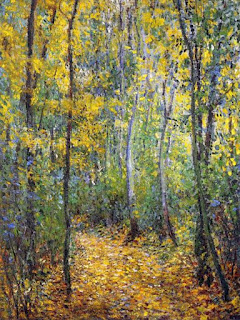
Wood Lane, Claude Monet, 1876


🌳 I loved also her observation on the simple life of farmers, when visiting a farmer house, she observed that they provide most of their domestic needs at home; doing all their spinning, weaving, dyeing by themselves.

🌳 Sometimes Cooper would talk about some unusual sights, like how, on one foggy dawn, a flock of wild pigeons alighted on the trees at the heart of the village (a rare sight!), and only after the fog has lifted, that the birds flown again. Some cows Cooper saw on her walk one evening, were returning home after pasturing along the road side or unfenced woods. They were left to forage by themselves, and usually came from different houses. They would leave home in the morning, and return home in the evening, one to this house, the other to that - all by themselves without anyone accompanying them.

🌳 Few more amusing things Cooper observed: Otters - these animals have one very strange habit: it is said that they actually slide down hill on the snow, merely for amusement. Then there is her amusing comment on singular leaf of a tree that dances merrily, moved by some light puff of air:

"A single leaf or two in rapid movement, all else still and calm; and one might fancy Puck, or some other mischievous elf, sitting astride the stem, shaking his sides with laughter at the expense of the bewildered spectator."
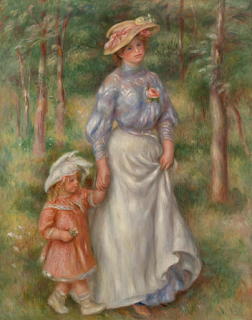
La Promenade, Pierre-Auguste Renoir, 1875


🌳 Cooper shared her father's sentiments regarding the Indians, which she showed in her note: "..a savage race is almost invariably corrupted rather than improved by its' earliest contact with a civilized people; they suffer from the vices of civilization before they learn justly to comprehend its merits. It is with nations as with individuals-amelioration is a slow process, corruption a rapid one."

🌳 I've just realized that the US named their rivers, mountains, or cities with Indian names: Michigan, Ontario, Mississippi, Potomac, and many more. Cooper beautifully put it into this reflection:

"A name is all we leave them, let us at least preserve that monument to their memory; as we travel through the country, and pass river after river, lake after lake, we may thus learn how many were the tribes who have melted away before us, whose very existence would have been utterly forgotten but for the word which recalls the name they once bore. And possibly, when we note how many have been swept from the earth by the vices borrowed from civilized man, we may become more earnest, more zealous, in the endeavor to aid those who yet linger among us."


🌳
Sometimes too, we get glimpses of some village stories or legends. One of my favorites is of a pet fawn, who, after being saved from haunting dog's chase by some people, was then shot by a hunter because it approached him without fear. Another reminder to us to let wild animals be wild!

🌳 I think from what I've written and quoted above, you can see how I loved this book! For a person who live in a tropical country with only two seasons: wet and dry, where the flowers keep blossoming, and the landscape never changes its hue, Cooper's journal provided me with invaluable glimpses of the four beautiful seasons I wouldn't have witnessed. I loved every little change of the lake color, the leaves, or the flower petals, from season to season. I'm a 'color' person, and this has been a wonderful "experience" of a lifetime, though only through Susan Fenimore Cooper's pen.

Rating: 4,5 / 5


Tuesday, March 21, 2023

Top Ten Tuesday: One-Word Reviews for the Last 10 Books I Read


Top Ten Tuesday is a weekly meme hosted by That Artsy Reader Girl, and this week's prompt is... Rewind (Pick a previous topic that you missed or would like to re-do/update). I picked the May 2022 topic I haven't done before but found very interesting and quite tricky:


One-Word Reviews for the Last 10 Books I Read

This year I've read nine books and three short stories, so here are one-word reviews of all the nine books plus one of the short stories - I tried to not double-use the words, but choose the most appropriate one to represent each book/story. Follow the links to read my original reviews.


The Woodlanders by Thomas Hardy:
gloomy

Dandelion Wine by Ray Bradbury:
summer

Sad Cypress by Agatha Christie:
melancholy

Little House in the Big Woods by Laura Ingalls Wilder:
cozy

Jane of Lantern Hill by L.M. Montgomery:
jolly

bitter

The Enchanted April by Elizabeth von Arnim:
blissful

Rural Hours by Susan Fenimore Cooper (not yet reviewed):
nature

All Creatures Great and Small by James Herriot (not yet reviewed):
rustic

Jack-a-Boy by Willa Cather (short story):
affectionate


Have you read those books? What one-word would you use to describe them?


Saturday, March 18, 2023

Jack-a-Boy by Willa Cather: A Short Story #WCSSP2023


πŸ’™ For the past five years I’ve been living in an apartment building. And so, I have a certain interest in stories which are set in apartment or flat, just like this one. The name of the building is Windsor Terrace. I don't know what 'Terrace' alludes to in this case, but the narrator - a piano teacher called Miss Harris - says that "people who live in terraces are not usually those who have made the most brilliant success in life." Does it mean that the Terrace is the humbler type of flats?

πŸ’™ Jack-a-Boy and his family just moved in to number 324. He's a six year old girlish boy with big violet eyes. At first nobody pays any attention to him. Children are usually boisterous, and in an apartment building especially, they are doubly annoying. We can hear their footsteps while running around along the corridor, or shouting excitedly to their parents inside the lift. Oh yes, little children aren't truly welcomed in apartment buildings. But Jack-Boy isn't just any boy.

πŸ’™ He's a sweet little boy, unassuming, quiet and polite, affectionately warm to others. Right after the family's arrival, he visited his neighbors one by one, and they instantly succumbed to his pleasant habit of wanting to please everyone! At the Professor's, who study Ancient Greek, for instance, the boy would curl himself on the rug, quietly browsing at a picture book borrowed from the Professor, without disturbing him. And then he asks the Professor to tell a Greek story (Trojan war), to which he listened attentively. The boy kept reverently an ugly toy dog made by another neighbor, just because he "wouldn't like to hurt her feelings". How sweet!


πŸ’™
Besides loving Ancient Greek stories and seemingly rather talented in playing piano, Jack-a-Boy doesn't like playing with other boys, because "they are such rough boys". But that doesn't mean he's a gentle coward either, for when a little girl was bullied by another boy, he bravely "flew at him like a wild cat, fists, teeth, feet and all the rest of him".


πŸ’™ Approaching May Jack-a-Boy busied himself preparing for his May-basket hanging - a basket filled with colorful tissue papers and flowers to be hung on the neighbor's door. What a sweet little boy, this Jack-a-Boy is - an angelic one, almost. And I think I've guessed all along how this story would end - what usually happens in literature to these kind of children, so I prepared myself.

πŸ’™ Reading this story, I could feel that Cather wrote it by heart; that this story is special for her. And I was right, searching on google, I learned that it's a reference to Cather's little brother whom she nursed through a serious disease.

πŸ’™ One more thing, the day after that fatal day, Miss Harris is discussing with the Professor about how missing Jack-a-Boy meant to them. The Professor's lamenting what Jack-o-Boy would have been if he were still with them - an exceptional Greek scholar. While Miss Harris was only missing him as himself, "It was the little human boy that I loved". I am perhaps more with Miss Harris, and I guess Willa Cather was too. But maybe it's better that he leaves this corrupted world while still being innocent. One might never know what he would turn into while growing up.

πŸ’™ A heartwarming little story about a little boy, that will leave you pondering more about human's frailty.

Rating: 5 / 5


Wednesday, March 15, 2023

Ronggeng Dukuh Paruk (The Dancer) by Ahmad Tohari: An Indonesian Classic


πŸ’ƒπŸ» Srintil and Rasus, our protagonists, were born and grew up in a small village in Indonesia called Dukuh Paruk, which, geographically, is quite isolated. It can only be reached from the outside by traversing the network of dikes bordering the wet rice fields. This isolation, I believe, has contributed to the illiteracy, poverty, obscenity, and superstition of its people.

πŸ’ƒπŸ» Set in the year 1950s-60s, Dukuh Paruk's pride is in their Ronggeng. Here's my previous post where I talked about Ronggeng and its little similarity with Geisha. They believe that when a Ronggeng spirit inhabits a little girl, she is destined to grow up as a Ronggeng. Srintil is this little girl. She loves to sing Ronggeng songs while playing with a boy called Rasus, her best friend. Like her, he is also an orphan, due to a tragic poisoning case which took their parents' lives. Becoming a Ronggeng, thus, is Srintil's obsession, though without fully understanding of what it truly is.

πŸ’ƒπŸ» Rasus, on the other hand, longs for a mother's affection. He's often wondering how his mother looks like, and innocently he took Srintil as the perfect image of a mother he never knew. When Srintil is 11 years old, it's time to initiate her to be a Ronggeng. The initiation includes a rite called 'Bukak Klambu' (freely translated as opening the mosquito net, which is usually hung around the bed). In other words, it's when her virginity is sold to the highest bidder.

πŸ’ƒπŸ» This rite enraged Rasus - not so much because he cares about Srintil, but more because it shatters the image of his unknown mother, which he hitherto portrays in her head like Srintil. He left Dukuh Paruk - but not before having sex with Srintil, as she has rather offered her virginity to him than to the highest bidder of Bukak Klambu. Not a proper gentleman this Rasus man, I know.

The Ronggeng dance in the adaptation of Ronggeng Dukuh Paruk, 2011


πŸ’ƒπŸ» 1960s marked a dark turmoil in Indonesian politics, as I have slightly alluded in previous post. Rasus becomes a soldier, while Srintil becomes a famous Ronggeng of Dukuh Paruk. When she doesn't perform on stage, she receives men who wishes to have sex with her, all arranged by an old couple who serve as Srintil's agent slash pimp.

πŸ’ƒπŸ» Due to Dukuh Paruk people's ignorance, Srintil is unwittingly involved in the revolutionary's event. Srintil and her group were caught and imprisoned, accused of being supporters of communist party, while their village was burnt down. The imprisonment itself is already bad, but not as bad as the label then applied to ex-political prisoners after they were released. They were banished from society, and viewed as the main cause of the tragedy, though many of them, including Srintil, didn't even understand what it was all about.

πŸ’ƒπŸ» The imprisonment changed Srintil's view of life considerably. She refused to perform as Ronggeng, as well as serving men. Instead, she's inspired to be an ordinary but respectable house wife. Rasus' return to Dukuh Paruk (now a respectable soldier) provides a new hope in Srintil. Not only her, all Dukuh Paruk people fervently hope they will eventually marry, and thus help reviving their village. But no, marriage isn't Rasus' inclination, though there's no doubt that he loves her still.

πŸ’ƒπŸ» After Rasus, came Bajus, a polite handsome young man from Jakarta. He pays attention to Srintil, and gentlemanly paying court to her. Now he is Srintil's last hope. He will prove to be, either her great salvation, or the crushing blow to her already battered soul.

πŸ’ƒπŸ» Ronggeng Dukuh Paruk quite surprised me. I didn't expect to love it, though had been rather intrigued by the Ronggeng theme (I have thought it's about dancer, never expected to be disgusted by prostitution!) Political tragedy is not appealing to me, nor the grossness of most of Dukuh Paruk people. The only thing that made me keep reading, though, is Tohari's poetic prose and his beautiful portrayal of the rustic village landscape. I was transported to the peaceful and calm life in the village, to the sounds of birds, the shady trees, or the melodious music of traditional instruments. It's a perfect portrayal of a humble small village, before the touch of modernization enters it.

πŸ’ƒπŸ» I officially crowned Ahmad Tohari as one of the best Indonesian writers I've read so far. Many people worship Pramoedya Ananta Toer perhaps, but I have read two books of him, and don't quite agree. He was a good story-teller, but rather melodramatic and sometimes exaggerating. While Tohari's prose is perfectly proportional; brutally realistic, not overwritten, but beautiful at the same time. Ronggeng Dukuh Paruk has been translated to English by Rene T.A. Lysloff, titled “The Dancer”, and published by Lontar Foundation in January 2013.

Rating: 4,5 / 5