🌳 Rural Hours is a
journal written by 19th century female author: Susan Fenimore Cooper. If you
feel familiar with her surname, it's because she was the daughter of James
Fenimore Cooper, the author of
The Last of the Mohicans. More background
facts about Susan Fenimore Cooper, and how this journal had inspired Darwin and
possibly Thoreau, I have written in my
1st Impression on this book.
🌳 Cooper was an amateur
naturalist; she read many books or essays by other naturalists, and recorded
her observations on animals, plants, landscape, as well as rural life during
her daily excursions, onto her journals. This book was derived from these
notes, took up a course of four seasons of 1848, beginning from the spring.
🌳 Reading an amateur
naturalist has its advantage. I took pleasure of Cooper's observations, as if I
was walking with her, but without being troubled too much with scientific
phrases of a pedantic. While bird-watching, she would observe:
"It was amusing to watch the
parents flying home, and listen to the family talk going on; there was a vast
deal of twittering and fluttering before settling down in the nest, husband and
wife seemed to have various items of household information to impart to each
other, and the young nestlings made themselves heard very plainly; one gathered
a little scolding, too, on the part of some mother-robins."
Can you imagine yourself taking a
stroll with Cooper, bird-watching with amusement like that? That has always
been my dream!
🌳 I loved Cooper's sharp
wit in her observations, such as when she wrote about a spider:
"A huge spider, by-the-bye,
with her intricate web and snares, would form no bad emblem of a courtier and
diplomatist, of the stamp of Cardinal Wolsey. He certainly took "hold with
his hands, in kings' palaces," and did his share of mischief there."
🌳 Beyond the animals or
plants (she could talk about trees for some pages!), Cooper is also a sharp
observer of human nature and their civilization. She criticized her nation for
their reckless behavior towards horticulture, and for not focusing on the
advantages of gardening. She also noticed how her people were gradually taking
distance from nature, even on adorning their houses:
"In very truth, a fine tree
near a house is a much greater embellishment than the thickest coat of paint
that could be put on its walls, or a whole row of wooden columns to adorn its
front; nay, a large shady tree in a door-yard is much more desirable than the
most expensive mahogany and velvet sofa in the parlor."
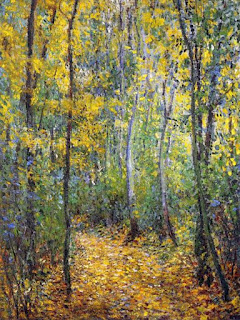 |
| Wood Lane, Claude Monet, 1876 |
🌳 I loved also her
observation on the simple life of farmers, when visiting a farmer house, she
observed that they provide most of their domestic needs at home; doing all
their spinning, weaving, dyeing by themselves.
🌳 Sometimes Cooper would
talk about some unusual sights, like how, on one foggy dawn, a flock of wild
pigeons alighted on the trees at the heart of the village (a rare sight!), and
only after the fog has lifted, that the birds flown again. Some cows Cooper saw
on her walk one evening, were returning home after pasturing along the road
side or unfenced woods. They were left to forage by themselves, and usually
came from different houses. They would leave home in the morning, and return
home in the evening, one to this house, the other to that - all by themselves
without anyone accompanying them.
🌳 Few more amusing things
Cooper observed: Otters - these animals have one very strange habit: it is said
that they actually slide down hill on the snow, merely for amusement. Then
there is her amusing comment on singular leaf of a tree that dances merrily,
moved by some light puff of air:
"A single leaf or two in
rapid movement, all else still and calm; and one might fancy Puck, or some
other mischievous elf, sitting astride the stem, shaking his sides with
laughter at the expense of the bewildered spectator."
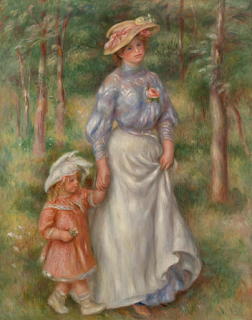 |
| La Promenade, Pierre-Auguste Renoir, 1875 |
🌳 Cooper shared her
father's sentiments regarding the Indians, which she showed in her note:
".
.a savage race is almost invariably corrupted rather than improved by
its' earliest contact with a civilized people; they suffer from the vices of
civilization before they learn justly to comprehend its merits. It is with
nations as with individuals-amelioration is a slow process, corruption a rapid
one."
🌳 I've just realized that
the US named their rivers, mountains, or cities with Indian names: Michigan,
Ontario, Mississippi, Potomac, and many more. Cooper beautifully put it into
this reflection:
"A name is all we leave them,
let us at least preserve that monument to their memory; as we travel through
the country, and pass river after river, lake after lake, we may thus learn how
many were the tribes who have melted away before us, whose very existence would
have been utterly forgotten but for the word which recalls the name they once
bore. And possibly, when we note how many have been swept from the earth by the
vices borrowed from civilized man, we may become more earnest, more zealous, in
the endeavor to aid those who yet linger among us."
🌳 Sometimes too, we get
glimpses of some village stories or legends. One of my favorites is of a pet
fawn, who, after being saved from haunting dog's chase by some people, was then
shot by a hunter because it approached him without fear. Another reminder to us
to let wild animals be wild!
🌳 I think from what I've
written and quoted above, you can see how I loved this book! For a person who
live in a tropical country with only two seasons: wet and dry, where the
flowers keep blossoming, and the landscape never changes its hue, Cooper's
journal provided me with invaluable glimpses of the four beautiful seasons I
wouldn't have witnessed. I loved every little change of the lake color, the
leaves, or the flower petals, from season to season. I'm a 'color' person, and
this has been a wonderful "experience" of a lifetime, though only
through Susan Fenimore Cooper's pen.
Rating: 4,5 / 5


.jpg)


