Thursday, December 30, 2021

2021 Reading WRAP UP

📚BOOKS READ

In chronological order:

1. Eugene Onegin by Alexander Pushkin ⭐⭐⭐1/2
2. Death on the Clouds by Agatha Christie (re-read) ⭐⭐⭐⭐
3. The Conquest of Plassans by Émile Zola (re-read) ⭐⭐⭐⭐⭐
4. Nicholas Nickleby by Charles Dickens ⭐⭐⭐⭐1/2
5. Things Fall Apart by Chinua Achebe ⭐⭐⭐1/2
6. Murder in Mesopotamia by Agatha Christie (re-read) ⭐⭐⭐⭐
7. The Sin of Abbé Mouret by Émile Zola (re-read) ⭐⭐⭐1/2
8. A Biography of Êmile Zola by Alan Schom ⭐⭐⭐⭐⭐
9. The A.B.C Murders by Agatha Christie (re-read) ⭐⭐⭐1/2
10. My Ántonia by Willa Cather ⭐⭐⭐⭐1/2
11. One of Ours by Willa Cather ⭐⭐⭐⭐⭐
12. Cards on the Table by Agatha Christie (re-read) ⭐⭐⭐⭐
13. The Beautiful and Damned by F. Scott Fitzgerald ⭐⭐⭐1/2
15. Dumb Witness by Agatha Christie (re-read) ⭐⭐⭐⭐
16. Mrs. Harris Goes to Paris by Paul Gallico ⭐⭐⭐⭐1/2
17. The Hunchback of Notre Dame by Victor Hugo (re-read) ⭐⭐⭐
18. The Return of the Native by Thomas Hardy ⭐⭐⭐⭐
19. Watership Down by Richard Adams ⭐⭐⭐⭐⭐
20. Lady Audley's Secret by Mary Elizabeth Braddon ⭐⭐⭐⭐1/2
21. Lady Windermere's Fan by Oscar Wilde ⭐⭐⭐⭐
22. The Franchise Affair by Josephine Tey ⭐⭐⭐1/2
23. The Inimitable Jeeves by P.G. Wodehouse ⭐⭐⭐1/2
24. The Guernsey Literary and Potatoe Peel Pie Society by Mary Ann Shaffer & Annie Barrows ⭐⭐⭐⭐1/2
25. Death on the Nile by Agatha Christie (re-read) ⭐⭐⭐1/2
26. The Nutcracker and the Mouse King by E.T.A. Hoffman ⭐⭐⭐
27. Mistletoe and Murder by Robin Steven's ⭐⭐⭐⭐
28. A Nancy Drew Christmas by Carolyn Keene ⭐⭐⭐⭐
29. The Christmas Mystery by Jostein Gaarder ⭐⭐⭐⭐1/2
30. The Burglar's Christmas by Willa Cather ⭐⭐⭐⭐1/2


📊STATISTICS

- Books read: 3️⃣0️⃣
- Classic: 2️⃣5️⃣ Non classics: 5️⃣
- Reread: 9️⃣
- Non Fiction: 2️⃣
- Play: 1️⃣
- Short story/Short stories collection: 2️⃣
- Classic new author: 7️⃣


🏆WINNER vs LOSER

- Most favorite 👍🏼: Watership Down by Richard Adam ⭐⭐⭐⭐⭐
- Least favorite 👎🏼: The Hunchback of Notre Dame ⭐⭐⭐

This year has been surprisingly productive for me, I only hope it will continue next year. In the meantime, I'll say Auf Wiedersehen for now, as this will be my last post for 2021. Happy New Year! 🥳

Sunday, December 26, 2021

Back to the Classics Challenge 2021 - WRAP UP


This year is proved to be one of the hardest I had lived through! Covid-19 pandemic is one of the causes (July 2021 was the worst time for us in Indonesia), and then my father was diagnosed with Parkinson's disease, after his fall. Since then my life has been completely changed, and I needed some months to be finally able to accept things as they were, and moved on with my new life. Through these hard times, my readings have been my biggest consolation.

And that's why I am so proud, that despite all that has happened, I COMPLETED this challenge!! 

Books I have read for ALL twelve categories:

1. A 19th century classic: any book first published from 1800 to 1899 – The Return of the Native by Thomas Hardy

2. A 20th century classic: any book first published from 1900 to 1971. All books must have been published at least 50 years ago; the only exceptions are books which were written by 1971 and posthumously published. – My Antonia by Willa Cather

3. A classic by a woman author. – Lady Audley’s Secret by Mary Elisabeth Braddon

4. A classic in translation, meaning any book first published in a language that is not your primary language. You may read it in translation or in its original language, if you prefer.  – The Hunchback of Notre Dame by Victor Hugo

5. A classic by BIPOC author; that is, a non-white author. – Things Fall Apart by Chinua Achebe

6. A classic by a new-to-you author, i.e., an author whose work you have never read. – Eugene Onegin by Alexander Pushkin

7. New-to-you classic by a favorite author -- a new book by an author whose works you have already read.  – Nicholas Nickleby by Charles Dickens

8. A classic about an animal, or with an animal in the title. The animal can be real or metaphorical. (i.e., To Kill a Mockingbird). – Watership Down by Richard Adams

9. A children's classic. – The Nutcracker by E.T.A. Hoffmann

10. A humorous or satirical classic. – The Inimitable Jeeves by P.G. Wodehouse 

11. A travel or adventure classic (fiction or non-fiction). It can be a travelogue or a classic in which the main character travels or has an adventure. – Mrs. Harris Goes to Paris by Paul Gallico

12. A classic play. Plays will only count in this category. – Mrs. Windermere's Fan by Oscar Wilde


I must thank Karen for hosting yet another year of this challenge, and hope for the best for the next year!


My contact: vixxiomail at gmail dot com

Saturday, December 25, 2021

My Christmas Reading 2021 - WRAP UP


My Christmas reading this year has been a blast, and I'm enjoying every second of every book/story!

Books I have read:

1. The Nutcracker and the Mouse King by E.T.A. Hoffman   ⭐⭐⭐
2. Mistletoe and Murder by Robin Stevens   ⭐⭐⭐⭐
3. The Christmas Mystery by Jostein Gaarder    ⭐⭐⭐⭐1/2
4. A Nancy Drew Christmas by Carolyn Keene     ⭐⭐⭐⭐
5. The Burglar's Christmas by Willa Cather     ⭐⭐⭐⭐1/2

Two classics, two mysteries, and one...extraordinary story.
Combined, they gave me much joy as well as a lot of reflections to welcome Christmas.

Merry Christmas!


Wishing all my readers, followers, and friends a Merry and Blessed Christmas of 2021!

Friday, December 24, 2021

#AdventReading Day-24: The Christmas Mystery - The Christ-Child


credit: Flora Waycott


It is with mixed feelings that I type this #AdventReading post for the 24th and last time. I've been enjoying every moment of reading and sharing the stories with you. But everything must come to an end, and while Advent is over, we will get a more joyful time at Christmas tomorrow! I think it's with the same sentiment that Joachim and his parents open their last door of the magic Advent calendar today. John has specifically asked them to wait till Christmas bell ring at noon before opening the door. So, they are busy buying presents and preparing for Christmas dinner to while away the time.

Noon comes, and the last door is revealing a picture of a cave in a mountain, within which is surely where the Christ-child will be born. I guess I don't have to tell you what the last story is titled, because it's surely the most important character of every Christmas story: the Christ-child Himself!

I loved how Gaarder put an all out effort in his writing of this last chapter. You'll see a lot of quotation here, and I'll begin with this opening paragraph of the story:

"It's the middle of the world between Europe, Asia, and Africa. It's in the middle of history at the beginning of our era. Soon it will be the middle of the night as well. A silent crowd is stealing upwards between the houses in Betlehem..."

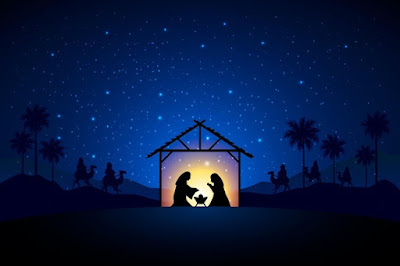
Seven sheep, four shepherds, five angels, three Wise Men, one Roman Emperor, one Governor of Syria, and a little girl are in a procession on the road in Betlehem. The stars are shinning brightly in the sky - "they are like sparks from a beacon far away" - but one star in particular is brighter that the others. In front of an inn, the innkeeper appears at the window, and to the pilgrims he points to a cave outside, in the wall of rock.

They stop in front of the cave, with a stable inside it. Suddenly the silence is broken by a cry of a child. And so, it is solemnly happening, the Christ-child is born in a stable in Betlehem. "He has come to our miserable world."

"This is a meeting of heaven and earth. For the child in the manger is also a spark from the great beacon behind those weak lanterns in the sky."


In a moment, all characters except Elisabet, are hurrying up to "perform their duties" like in the first Christmas, leaving Elisabet alone outside the cave. She asks then whether she may go in, and of course, she may, because "that is your role", says the Emperor.

"Elisabet looked up at the starry sky. She had to tilt her head far back to see the big star which was shining so brightly. Again she heard the cry of a child from inside the cave. So she went into the stable."

.....and there's where this magnificent story ends...

But what about the Elisabet/Tebasile mysteries? Calm down... Gaarder really spoilt us with a... surprise!

John the flower seller is back for coffee, and now he's about to reveal why and how he made the Advent calendar. The large picture on the calendar, at least, was intended to be giving the person owns it something new to discover, at least everyday during Advent, because...

"All God's creation was like that. The more we understand, the more we see things around us, and the more we see in things around us, the more we understand."

When asked whether he's found news about Elisabet, John is giving them all a surprise, because at that moment the door bell rings, and lo and behold.... a woman aged around 50 is standing there, wearing a red coat and a silver cross with red stone - Elisabet Hansen herself! - or to be precise: Elisabet Tebasile Hansen. She's just arrived in Norway, and has reunited with her old mother the day before. And at last, this is her story....

Elisabet grew up in Palestine, in a little village near Betlehem with poor people. Their lands was taken away, and since then Elisabet had lived in some refugee camps. When she's a child, Elisabet had been kidnapped by some kind people whose mission is to help people in need in Betlehem, where she lived among shepherds. When she told John that she's kidnapped by "angels", she meant the kind people. That's all she remembers about her childhood. She did came to Rome and met John, but then disappeared because she's suspicious that John intended to harm her people (the refugees).

But John has his own theory. And he wrote it down as the stories we've been reading through Advent. Both Elisabet and John insist that each version is the truth. Who's really telling the truth? No one can say. Joachim and Mama believes in John's version, but Papa thinks Elisabet's version is the truth. John's reaction is worth reflected:

"We mustn't start quareling even though we believe slightly different things. That's the message of Christmas too."

Mama's insight is no less worthy for deeper reflection too:

"We open the last door in an old Advent calendar and hear about Elisabet who goes into a stable in Betlehem to welcome the Christ-child into the world. Immediately afterwards the same Elisabet rings the doorbell in our own house. So it almost seems as if this house is the same as the stable where Jesus was born." - beautiful isn't it?

Now for the surprise.

Later that night before going to bed, Joachim is starring out of the window, into the Christmas night. Suddenly he sees some figures running down the road for only a second or two. He thinks it's Elisabet, Ephiriel and the other pilgrims who have been going to Betlehem with Elisabet... and who are now... escorting her back!

Really interesting, right? 

And so, it's the end of a long journey through Advent. I admit, I've never had this kind of Advent before, and this reading and posting have been fun, insightful, and worthy activities to wait for Christmas. Thanks to all of you who've been reading along with me!


Previous posts:
Day-1          - Day-13
Day-2          - Day-14
Day-3          - Day-15
Day 4          - Day-16
Day-5          - Day-17
Day-6          - Day-18
Day-7          - Day-19
Day-8          - Day-20
Day-9          - Day-21
Day-10        - Day-22
Day-11        - Day-23
Day-12


Thursday, December 23, 2021

#AdventReading Day-23: The Christmas Mystery - Mary and Joseph


credit: Flora Waycott

It's Christmas! Or at least, in Scandinavian countries, Christmas festivities begins at 23rd December, the Little Christmas Eve. When Joachim opens the last door but one in his Advent calendar, a picture of a man walking beside an ass, and on the ass sat a woman in red clothes. Well, it's not hard to guess what title is written on the folded paper: Mary and Joseph.

So, finally, the twenty three pilgrims arrive at Betlehem, in the year 0. This is it! But before entering the city gate, Emperor Augustus opens the census book he's been carrying under his arm, and asks all the pilgrims - well, except for the sheep, that is - to write down their names and sign it. But Elisabet has an idea to include the seven sheep in the book too (but without names).

Now that their destination is nearly there, the innkeeper hurries to reach there before Mary and Joseph arrive. It happens right after they all watch down a road where a young man is walking beside an ass, with a woman in red clothes sits on it. Then all of them become more nervous and solemn, like one who is expecting something holy to happen. Each is sort of rehearsing something they have to say or do when Jesus is born (as we read in Bible) - something they seem to have known by heart.

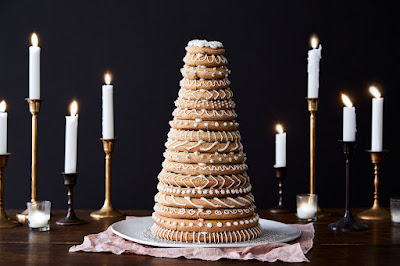
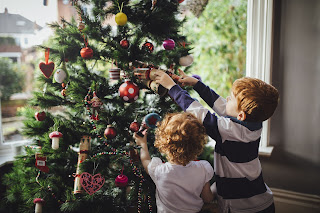
Meanwhile, Joachim and his parents are also exciting to wait for John's visit - decorating the Christmas tree and baking Macaroon Cake (it might be what Norwegians call Kransekake - a towering stack of cookie rings, decorated with whimsical royal icing).


John comes as he promised, bringing a bouquet of roses, and finally tells a remarkable story of what had inspired him to make the Advent calendar. He's born in Damascus, and as a boy he found an old jar containing scrolls of very old manuscript. Some of these reported that a strange procession had been seen in the 1st century. Obsessed by many myths and legends of the similar incidents, John made a research, and found that these mysterious apparitions had been seen in many countries through centuries. 

"Something that is mysterious for one second is often quenched like an empty oil lamp in the next. Yet, if only we turn our heads in another direction, a new light may be lighted there. For we cannot take in what is sacred in the same way as we pick up a stone from the ground and put it in our pockets." - what a remarkable thing to say.

Then John met a young woman in Rome called Tebasile. She's very secretive, and said that she's probably born in Norway, but grew up among shepherds and sheep farmers in Palestine. She said she was kidnapped when she's little, by an angel who needed her in Betlehem. After his researches on all the angel stories, of course John believed she said the truth.

But Tebasile said she will be leaving Rome, and after that John never meet her again. But not before he took her picture in front of St. Peter's Square (hence the photograph in book store window). John eventually came to Norway in search of this mysterious woman. There he learned about the missing young girl called Elisabet, and realized that Tebasile might be Elisabet read backwards. And that's when he began to make the Advent calendar, in hope that the story will be known by others beside him.

Last of all, John believes that the young woman's name is Elisabet Tebasile. There's a telephone subscriber in Rome of that name. And that's the end of his story. He won't reveal more, because it's not Christmas yet.

Quite a story, eh? I can't wait to reveal the last of this amazing story tomorrow!


Previous posts:

Day-1          - Day-13
Day-2          - Day-14
Day-3          - Day-15
Day 4          - Day-16
Day-5          - Day-17
Day-6          - Day-18
Day-7          - Day-19
Day-8          - Day-20
Day-9          - Day-21
Day-10        - Day-22
Day-11 
Day-12


Wednesday, December 22, 2021

#AdventReading Day-22: The Christmas Mystery - The Inn Keeper


credit: Flora Waycott

Three days before Christmas, the family find a picture of "a man standing in a river that reached up to his waist. The upper part of his body was clothed in rags." There's no doubt about who it might be implying - of course, it's John the Baptist. But is it the day we're gonna know whether John the flower seller is indeed John the Baptist?

The folded paper inside the door number 22 is titled: The Inn Keeper (I didn't see that coming, though - we never think about the inn keeper when we are talking about Christmas).

Anyway, today is the year 91, and Elisabet & co. is journeying through Samaria. They make a stop in River Jordan, then continuing to Jericho, which, according to Ephiriel, is possibly the oldest city in the world. Next they climb the Mount of Olives, from where they look down at Gethsemane.

Their next destination is, of course, the city of Jerusalem. it is now the year 71, and Elisabet is wondering how the city with ruined and destroyed buildings can be the Jewish capital. To which, Ephiriel is explaining about how the Romans had sacked and destroyed Jerusalem the year before, because its people had rebelled against Roman.

Impuriel is lamenting how humans kept singing about peace every Christmas, but never stop fighting each other. To which, Ephiriel is emphasizing that "...those who celebrate Christmas must remember that. Peace is the message of Christmas."

Entering the gate of Betlehem, they meet a man who is walking beside an ass, who introduces himself as The Inn Keeper, and that he is "one of them".

Meanwhile Joachim and his parents are wondering whether John the flower seller isn't in fact John the Baptist because when Joachim invited the flower seller to 'a cup of coffee', he said that he couldn't because he'll be going out in the wilderness - and John the Baptist also lived in the wilderness! However, a letter comes today for Joachim from the flower seller, who's inviting himself to 'a cup of coffee and a Christmas cookie' on Little Christmas Eve. I've just learned a Scandinavian tradition of Little Christmas Eve on the 23rd of December, when people usually begin to put and decorate their Christmas trees.


I can't wait to read about that little party tomorrow, but we must part here in the meantime.


Previous posts:

Day-1          - Day-13
Day-2          - Day-14
Day-3          - Day-15
Day 4          - Day-16
Day-5          - Day-17
Day-6          - Day-18
Day-7          - Day-19
Day-8          - Day-20
Day-9          - Day-21